 Henan Xuye Machinery Equipment Co., Ltd.

SEARCH WHAT YOU WANT
Search allProductNews
SEARCH
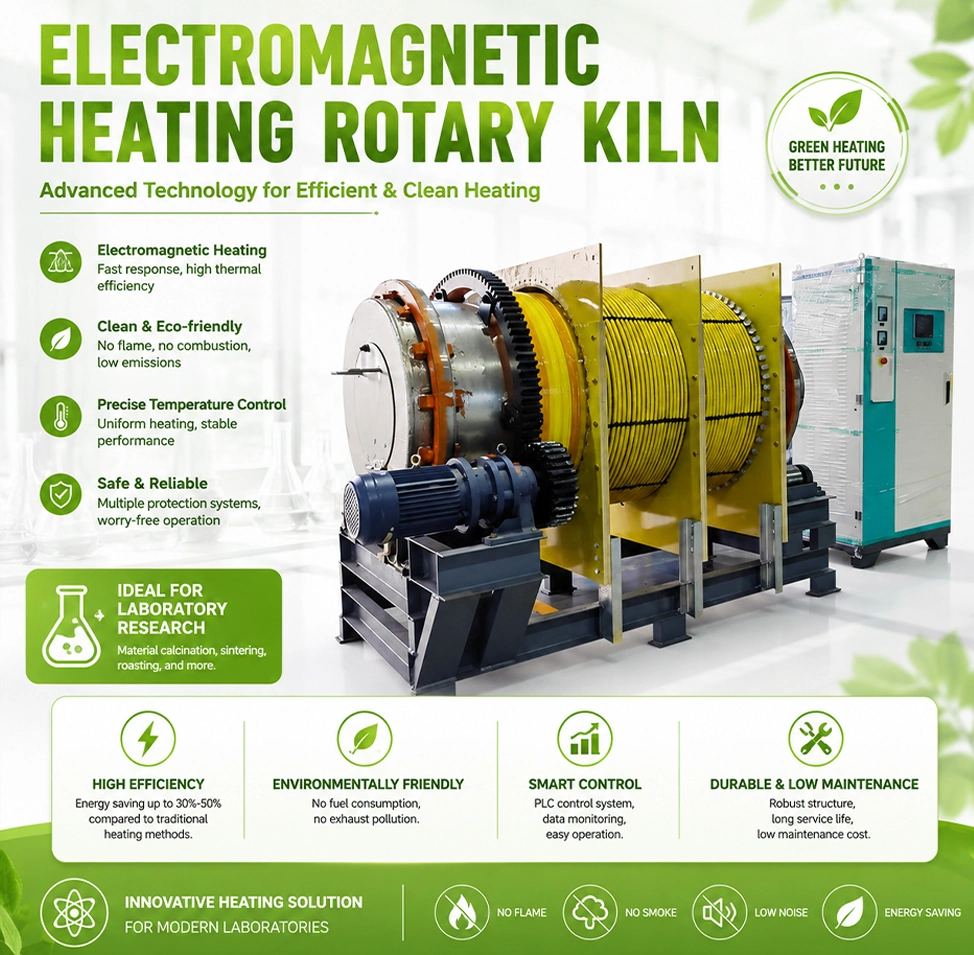
The Laboratory Small Electromagnetic Rotary Kiln is a high-precision experimental thermal processing equipment designed for material research, scientific testing, and pilot-scale development. It integrates advanced electromagnetic induction heating technology with a rotary kiln structure, enabling fast, uniform, and controllable high-temperature processing in laboratory environments.
This equipment is widely used in universities, research institutes, industrial laboratories, and new material development centers. It is especially suitable for experiments involving pyrolysis, calcination, sintering, thermal decomposition, and material transformation studies.
Compared with traditional electric heating or gas-fired rotary kilns, the electromagnetic heating system offers higher efficiency, faster response speed, cleaner operation, and more accurate temperature control. These advantages make it an ideal solution for modern scientific research and advanced material testing.
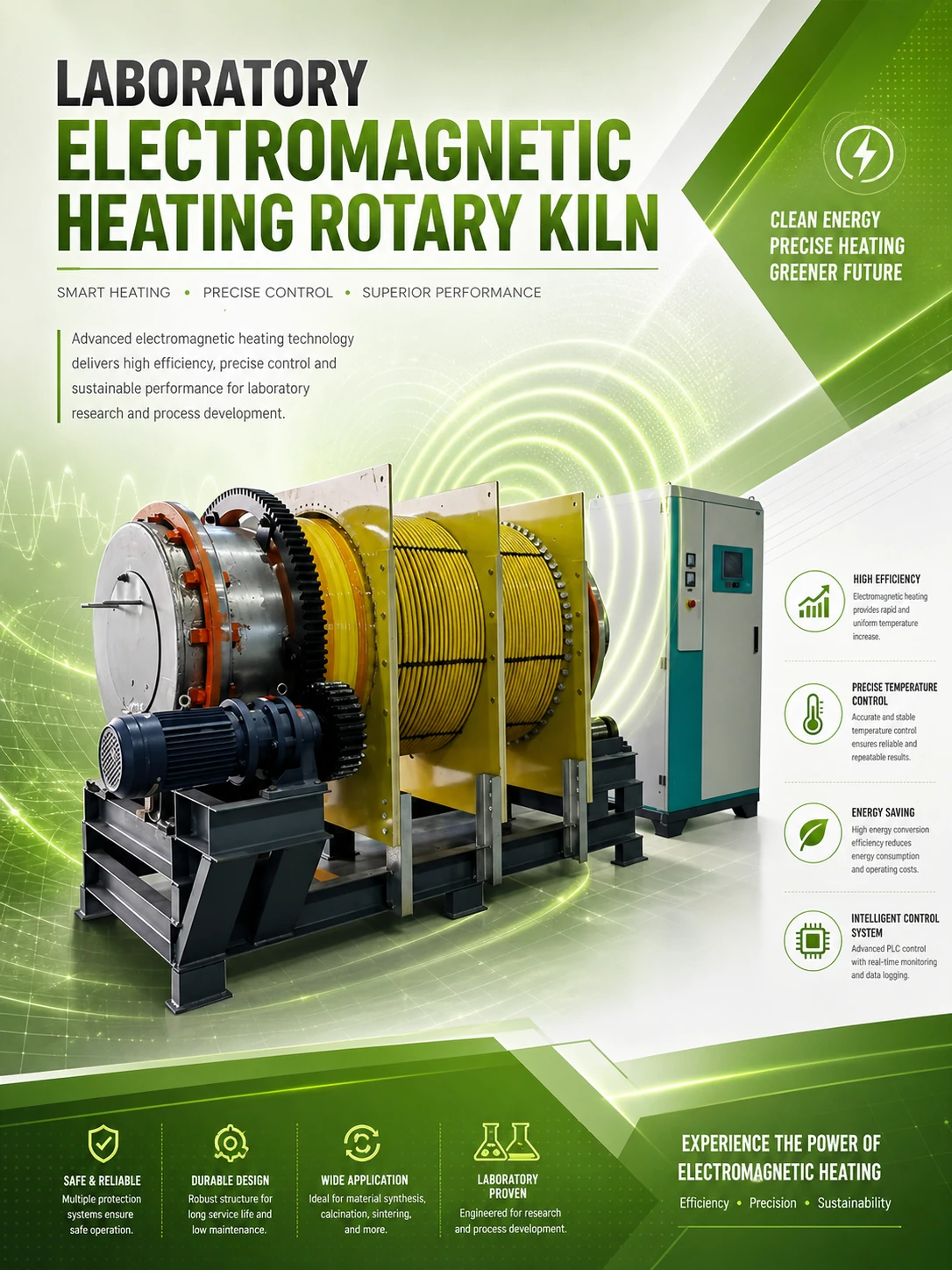
A laboratory electromagnetic rotary kiln is a small-scale thermal treatment device that uses electromagnetic induction heating to generate heat directly in the kiln body or heating medium. The kiln rotates at adjustable speed, allowing materials inside to be evenly heated and continuously mixed during the experiment.
The main purpose of this equipment is to simulate industrial high-temperature processes under controlled laboratory conditions. Researchers can use it to study how materials react, decompose, or transform under different temperature profiles and atmospheric environments.
This type of kiln is particularly important in:
Its compact size and precise control system make it highly suitable for laboratory and pilot-scale applications.
The working principle of the laboratory electromagnetic rotary kiln is based on electromagnetic induction heating technology.
When alternating current passes through the induction coil, it generates a high-frequency magnetic field. This magnetic field induces eddy currents in the conductive heating components, which produce heat directly inside the system.
This heating method has several advantages:
At the same time, the kiln body rotates slowly during operation. This rotation ensures that materials are evenly distributed inside the chamber, improving heat transfer efficiency and ensuring consistent experimental results.
The combination of electromagnetic heating and rotary motion creates a highly stable and efficient experimental environment for advanced material processing.
The system is equipped with an intelligent temperature control module that allows precise adjustment of heating parameters. Temperature fluctuations are minimized, ensuring high repeatability of experimental results.
Unlike traditional resistance heating systems, electromagnetic induction heating provides almost instant heat generation. This significantly reduces preheating time and improves experimental efficiency.
Because heat is generated directly within the system rather than transferred from external sources, energy loss is greatly reduced. This makes the equipment more environmentally friendly and cost-effective.
The equipment is designed specifically for laboratory use. Its small footprint allows easy installation in research rooms, fume hoods, or pilot-scale testing environments.
The rotary mechanism can be adjusted in speed and direction, allowing researchers to simulate different industrial processing conditions.
Optional gas control systems allow experiments under different atmospheres such as nitrogen, carbon dioxide, or air.
| Parameter | Specification |
|---|---|
| Equipment Type | Laboratory Small Electromagnetic Rotary Kiln |
| Heating Method | Electromagnetic Induction Heating |
| Working Temperature Range | 200°C – 1200°C (custom up to 1600°C) |
| Kiln Tube Material | 310s Stainless Steel |
| Rotation Speed | 0–10 rpm adjustable |
| Control System | PLC + Touch Screen Interface |
| Atmosphere Control | Optional (N₂ / CO₂ / Air) |
| Sample Capacity | Laboratory scale / small batch |
| Power Supply | 220V / 380V |
| Heating Zone | Single or multi-zone optional |
| Safety System | Over-temperature protection, alarm system |
Electromagnetic heating significantly reduces energy loss compared with gas-fired or resistance heating systems.
The combination of rotary motion and induction heating ensures more uniform heat distribution inside the kiln.
No combustion process is required, eliminating gas emissions and making the system more environmentally friendly.
Shorter heating and cooling times allow researchers to complete more experiments in less time.
Stable temperature control ensures more reliable and reproducible experimental data.
Used for testing thermal stability, phase transformation, and structural changes of advanced materials.
Widely used in biochar production research, waste recycling experiments, and energy conversion studies.
Used for catalyst activation, regeneration, and performance evaluation under high-temperature conditions.
Applied in ore reduction, mineral calcination, and metal sintering experiments.
Used for thermal decomposition, reaction kinetics, and process optimization research.
Used in studies related to waste treatment, pollution control materials, and carbon neutrality technologies.
Electromagnetic induction heating represents a modern advancement in thermal processing technology. Compared with conventional heating systems, it provides:
For laboratory researchers, this means more accurate experimental results and better simulation of industrial processes.
The laboratory small electromagnetic rotary kiln typically consists of the following components:
Made of high-temperature resistant materials such as quartz, ceramics, or stainless steel depending on experimental requirements.
Includes coils, power supply unit, and frequency control system.
Provides adjustable rotation speed to ensure uniform material processing.
PLC-based intelligent control system with touchscreen interface for temperature, speed, and atmosphere adjustment.
Allows continuous or batch processing depending on experimental design.
Includes over-temperature protection, emergency stop, and alarm functions.
The operation of the laboratory electromagnetic rotary kiln is simple and user-friendly:
This streamlined process makes it suitable for both experienced researchers and laboratory technicians.
Safety is a key consideration in laboratory equipment design. This system includes:
These features ensure safe operation under high-temperature experimental conditions.
The laboratory small electromagnetic rotary kiln is suitable for:
It is used for high-temperature experimental processes such as calcination, pyrolysis, sintering, and material testing.
It provides faster heating, better energy efficiency, and more precise temperature control.
Yes, it is widely used in biochar and biomass energy research.
Metals, ores, biomass, catalysts, ceramics, and chemical materials.
It is mainly designed for laboratory batch or small pilot-scale experiments.