 Henan Xuye Machinery Equipment Co., Ltd.
SEARCH WHAT YOU WANT
Search allProductNews
SEARCH
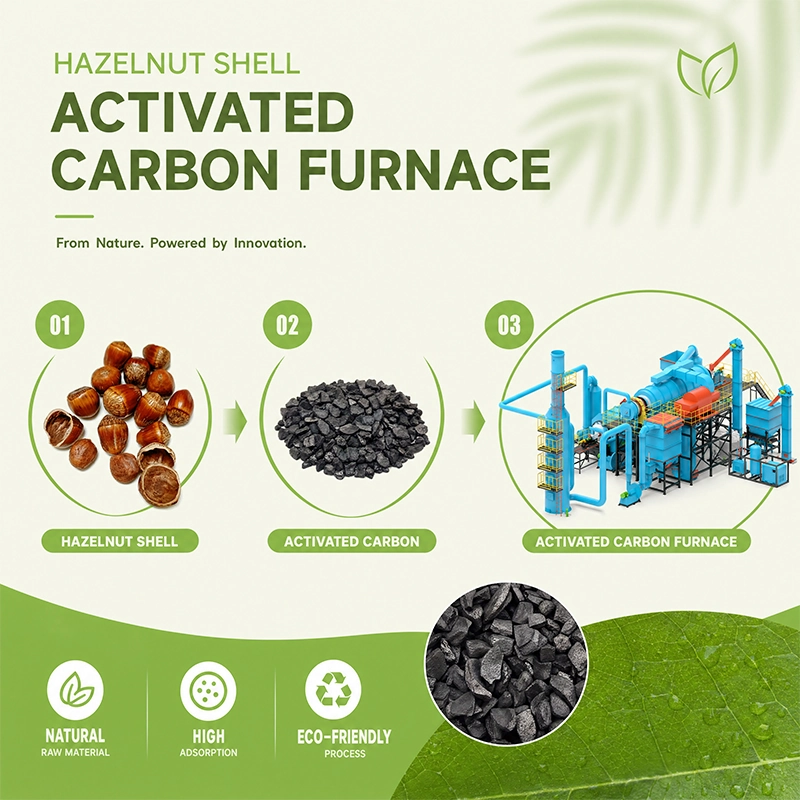
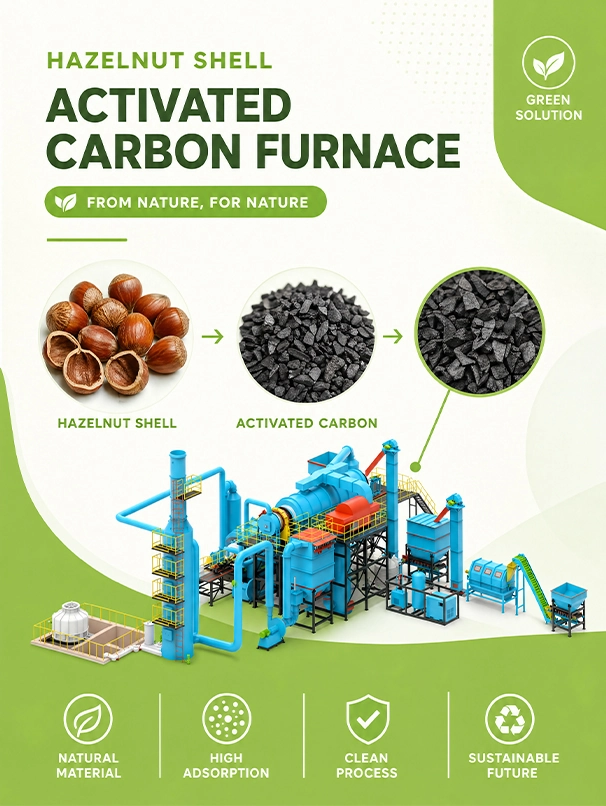
A hazelnut shell activated carbon rotary kiln is designed for converting hazelnut shells and other biomass shells into high-value activated carbon through controlled carbonization and activation. With stable temperature control, adjustable residence time, and continuous operation, the rotary kiln helps manufacturers produce activated carbon with consistent pore structure, high adsorption performance, and reliable output.
Our hazelnut shells activated carbon rotary kiln system can be customized for raw material pretreatment, carbonization, steam activation, cooling, dust collection, and exhaust gas treatment, making it suitable for industrial activated carbon production lines.
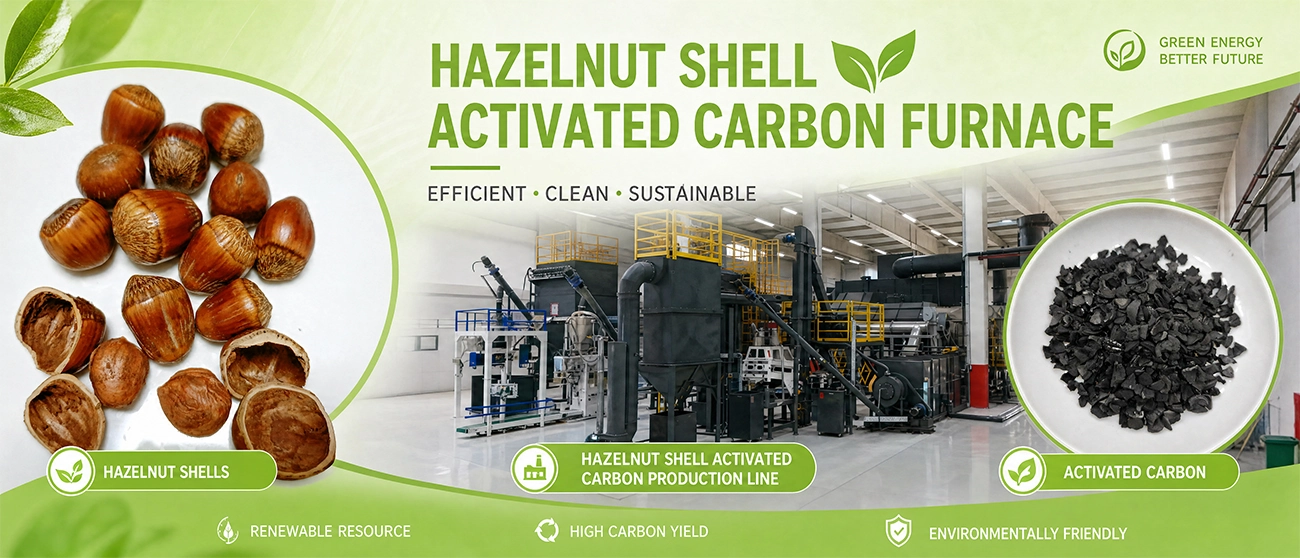
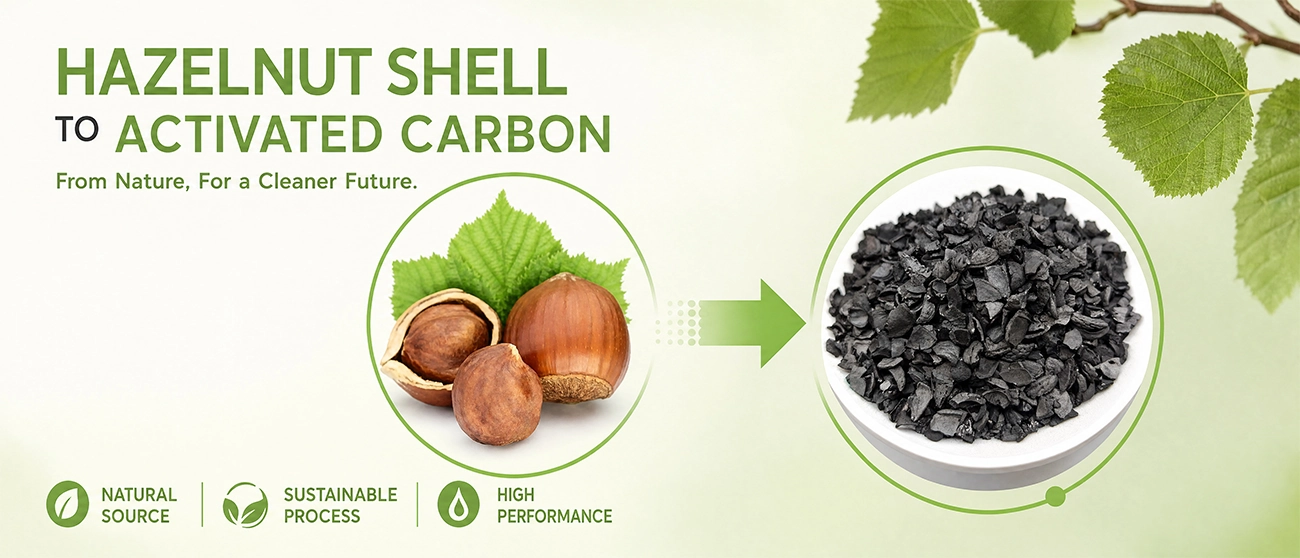
The quality of activated carbon depends heavily on the raw material. A good feedstock should provide suitable fixed carbon, stable structure, reasonable ash content, and predictable behavior during carbonization and activation. Hazelnut shells can meet these requirements when they are properly prepared and processed.
First, hazelnut shells have a hard biomass structure. This is important for granular activated carbon because the final particles must resist abrasion during transport, loading, filtration, backwashing, and long-term use. Higher mechanical strength can reduce dust generation and improve service life in fixed-bed adsorption systems.
Second, hazelnut shells can form a solid char after volatile matter is removed. During carbonization, moisture evaporates and organic components decompose, leaving a carbon-rich material. This char then becomes the base material for activation. With proper steam activation, the pore network develops and the carbon gains adsorption capacity.
Third, hazelnut shells are an agricultural by-product. In regions with hazelnut processing industries, shells may be available in large quantities and at relatively stable cost. Turning this by-product into activated carbon supports biomass utilization, waste valorization, and circular economy goals.
Finally, a biomass activated carbon rotary kiln designed for hazelnut shells can often be adjusted for other shell-based raw materials, such as coconut shells, walnut shells, palm kernel shells, apricot shells, peach stones, and similar hard biomass materials. This gives producers more flexibility when raw material supply changes.
The XUYE company’s hazelnut shell activated carbon production line uses an external heating carbonization kiln and an external heating activation rotary kiln. Unlike direct-fired systems, the external heating design transfers heat through the kiln shell rather than allowing combustion gases to contact the material directly. This indirect heating method provides a cleaner processing environment, more uniform temperature distribution, better process control, and reduced risk of product contamination, making it suitable for manufacturing high-quality shell-based activated carbon.
The rotary kiln consists of a long cylindrical shell installed at a slight inclination. The cylinder rotates slowly while the prepared hazelnut shells move continuously from the feed end to the discharge end. Throughout this movement, the material is heated evenly by the external heating system. The kiln speed, inclination, feeding rate, internal lifting structure, temperature profile, and residence time work together to ensure stable carbonization and activation while maintaining consistent product quality.
Before entering the carbonization kiln, the hazelnut shells are typically dried, crushed, and screened to obtain a uniform particle size and moisture content. Proper raw material preparation improves heat transfer efficiency, stabilizes kiln operation, and produces activated carbon with more consistent physical properties. Excessive moisture increases energy consumption during drying, while oversized or undersized particles may result in uneven carbonization or activation.
The first processing stage is carbonization. In the XUYE external heating carbonization kiln, hazelnut shells are heated under oxygen-limited conditions without direct flame contact. Moisture and volatile compounds are gradually removed, leaving carbon-rich charcoal with a stable structure suitable for activation. Accurate temperature control is essential because insufficient carbonization leaves residual volatile matter, while excessive carbonization may reduce charcoal yield and damage the pore-forming structure.
The second stage is activation. The carbonized material enters the XUYE external heating activation rotary kiln, where it is activated with steam at high temperature. Steam reacts with the carbon matrix to develop a large number of micropores and mesopores, significantly increasing the internal surface area. Operators can accurately adjust activation temperature, steam flow rate, residence time, kiln rotation speed, and material loading to produce activated carbon with different iodine values, methylene blue adsorption capacity, pore size distribution, hardness, burn-off ratio, and final yield according to customer requirements.
After activation, the hot activated carbon is transferred to a cooling system before being exposed to ambient air. Depending on production capacity and plant layout, a rotary cooler, water-cooled screw conveyor, jacketed cooling unit, or other cooling equipment can be installed. Controlled cooling minimizes oxidation, protects pore structure, improves product quality, and ensures safe downstream screening, storage, and packaging.
Environmental protection is also an important part of the XUYE activated carbon production line. Carbonization and activation generate combustible gases, water vapor, tar compounds, smoke, dust, and process exhaust. According to customer requirements and local environmental regulations, the production line can be equipped with cyclones, bag dust collectors, scrubbers, thermal oxidizers, waste heat recovery systems, induced draft fans, and chimney systems to achieve clean and efficient operation while improving overall energy utilization.
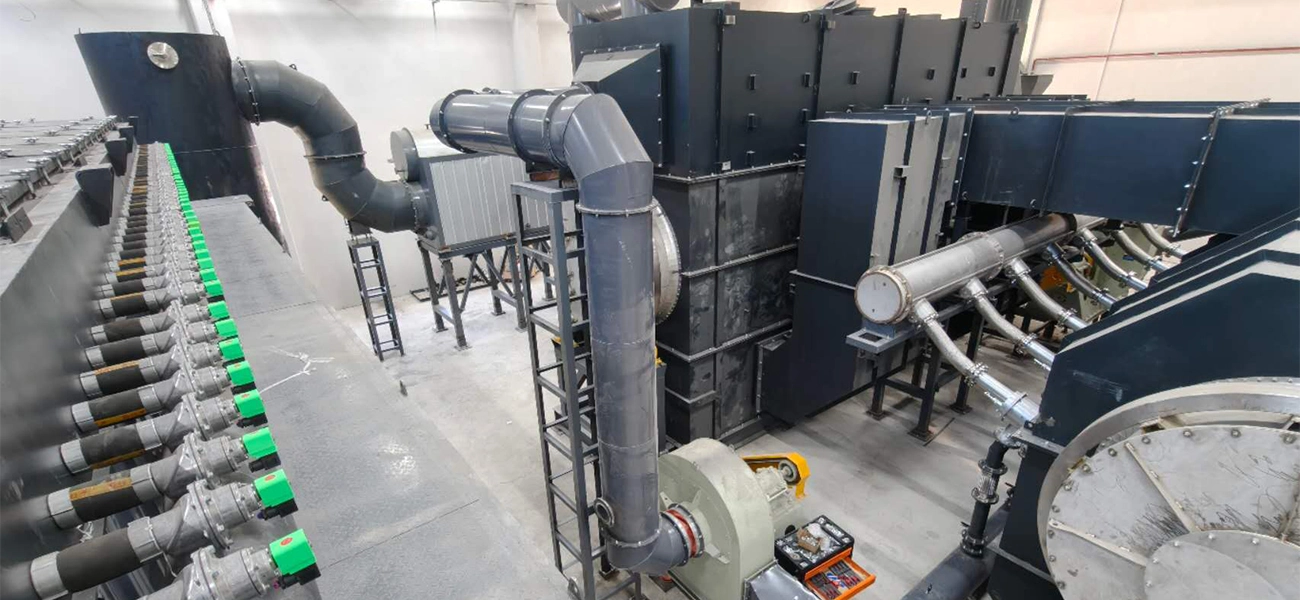
Our hazelnut shell activated carbon rotary kiln is designed for continuous industrial operation. The kiln body, support system, drive unit, sealing structure, refractory lining, insulation layer, heating system, steam activation system, and control cabinet are selected according to the process conditions of activated carbon production.
The rotary shell is built for high-temperature service and stable material movement. As the kiln rotates, the shells or char turn inside the cylinder, improving contact with heat and reducing local overheating. This movement helps produce more uniform carbonization and activation results than static batch heating methods.
The heating system can be configured according to available fuel. Common options include natural gas, diesel, heavy oil, producer gas, biomass gas, coal gas, electricity, or recovered combustible gas from the carbonization process. The correct heat source depends on local energy cost, emission requirements, operating habits, and project budget.
Temperature control is central to product quality. Different stages of activated carbon production require different heat conditions. The system can be equipped with temperature sensors, control instruments, variable frequency drive, alarms, and PLC control. Operators can monitor kiln temperature, adjust feeding speed, control residence time, and manage the activation process more consistently.
The sealing system helps reduce unwanted air leakage. In carbonization and activation, uncontrolled oxygen can reduce yield, disturb the process atmosphere, and create safety risks. Good sealing at the feed and discharge ends supports stable operation and protects the quality of the final activated carbon.
The steam activation system is designed to introduce steam effectively into the activation zone. Balanced steam distribution helps develop pores without causing severe local burn-off. The process can be adjusted for different product targets, such as water treatment carbon, gas adsorption carbon, or industrial purification carbon.
For complete production lines, auxiliary equipment can include dryers, crushers, screens, conveyors, sealed feeders, burners, coolers, dust collectors, gas treatment equipment, control systems, storage silos, and packaging machines. Matching these sections properly reduces bottlenecks and improves daily production efficiency.
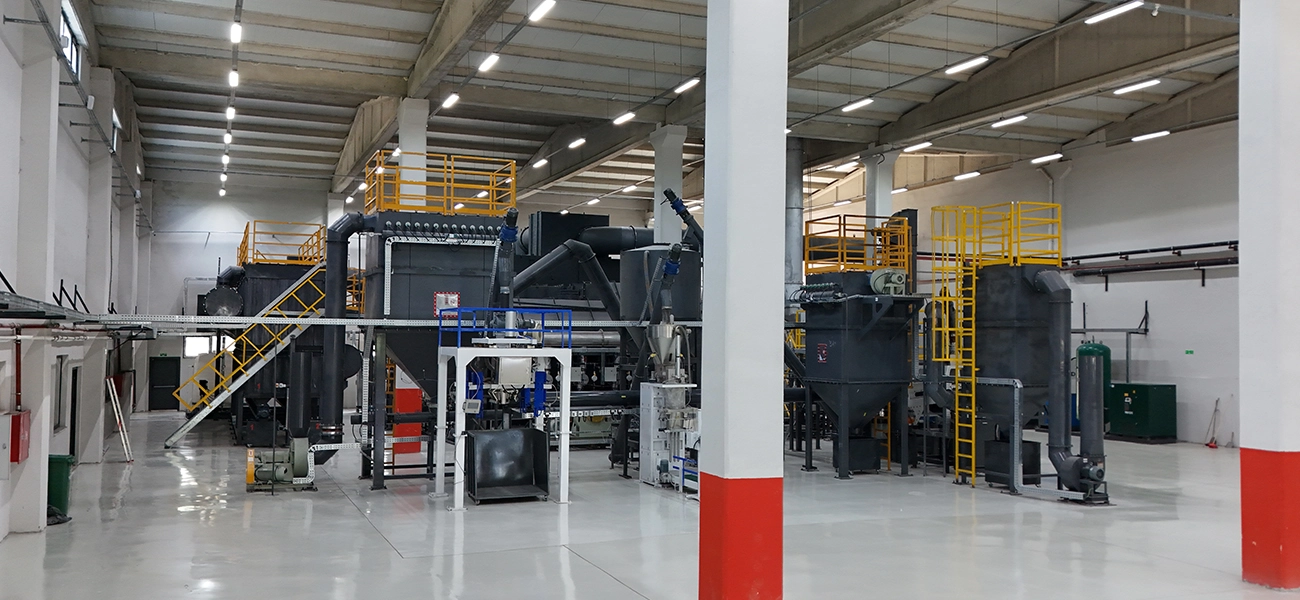
A complete hazelnut shell activated carbon production line normally begins with raw material preparation. Hazelnut shells may arrive with moisture, dust, impurities, and uneven particle size. The preparation section can include storage, magnetic separation, crushing, screening, and drying. Good preparation makes the kiln easier to control and helps improve final product consistency.
The feeding section delivers prepared shells into the kiln at a stable rate. Stable feeding is important because changes in feed volume affect temperature, residence time, and activation quality. Depending on the process, the system may use belt conveyors, screw conveyors, rotary valves, or sealed feeders.
The carbonization section converts shells into char. Some projects use a separate carbonization kiln before the activation kiln. Other projects use an integrated process depending on capacity, product grade, and investment level. Separate carbonization and activation systems can provide more independent control, while integrated lines may reduce layout complexity in certain applications.
The activation section develops the adsorption structure of the carbon. Steam, temperature, and residence time must be controlled together. Stronger activation can increase adsorption capacity but may reduce yield if burn-off becomes excessive. The goal is to reach the required quality indicators while maintaining reasonable production cost.
The cooling and finishing section handles the hot activated carbon after the kiln. The product may be cooled, screened into different mesh sizes, crushed, milled into powder, washed to reduce ash, dried again, blended, or packaged. The final configuration depends on whether the customer wants granular activated carbon, powdered activated carbon, or customized grades.
Environmental protection equipment is planned according to emissions and local rules. Dust collection points may be installed at crushing, screening, transfer, cooling, and packaging areas. Exhaust gas from carbonization and activation may require combustion, filtration, scrubbing, or other treatment. A suitable environmental system improves workplace conditions and supports long-term compliance.
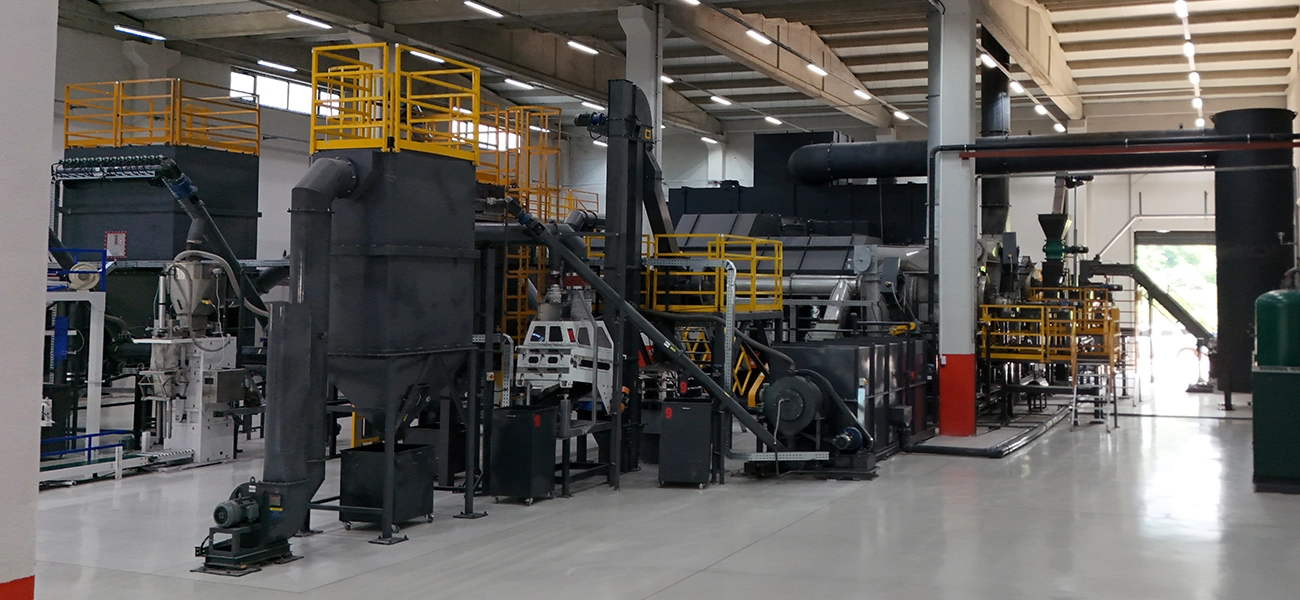
The purpose of a hazelnut shell activated carbon rotary kiln is not only to process biomass, but to produce activated carbon that meets market requirements. Different customers may focus on different indicators. Water treatment carbon may require strong iodine adsorption, good hardness, controlled ash, and stable particle size. Air purification carbon may require suitable pore structure for odors and volatile organic compounds. Solvent recovery carbon may require high adsorption capacity and regeneration performance. Food, beverage, chemical, or pharmaceutical applications may require stricter purity and washing.
Common quality indicators include iodine value, methylene blue adsorption, BET surface area, ash content, moisture, hardness, bulk density, particle size distribution, pH value, volatile matter, and abrasion resistance. These indicators are influenced by raw material quality, carbonization temperature, activation temperature, steam flow, residence time, particle size, and cooling method.
For example, higher activation intensity may improve pore development, but it can also reduce yield if too much carbon is consumed. Longer residence time may improve reaction completeness, but it may reduce throughput. Smaller particles may heat faster, but they can create more dust and may not be suitable for granular activated carbon markets. Because these factors are connected, process design must balance quality, capacity, yield, energy cost, and product application.
Before recommending a kiln model, we review the customer’s raw material, target output, final product use, fuel conditions, factory layout, and environmental requirements. If the customer has target specifications such as iodine value, particle size, hardness, or ash content, these are included in the equipment selection and process design. For new projects, raw material testing or pilot evaluation can help estimate yield and product potential.
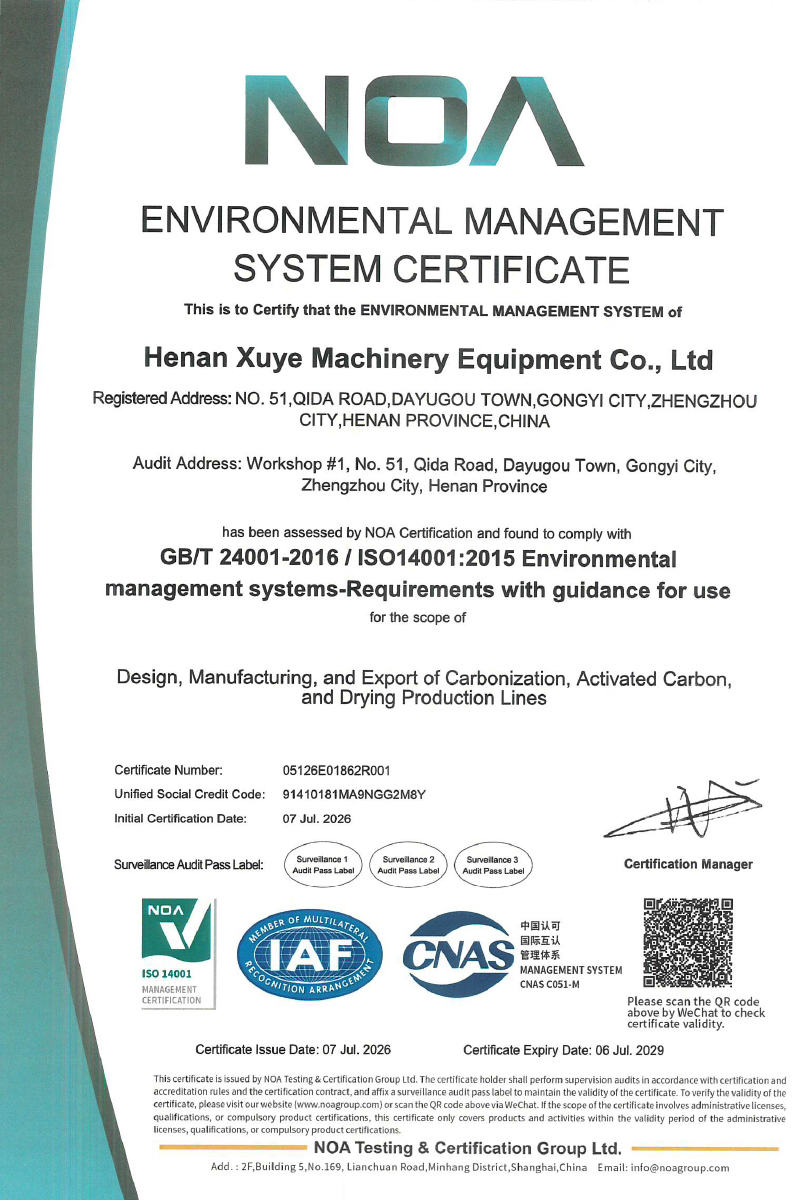
ISO Environmental Management Certificate
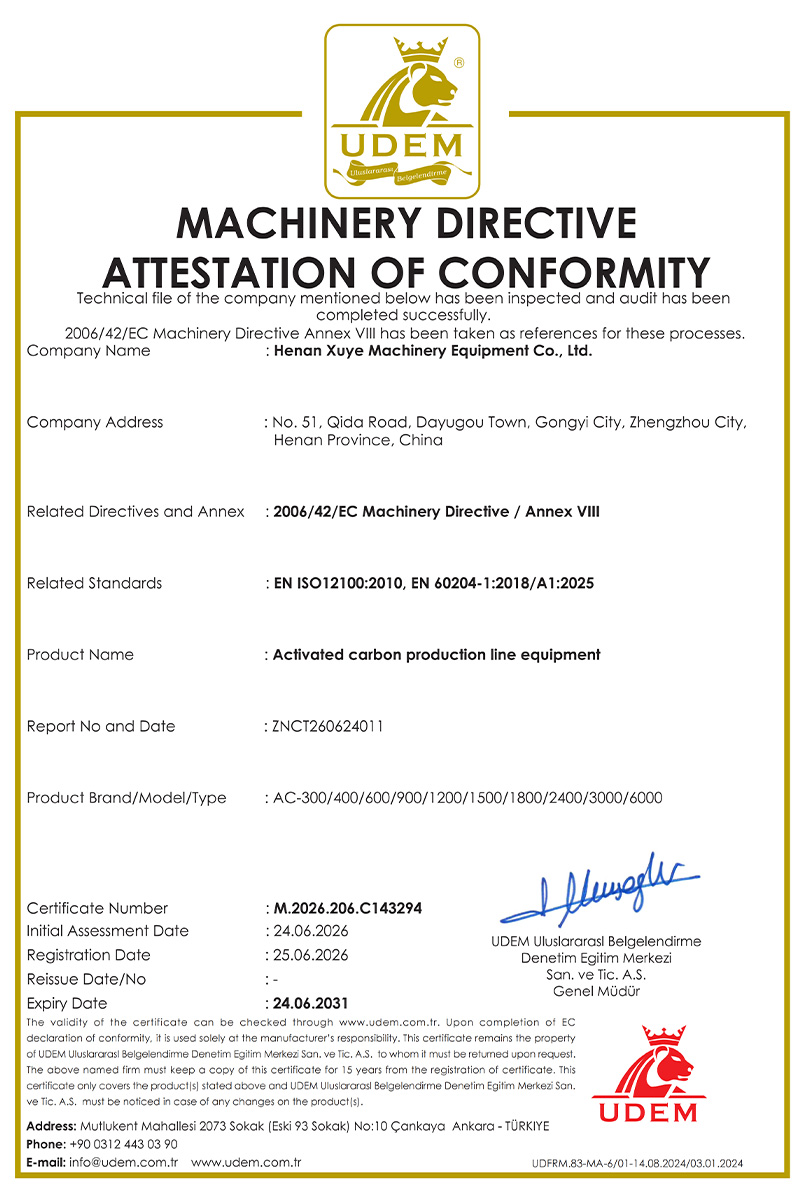
CE Certification
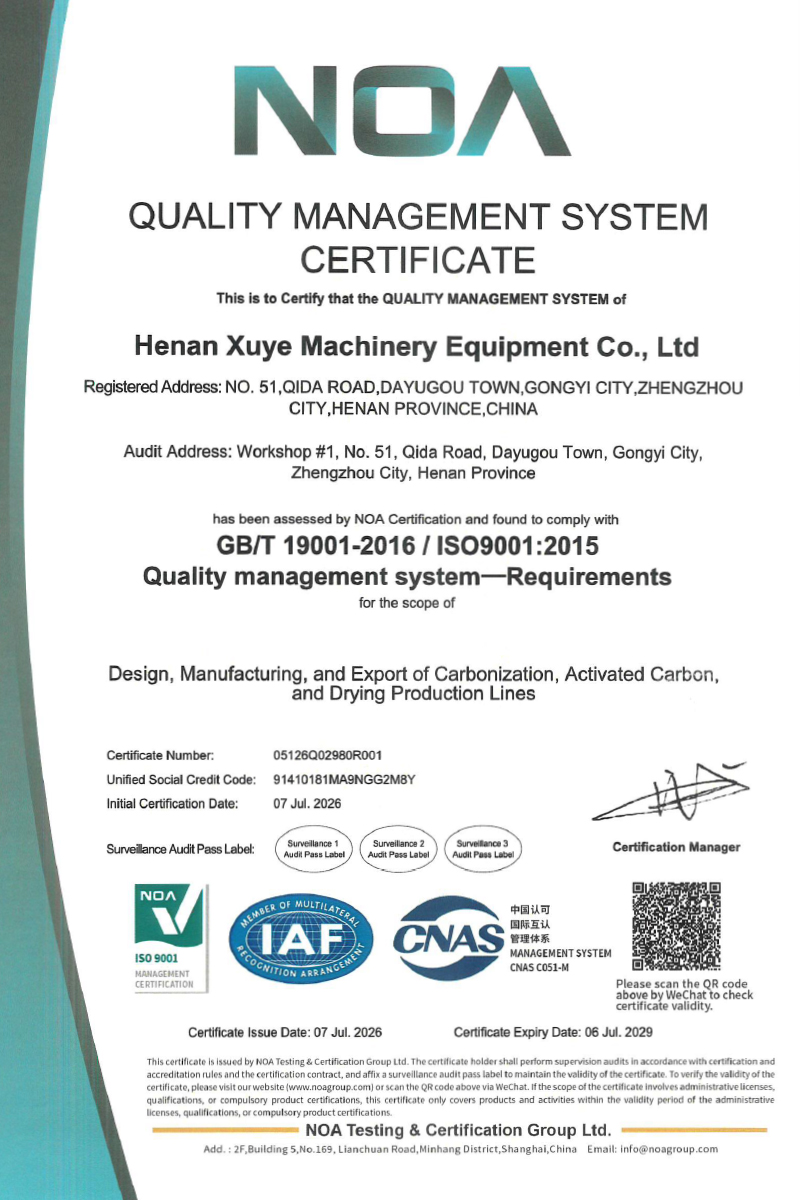
ISO Quality Management Certification
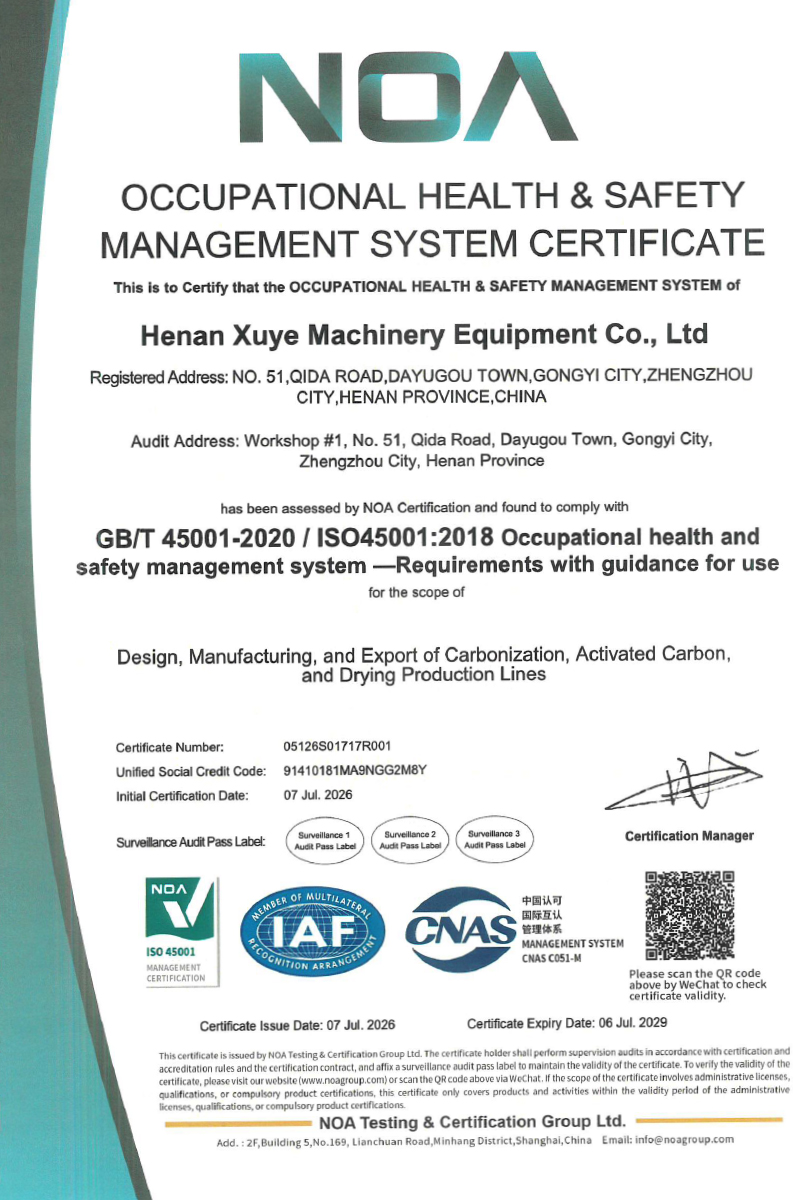
ISO Occupational Health Management Certification
Activated carbon made from hazelnut shells can be used in many industries. In water treatment, it can help remove color, odor, chlorine, organic pollutants, and trace contaminants from drinking water, wastewater, industrial process water, and municipal treatment systems. Granular activated carbon is often used in filter beds, while powdered activated carbon can be dosed directly into water treatment processes.
In air and gas purification, hazelnut shell activated carbon can adsorb odors, volatile organic compounds, solvent vapors, and certain gas-phase contaminants. It is used in industrial exhaust treatment, workshop air purification, ventilation filters, odor control systems, and environmental protection equipment.
In solvent recovery, activated carbon captures valuable organic solvents from exhaust streams. The adsorbed solvent can then be recovered through regeneration, helping reduce emissions and material loss. In chemical processing, activated carbon can be used for purification, decolorization, catalyst support, and impurity removal.
In food and beverage processing, suitable grades of activated carbon can be used for decolorization, deodorization, and purification. These applications may require additional washing, purity control, and strict production management. In precious metal recovery, some activated carbon grades are used for gold adsorption, where hardness and adsorption performance are especially important.
Because application requirements vary, the rotary kiln process should be designed around the intended market. A product for general wastewater treatment may not require the same parameters as a high-hardness carbon for gold recovery or a special carbon for solvent adsorption.
Every activated carbon project is different. Some customers already have hazelnut shells from their own processing plant. Some purchase shells from different suppliers. Some need a complete new activated carbon production line, while others only need to upgrade an old carbonization kiln, add a steam activation rotary
kiln, or improve exhaust gas treatment.
We provide customized solutions based on actual project data. The design process may include raw material evaluation, capacity planning, process selection, kiln sizing, fuel selection, equipment layout, automation planning, and environmental protection configuration. For overseas projects, we can also support container loading, installation guidance, operator training, spare parts planning, and commissioning discussion.
Capacity planning is especially important. The raw hazelnut shell input and final activated carbon output are not equal because drying, carbonization, and activation all reduce material mass. Yield depends on moisture, shell composition, carbonization conditions, activation intensity, and final product requirements. A realistic capacity plan should consider both available raw material and target market demand.
Fuel selection also affects operating cost and equipment design. Natural gas, diesel, biomass gas, electricity, coal gas, and recovered process gas may all be considered in different projects. The best option depends on local energy prices, emission standards, safety requirements, and plant infrastructure.
Factory layout should allow smooth material flow from raw shell storage to finished product packaging. It should also leave space for maintenance, dust pipelines, exhaust gas treatment, control cabinets, access platforms, spare parts, and future expansion. Good layout planning reduces installation problems and makes daily operation easier.
Activated carbon production involves high temperature, combustible gas, fine carbon dust, steam, and moving equipment. A reliable hazelnut shells activated carbon rotary kiln system should include proper sealing, temperature monitoring, pressure control, emergency measures, dust management, and exhaust gas treatment.
During carbonization, volatile gases are released from biomass. These gases may contain combustible components and should be handled safely. Depending on the process design, they can be burned, treated, or partly recovered as heat energy. Proper gas handling improves safety and reduces environmental impact.
Dust control is also important. Activated carbon dust can affect worker health, equipment cleanliness, product recovery, and emission compliance. Dust collectors should be installed at transfer points, crushing areas, screening equipment, cooling discharge, and packaging stations as needed.
Environmental rules vary by country and region. Before finalizing the production line, customers should confirm local standards for particulate matter, smoke, odor, volatile organic compounds, sulfur compounds, nitrogen oxides, and wastewater if washing is included. The exhaust gas treatment system can then be matched to the required standard.
Choosing a hazelnut shell activated carbon rotary kiln supplier is not only about purchasing equipment. The success of the project depends on process matching, kiln structure, heating control, auxiliary system design, installation support, and long-term service.
We help customers evaluate raw materials, define production goals, select a process route, and configure the kiln system. Our solutions consider the relationship between feedstock, capacity, activation method, heat source, environmental requirements, and finished product use. This helps reduce the risk of poorly matched equipment.
The kiln is designed for durability, stable operation, and maintainability. Key components such as the rotary shell, support rollers, drive system, sealing device, refractory lining, burner, steam system, cooler, and control cabinet are selected according to operating conditions.
We can also supply related equipment for a complete activated carbon production line, including dryers, crushers, conveyors, screens, carbonization equipment, activation kilns, coolers, dust collectors, gas treatment equipment, packaging systems, and automation systems. A coordinated supply package reduces interface problems between different machines and supports smoother project execution.
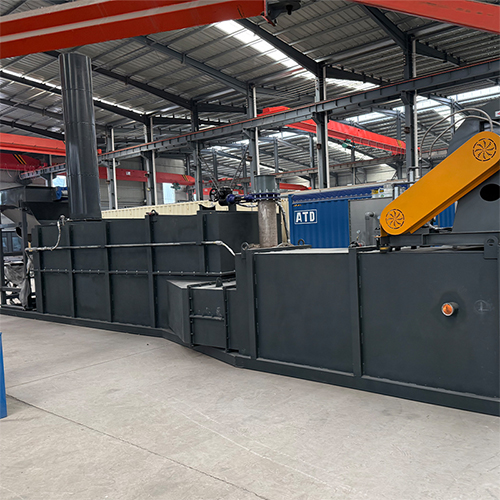
Continuous Carbonization Furnace Project in Spain
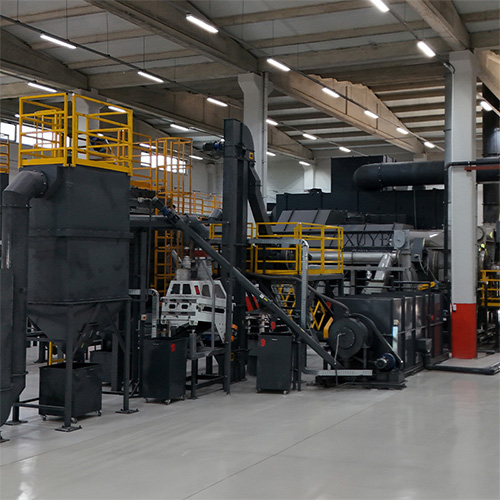
Turkish Hazelnut Shell Activated Carbon Project
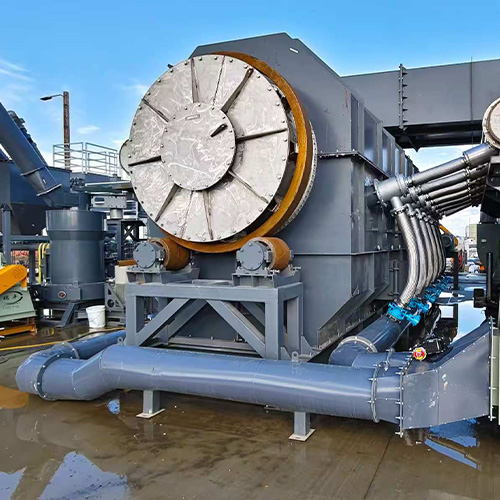
US Almond Shell Activated Carbon Project
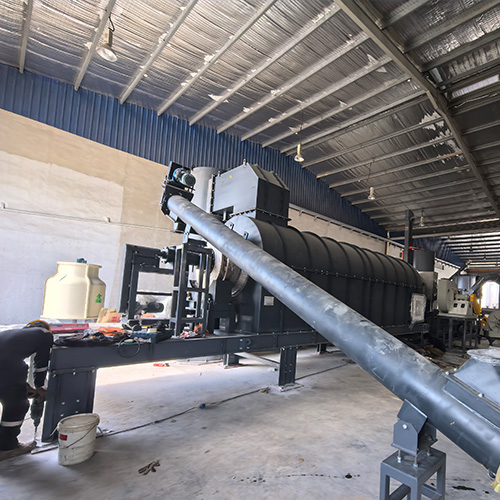
Malaysia Coconut Shell Activated Carbon Project
If you are planning to produce activated carbon from hazelnut shells, our engineering team can help you build a practical and scalable production system. Whether you need one rotary kiln, a carbonization and activation line, or a complete biomass activated carbon plant, we can design the equipment around your raw material, capacity, fuel, product quality, and environmental requirements.
Contact us today to discuss your hazelnut shell activated carbon rotary kiln project. Send us your raw material details, target output, factory location, and final product requirements. We will recommend a suitable technical solution and help you turn hazelnut shell waste into high-value activated carbon.
| capacity | 5-8t/d | 8-10t/d | 10-12t/d | 12-15t/d | 15-20t/d |
| Dryer model | HG-800 | HG-1000 | HG-1200 | HG-1500 | HG-1800 |
| Dryer power | 3kw | 4kw | 7.5kw | 15kw | 22kw |
| continuous carbonization furnace model | TH-1500 | TH-1500 | TH-1800 | TH-2000 | TH-2000 |
| Carbonization temperature | 600-850℃ | ||||
| Fixed carbon content after carbonization | 70-80% | ||||
| Carbonization furnace drum material | 309S/310S | 309S/310S | 309S/310S | 309S/310S | 309S/310S |
| Activation furnace model | HN-5 | HN-8 | HN-10 | HN-12 | HN-15 |
| Activation furnace power | 15kw | 22kw | 30kw | 37kw | 37kw |
| Activation furnace chamber material | QQ345+nano thermal insulation board+refractory | ||||
| Activation temperature | 850-950℃ | ||||
| Activator | Water vapor or Phosphoric acid (customized according to customer requirements, equipment design will be updated) | ||||
| Activation time | 1-2h | ||||
| Cooling machine model | GTL-1004 | GTL-1204 | GTL-1206 | GTL-1504 | GTL-1506 |
| Temperature after cooling | ≤40℃ | ||||
| Activated carbon crusher model | SGP-400 | SGP-400 | SGP-600 | SGP-800 | SGP-800 |
| Activated carbon finished product size | 4-60mesh | ||||
| Activated carbon iodine value | 800-1300mg/g | ||||
| Activated carbon specific surface area | 800-1500m²/g | ||||
| Activated carbon strength | ≥95 | ||||
| CTC | ≥60% | ||||
| Filling density | 0.45-0.55g/cm3 | ||||
| Activated carbon ash | ≤3% | ||||
Frequently asked questions
Here are answers to some frequently asked questions about skid-mounted carbonization furnaces. If you have any other questions, please feel free to contact our customer service team directly, and we will be happy to provide you with a detailed explanation.
Yes. Hazelnut shells are hard, carbon-rich biomass materials suitable for activated carbon production after drying, carbonization, steam activation, cooling, and screening.
Carbonization turns hazelnut shells into char by removing moisture and volatile matter. Activation develops the pore structure of the char, usually with high-temperature steam, so the material gains adsorption capacity.
In many cases, yes. The system can be designed or adjusted for coconut shells, walnut shells, palm kernel shells, apricot shells, peach stones, and other hard biomass materials.
Yes. We can provide drying, crushing, feeding, carbonization, activation, cooling, screening, dust collection, exhaust gas treatment, control, and packaging equipment.
The furnace is typically supplied with a PLC-based control system with HMI for temperature control, process monitoring, alarms, and safety interlocks. Remote monitoring and additional automation functions can also be offered based on project requirements.