 Henan Xuye Machinery Equipment Co., Ltd.
SEARCH WHAT YOU WANT
Search allProductNews
SEARCH
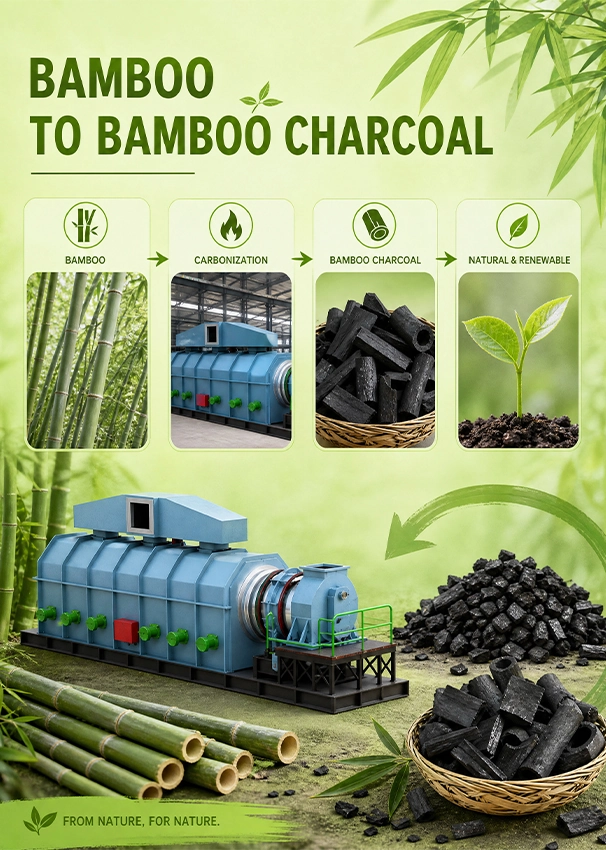
Bamboo is one of the fastest-growing and most abundant biomass resources in the world, but the bamboo processing industry — furniture makers, flooring producers, pulp mills, and bamboo plantations — generates enormous volumes of offcuts, branches, roots, and shavings every year. Instead of burning this waste openly or paying for disposal, forward-thinking operators are converting it into high-value bamboo charcoal using a dedicated bamboo charcoal making machine.
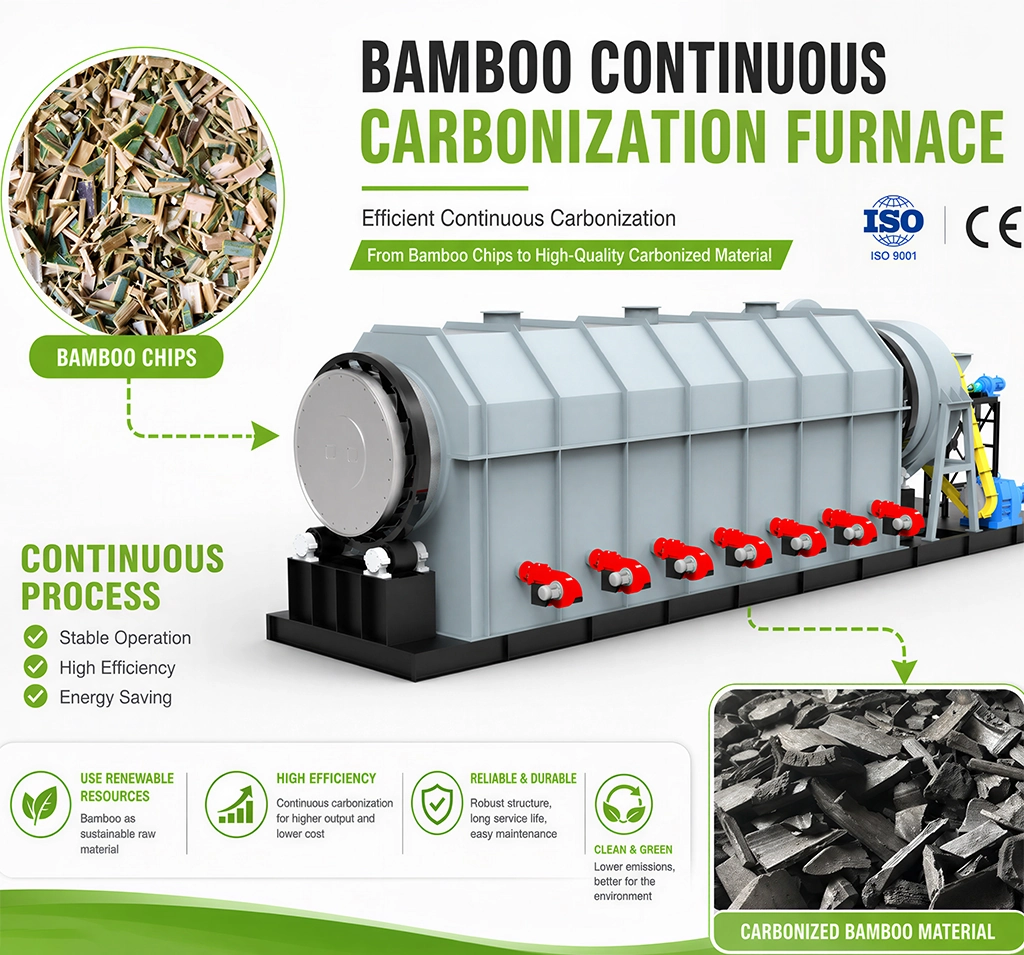
Bamboo charcoal is prized for its high fixed carbon content, fine pore structure, and strong adsorption properties, which make it valuable across multiple industries: BBQ and cooking charcoal, air and water purification products, soil amendment (biochar), industrial fuel, and even textile and deodorizing applications. But bamboo has a different fiber structure, density, and moisture profile than wood or agricultural waste, which means it requires carbonization equipment specifically engineered for its characteristics rather than a generic biomass carbonizer.
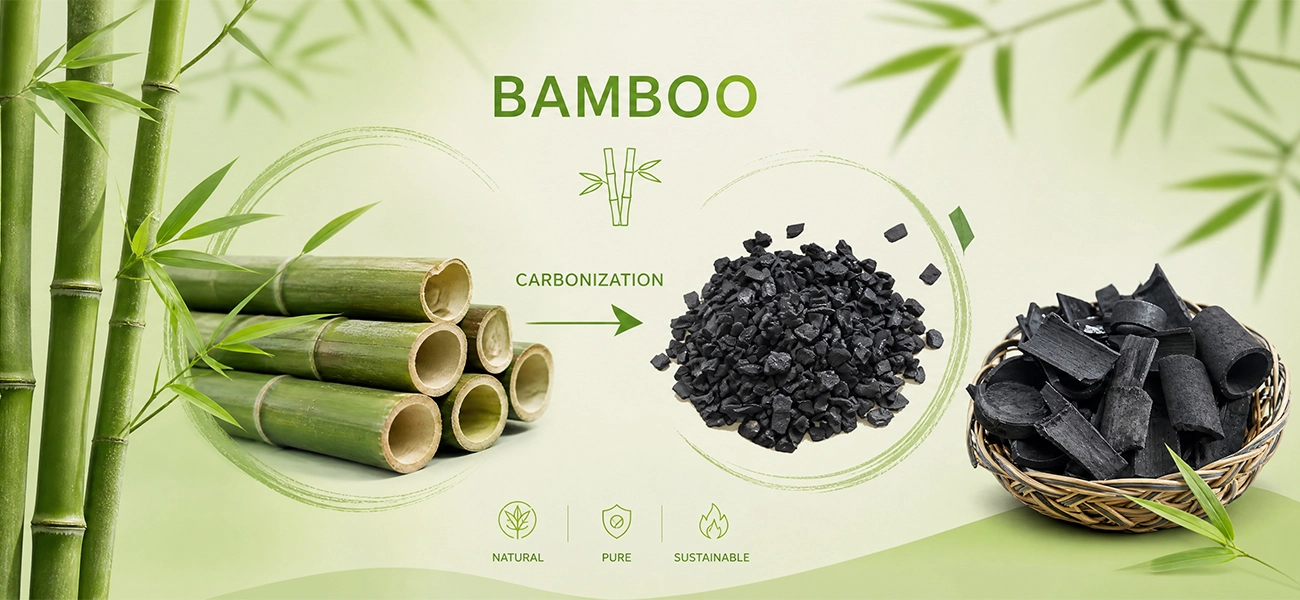
The Bamboo Continuous Carbonization Furnace is an efficient and environmentally friendly machine designed to convert bamboo materials into high-quality charcoal through a continuous carbonization process. It can process bamboo chips, bamboo strips, bamboo sawdust, and other biomass materials with stable feeding and discharging.
The furnace operates under controlled temperature and limited oxygen conditions, ensuring uniform carbonization and consistent charcoal quality. The combustible gases produced during carbonization can be recycled as fuel, which helps reduce energy consumption and operating costs. Its continuous operation improves production efficiency and saves labor.
With a robust structure, easy operation, and reliable performance, the Bamboo Continuous Carbonization Furnace is suitable for small, medium-sized, and large-scale charcoal production plants. The finished bamboo charcoal can be used as barbecue fuel, industrial fuel, soil conditioner, water purification material, or raw material for activated carbon.
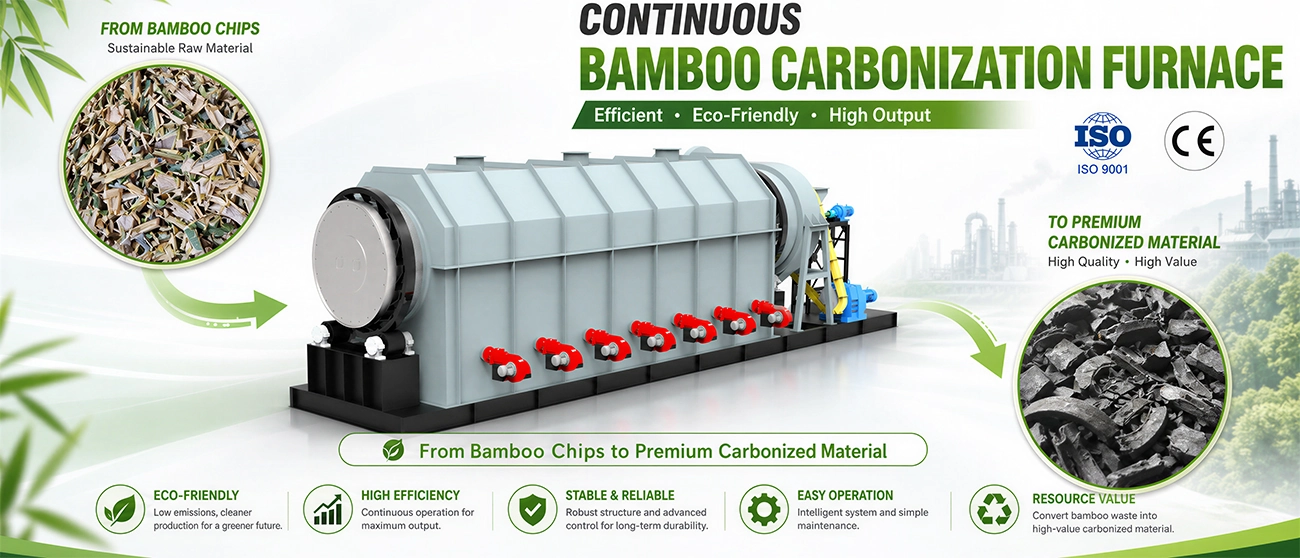
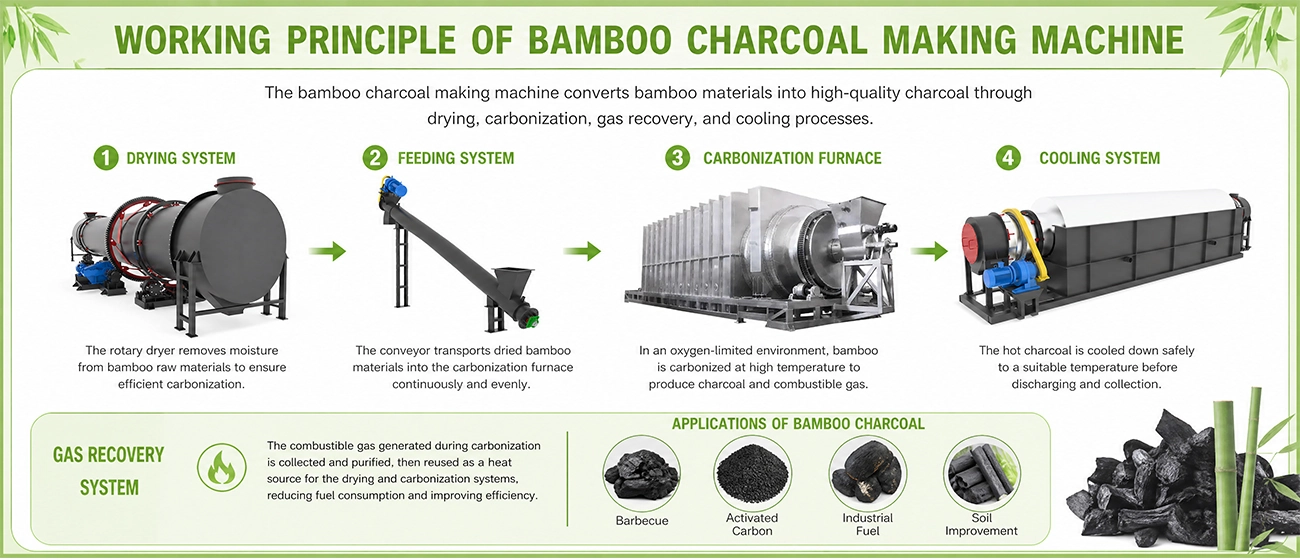
The working process of a bamboo charcoal making machine mainly includes raw material preparation, drying, feeding, carbonization, gas recovery, cooling, and charcoal discharging. First, bamboo materials such as bamboo poles, bamboo chips, bamboo sawdust, or bamboo waste are crushed or cut into suitable sizes and dried to reduce moisture content. The prepared bamboo is then fed into the carbonization furnace through the feeding system. Under high-temperature and oxygen-limited conditions, the bamboo is gradually carbonized and converted into charcoal. During the carbonization process, combustible gas is generated and can be collected, purified, and reused as a heat source for the system, helping reduce fuel consumption. After carbonization, the finished bamboo charcoal enters the cooling system to lower its temperature safely before discharge. Finally, the cooled charcoal can be collected, screened, packaged, or further processed according to its final application.
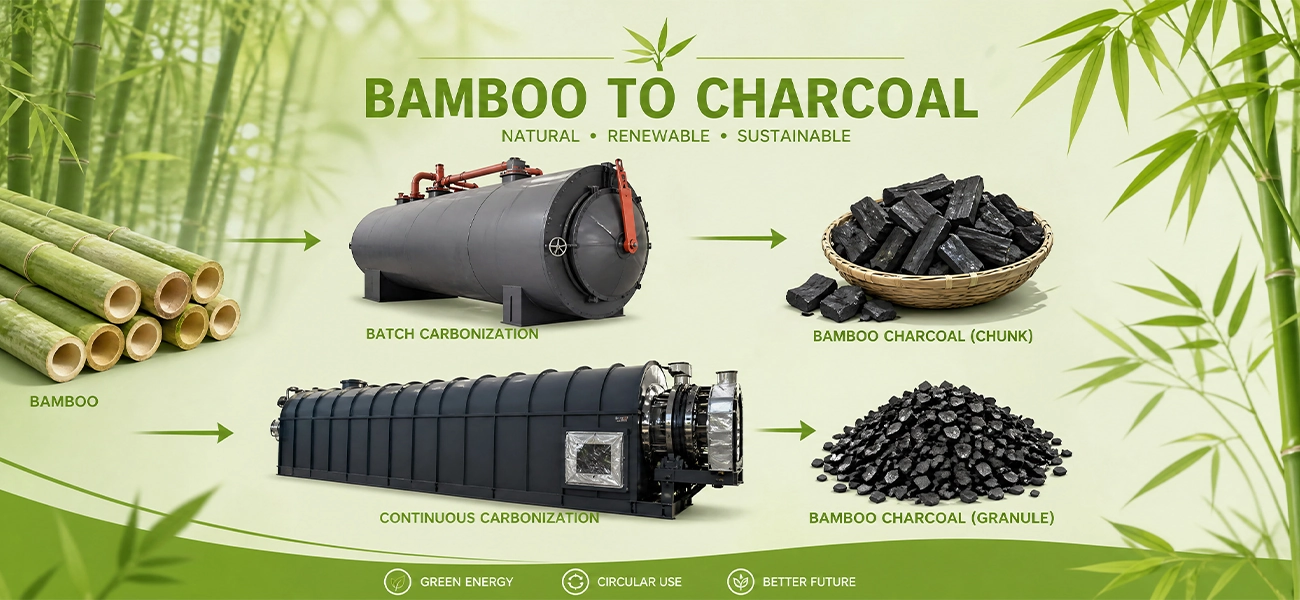
Bamboo charcoal making machines are available in two main configurations, and choosing between them depends on your production scale and budget:
Batch Bamboo Carbonization Furnace A fixed-chamber design where bamboo material is loaded, sealed, carbonized over a full cycle (often 24–48 hours depending on furnace size), then cooled and unloaded before the next batch begins. This design suits smaller producers or operations with limited and inconsistent bamboo supply, and requires a lower upfront investment.
Continuous Bamboo Carbonization Furnace A non-stop system where bamboo material is fed in and charcoal is discharged continuously, without pausing between cycles. This design dramatically increases daily output and fuel efficiency and is the preferred choice for commercial-scale bamboo processors with a steady, high-volume raw material supply. If you’re processing large, consistent volumes of bamboo waste, our Continuous Charcoal Making Machine — built around the same proven continuous carbonization furnace platform used across our full biomass equipment range — can be configured specifically for bamboo feedstock.
| Feature | Batch Bamboo Furnace | Continuous Bamboo Furnace |
|---|---|---|
| Cycle | Load → carbonize → cool → unload | Non-stop feeding and discharge |
| Daily output | Lower, fixed by cycle time | Higher, scalable |
| Fuel efficiency | Moderate | High (self-sustaining gas recycling) |
| Labor | Higher | Lower, automated |
| Best for | Small/medium producers, seasonal supply | Large-scale, continuous bamboo supply |
| Upfront investment | Lower | Higher |
Unlike generic carbonization equipment, our furnace design accounts for bamboo’s fibrous texture, natural silica content, and moisture behavior, resulting in more complete, even carbonization and less unburned or under-carbonized material.
Bamboo charcoal produced through properly controlled carbonization typically reaches 75–85% fixed carbon content, making it well suited for high-value applications like activated carbon precursor material and premium BBQ charcoal.
The condensation system captures bamboo vinegar (pyroligneous acid) as a valuable by-product during carbonization, which can be sold separately as an organic pesticide, soil conditioner, or deodorizing agent — adding an additional revenue stream to your operation.
Gas recycling technology allows the furnace to run largely on its own pyrolysis gas after startup, substantially reducing fuel costs compared with traditional bamboo-burning kilns.
Given bamboo’s higher silica and abrasive fiber content, key wear components are reinforced compared with standard wood-charcoal furnace models, extending equipment service life.
Integrated gas purification systems significantly reduce smoke and particulate emissions compared with open-air bamboo burning or traditional earthen kilns, helping producers meet local environmental standards.
Automated feeding, carbonization, and discharge reduce labor requirements and allow for a smaller operational footprint relative to output compared with traditional kiln setups.
While optimized for bamboo, this equipment can process a range of bamboo-related and compatible biomass materials, including:
For material with high moisture or fine, loose particle size, we recommend pairing the furnace with a dryer and/or briquetting machine to optimize carbonization efficiency and charcoal quality — see the related equipment section below.
Bamboo charcoal burns cleanly with a long, steady burn time and minimal smoke, making it a premium choice for BBQ charcoal markets, particularly in export markets that value odorless, long-lasting fuel.
Bamboo’s fine natural pore structure makes it an excellent precursor for activated carbon used in water filtration, air purification, and industrial adsorption applications.
Small-format bamboo charcoal is widely sold as a natural deodorizer and moisture absorber for household, automotive, and refrigerator use.
Bamboo biochar improves soil aeration, water retention, and microbial activity, making it valuable for agricultural and horticultural soil amendment applications.
High fixed-carbon bamboo charcoal can serve as a solid fuel substitute in select industrial heating and smelting applications.
Recovered bamboo vinegar is sold as a natural pesticide, fertilizer additive, and odor-control agent, giving producers an additional product line from the same raw material.mmend pairing the furnace with a dryer and/or briquetting machine to optimize carbonization efficiency and charcoal quality — see the related equipment section below.
| Model | XY-800 | XY-1000 | XY-1200 | XY-1500 | XY-1800 | XY-2000 |
| Number of cylinder layers | Single | Single | Double | Double | Double | Double |
| Cylinder diameter | 800mm | 1000mm | 1200/700mm | 1500/900mm | 1800/1200mm | 2000/1500mm |
| Capacity | 200-300kg/h | 300-400kg/h | 450-600kg/h | 600-800kg/h | 800-1000kg/h | 1000-1200kg/h |
| Cylinder material | 309S/310S/316L | 309S/310S/316L | 309S/310S/316L | 309S/310S/316L | 309S/310S/316L | 309S/310S/316L |
| Temerature | 500-800ºC | 500-800ºC | 500-800ºC | 500-800ºC | 500-800ºC | 500-800ºC |
| Carbonization time | 20-60min | 20-60min | 20-60min | 20-60min | 20-60min | 20-60min |
| Raw material particle size | ≤4cm | ≤4cm | ≤4cm | ≤4cm | ≤4cm | ≤4cm |
| Heating method | indirect heating | indirect heating | indirect heating | indirect heating | indirect heating | indirect heating |
| Operation mode | continuously working | continuously working | continuously working | continuously working | continuously working | continuously working |
| Control method | PLC control | PLC control | PLC control | PLC control | PLC control | PLC control |
Frequently asked questions
Here are answers to some frequently asked questions about skid-mounted carbonization furnaces. If you have any other questions, please feel free to contact our customer service team directly, and we will be happy to provide you with a detailed explanation.
Fresh bamboo typically has 40–60% moisture content, which is too high for efficient carbonization. We recommend drying bamboo material to below approximately 20% moisture before feeding it into the furnace, either through natural air drying or with a rotary dryer.
If your bamboo supply is limited, seasonal, or inconsistent, a batch furnace generally offers a lower-cost entry point. If you have a steady, high-volume bamboo supply and want to maximize daily output and fuel efficiency, a continuous system is typically the better long-term investment.
Charcoal yield from bamboo generally runs around 25–30% of dry input weight, though this varies based on bamboo species, moisture content, and furnace operating parameters.
Yes. Our smaller continuous models are well suited to processing offcut volumes from bamboo furniture and flooring workshops, turning waste disposal costs into a revenue-generating by-product.
Yes, our engineering team can adjust furnace parameters to accommodate mixed feedstock streams, though we recommend discussing your specific material mix with our technical team to optimize furnace settings.