 Henan Xuye Machinery Equipment Co., Ltd.
SEARCH WHAT YOU WANT
Search allProductNews
SEARCH
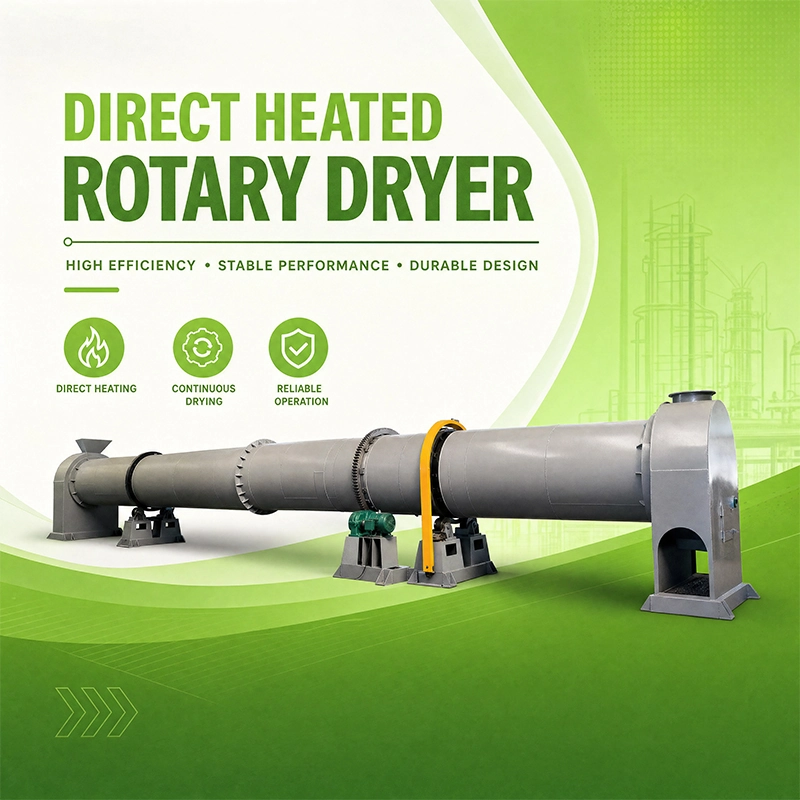
A Direct Heated Rotary Dryer (also known as a direct-fired rotary dryer or direct heating rotary drum dryer) is a type of industrial drying equipment that removes moisture from bulk solid materials through direct contact between the material and a stream of hot combustion gases. As the rotating cylinder turns, the material is continuously lifted and showered through the heated gas stream, achieving rapid and uniform moisture evaporation.
Direct rotary dryers are the most commonly employed type of industrial single drum rotary dryer for bulk solids processing. They account for the lion‘s share of bulk solids drying applications across mining, agriculture, chemical processing, and construction materials industries. The reason is simple: direct heating offers superior thermal efficiency, higher throughput, and lower operating costs compared to alternative drying methods.
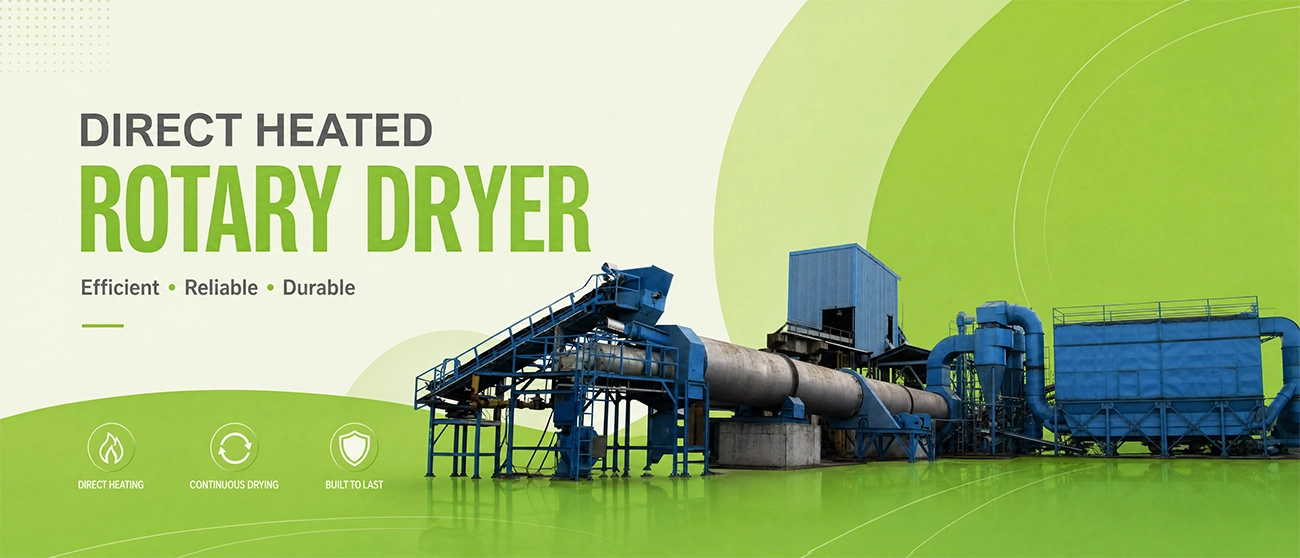
The direct heated rotary dryer operates on the principle of lifting and showering the product through a hot gas stream moving either in parallel (co-current) or counter-current flow. The efficiency of the dryer depends largely on the temperature differential between the inlet and exhaust gases, as well as the design of the internal flights and the rotational speed.
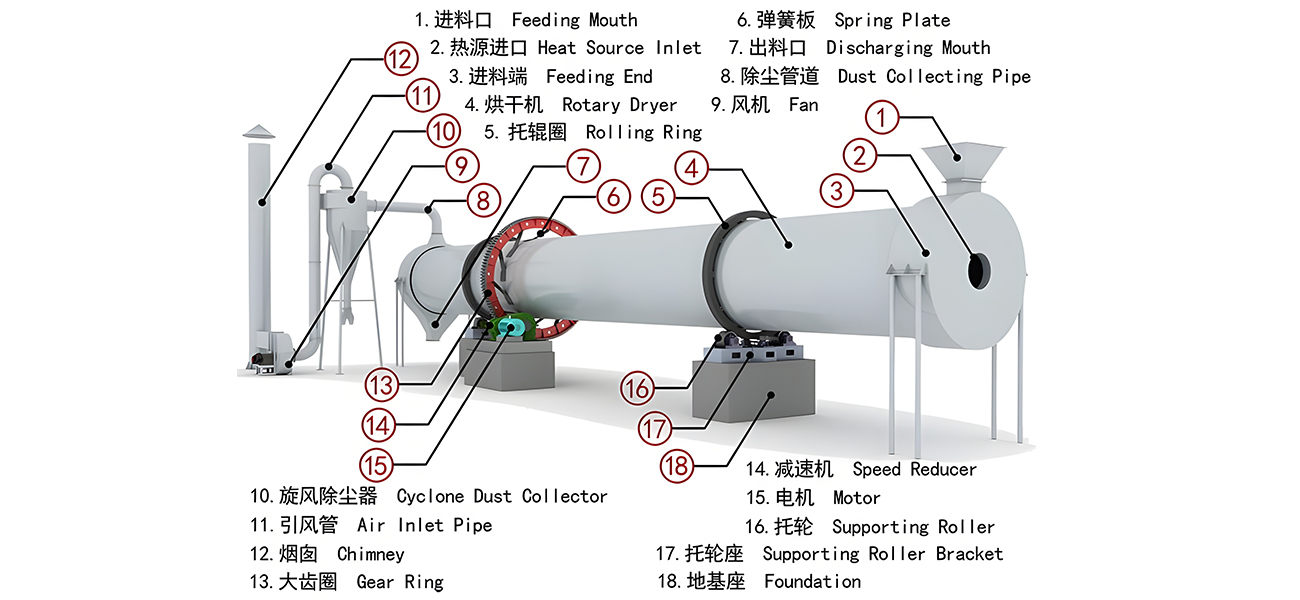
A typical direct heated rotary dryer consists of the following major components:
Step 1 – Material Feeding: Wet material is fed into the drum at the higher end through a feeding device.
Step 2 – Heat Generation: The burner generates high-temperature hot air (up to 850°C inlet temperature) by burning fuel. The hot gases enter the drum through the breeching chamber.
Step 3 – Material Lifting and Showering: As the drum rotates, the internal flights lift the material and carry it up the side of the drum. When the material reaches the top, it falls back down in a “curtain” through the hot gas stream. This cascading effect maximizes the contact surface area between the material and the hot gases.
Step 4 – Heat and Mass Transfer: Through convective heat transfer, the hot gases directly contact the material, rapidly evaporating moisture-. The material’s residence time in the dryer is governed by the rate of diffusion of water from the core to the surface of the particles.
Step 5 – Material Discharge: Due to the slight downward slope of the drum and the rotation, material gradually moves toward the discharge end and exits the dryer.
Step 6 – Exhaust Gas Treatment: Moist exhaust gases are discharged via an induced draft fan, often passing through dust collection or purification devices to meet environmental requirements.
It’s important to understand the distinction between direct-heat and direct-fired rotary dryers, as these terms are sometimes used interchangeably but have important technical differences.
In a direct-heated rotary dryer, only the heat—not the flame—from the combustion process contacts the material. A combustion chamber (a static furnace) is mounted to the end of the rotary dryer to house the combustion reaction and keep the flame away from the material. The burner is mounted onto the combustion chamber, so the actual flame never enters the rotary drum itself.
This configuration is preferred for heat-sensitive or high-value materials where product integrity is a concern. Contact with the flame could cause product degradation, discoloration, higher attrition, or the formation of undesirable byproducts.
In a direct-fired rotary dryer, the burner is mounted directly onto the end of the rotary drum shell breeching, without a combustion chamber. The flame itself comes into direct contact with the material being processed. These dryers are generally more efficient in terms of heat transfer because they utilize radiant energy near the burner, convective heat as gases move through the drum, and conductive transfer along the shell.
Direct-fired designs are commonly used for robust materials such as aggregates and minerals.
| Feature | Direct-Heated (with combustion chamber) | Direct-Fired (without combustion chamber) |
|---|---|---|
| Flame contact with material | No | Yes |
| Best for | Heat-sensitive, high-value products | Robust materials (minerals, aggregates) |
| Heat transfer efficiency | High | Higher |
| Risk of product degradation | Low | Higher |
If your material is sensitive to heat in any way—physically, chemically, or in appearance—the direct-heated configuration with a combustion chamber is the safer choice.
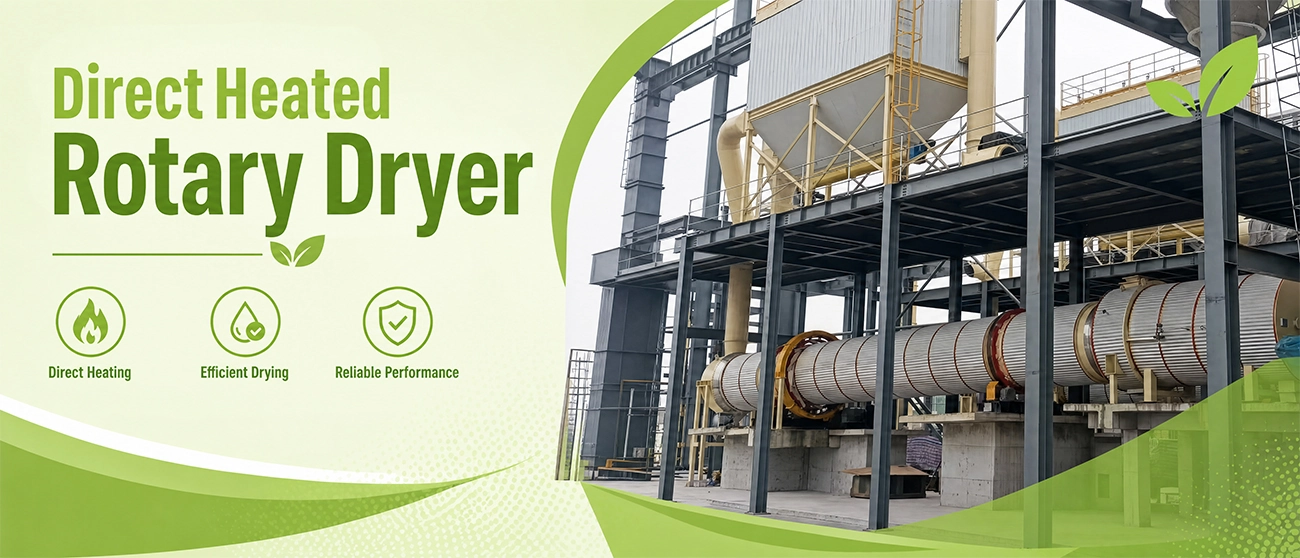
Direct contact between the material and the hot gases enables rapid and efficient heat transfer-. Thermal efficiency can reach 80% to 90% with proper design-. The direct heat transfer mechanism makes this type of dryer significantly more efficient than indirect dryers, which rely on conduction through the drum shell–.
Direct heated rotary dryers are available in capacities ranging from 1 to over 200 tons per hour-. They can handle large volumes of material continuously, making them ideal for high-production industrial operations-.
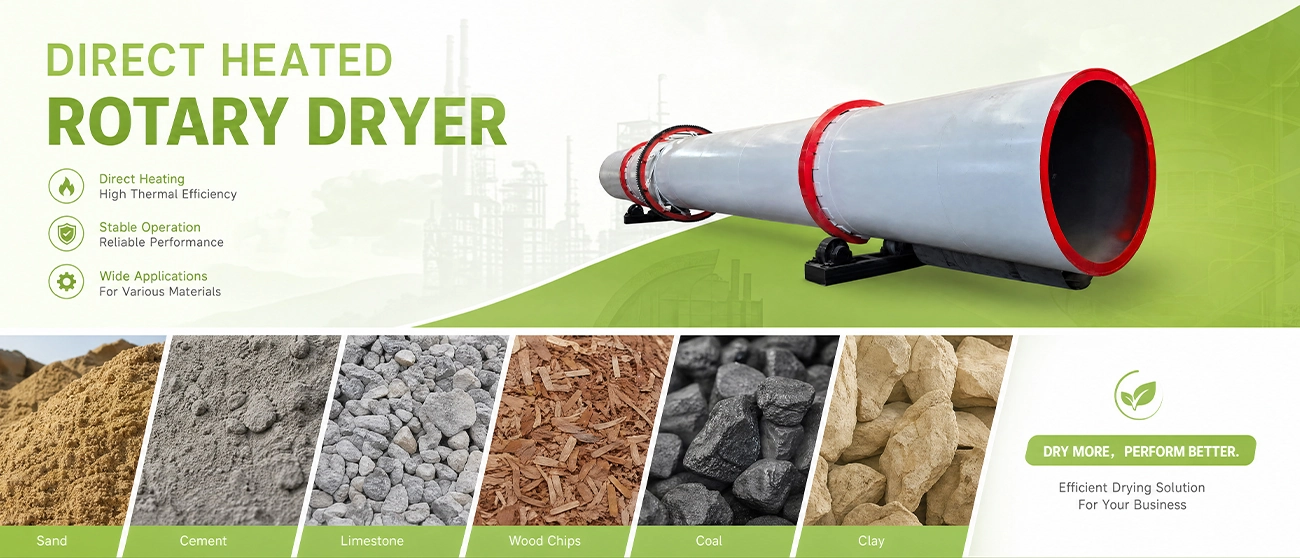
These dryers can process a wide range of materials, including:
Direct heated rotary dryers can be configured to use various fuels including coal, diesel, natural gas, heavy oil, and biomass (wood chips, straw). This flexibility allows operators to choose the most cost-effective and readily available fuel source for their location.
The design consists of a rotating cylinder with internal flights—a straightforward, mechanically reliable configuration that has been proven over more than a century of industrial use-. With proper maintenance, these dryers can operate for 10 to 20 years.
Direct heated rotary dryers are the most economical type of industrial dryer–. The direct heat transfer mechanism reduces fuel consumption, and the simple design minimizes maintenance costs.
These dryers are designed for continuous operation, allowing for uninterrupted production flow-. This is essential for large-scale industrial processes where downtime is costly.
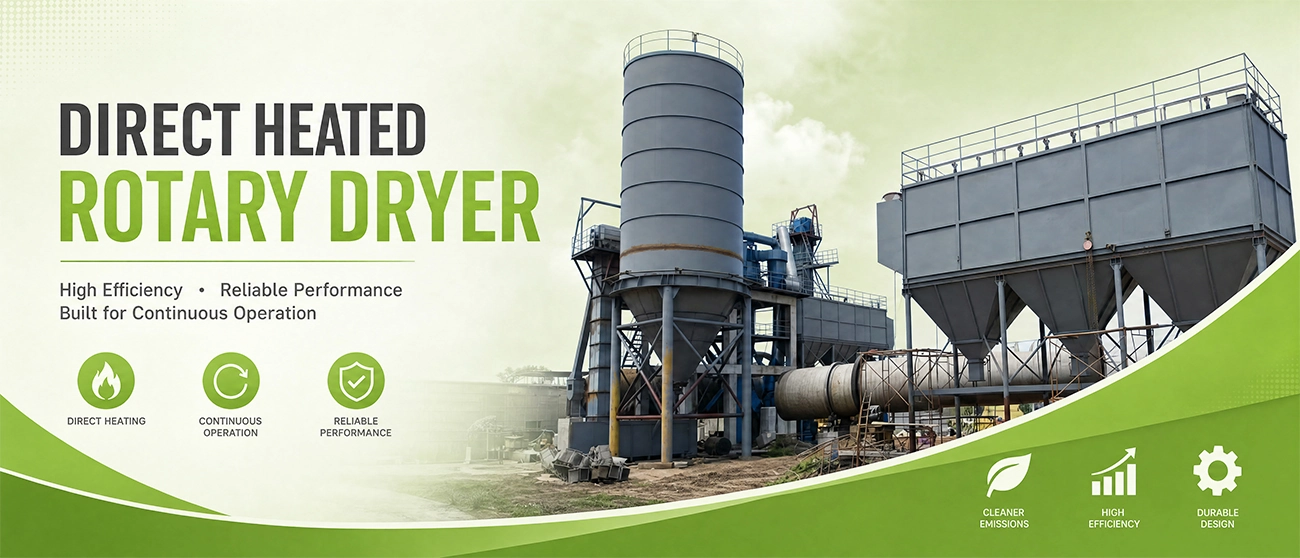
Direct heated rotary dryers can be configured for either co-current or counter-current airflow. The selection depends on the material properties and drying requirements.
In a co-current configuration, the material and the hot gases flow in the same direction—both entering at the feed end and exiting at the discharge end.
Advantages:
In a counter-current configuration, the material and hot gases flow in opposite directions—material enters at the feed end while hot gases enter at the discharge end.
Advantages:
Better for materials requiring very low residual moisturehere downtime is costly.
The driest material contacts the hottest gases, achieving lower final moisture content
More thermally efficient for materials that can tolerate higher temperatures.
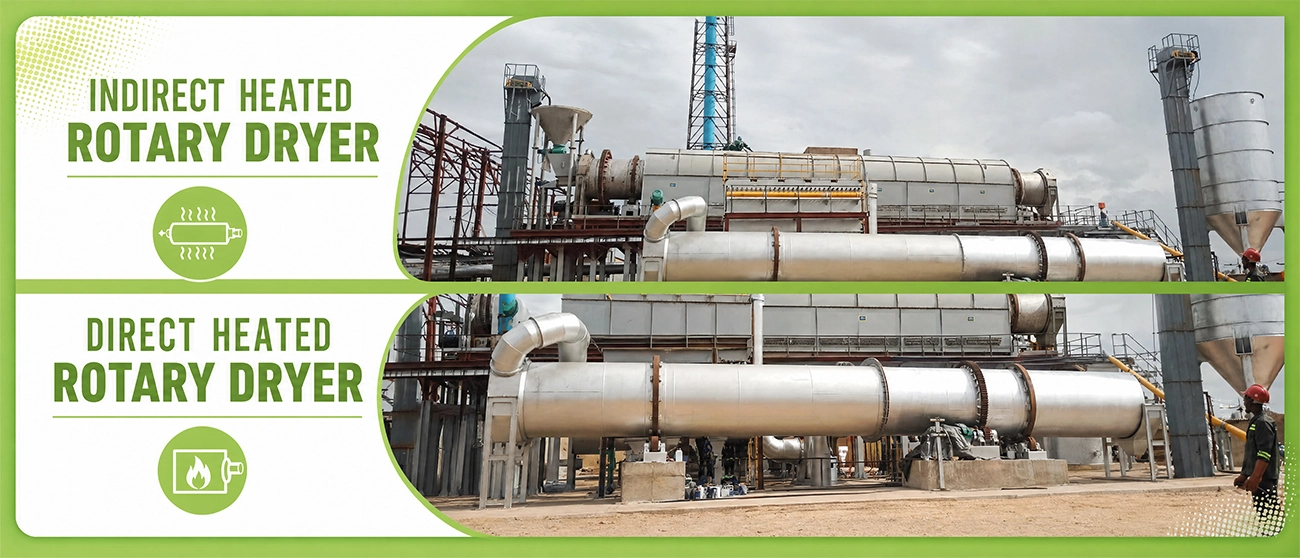
Understanding the difference between direct and indirect heating is crucial for selecting the right dryer for your application.
| Feature | Direct Heated Rotary Dryer | Indirect Heated Rotary Dryer |
|---|---|---|
| Heat transfer mechanism | Convection (direct contact with hot gases)- | Conduction (through the drum shell wall)- |
| Efficiency | High- | Lower |
| Fuel consumption | Lower | Higher |
| Material contact with combustion gases | Yes | No |
| Best for | Non-sensitive bulk solids | Fine solids, heat-sensitive materials- |
| Common applications | Minerals, aggregates, sand, coal | Specialty chemicals, pharmaceuticals |
| Cost | More economical | Higher |
Key Takeaway: Direct heated rotary dryers are used more frequently than their indirect counterparts because of the superior efficiency and lower operating costs they offer-. Indirect dryers are essential only when the material cannot tolerate direct contact with combustion gases—for example, when working with particularly fine solids to avoid excessive particle entrainment.
Direct heated rotary dryers are used across a diverse range of industries:
| Model | Cylinder diameter(mm) | Cylinder length(mm) | Cylinder volume(m3) | Cylinder rotary speed (r/min) | Power(kW) | Weight(t) |
| 0.6×5.8 | 600 | 5800 | 1.7 | 1-8 | 3 | 2.9 |
| 0.8×8 | 800 | 8000 | 4 | 1-8 | 4 | 3.5 |
| 1×10 | 1000 | 10000 | 7.9 | 1-8 | 5.5 | 6.8 |
| 1.2×5.8 | 1200 | 5800 | 6.8 | 1-6 | 5.5 | 6.7 |
| 1.2×8 | 1200 | 8000 | 9 | 1-6 | 5.5 | 8.5 |
| 1.2×10 | 1200 | 10000 | 11 | 1-6 | 7.5 | 10.7 |
| 1.2×11.8 | 1200 | 11800 | 13 | 1-6 | 7.5 | 12.3 |
| 1.5×8 | 1500 | 8000 | 14 | 1-5 | 11 | 14.8 |
| 1.5×10 | 1500 | 10000 | 17.7 | 1-5 | 11 | 16 |
| 1.5×11.8 | 1500 | 11800 | 21 | 1-5 | 15 | 17.5 |
| 1.5×15 | 1500 | 15000 | 26.5 | 1-5 | 15 | 19.2 |
| 1.8×10 | 1800 | 10000 | 25.5 | 1-5 | 15 | 18.1 |
| 1.8×11.8 | 1800 | 11800 | 30 | 1-5 | 18.5 | 20.7 |
| 1.8×15 | 1800 | 15000 | 38 | 1-5 | 18.5 | 26.3 |
| 1.8×18 | 1800 | 18000 | 45.8 | 1-5 | 22 | 31.2 |
| 2×11.8 | 2000 | 11800 | 37 | 1-4 | 18.5 | 28.2 |
| 2×15 | 2000 | 15000 | 47 | 1-4 | 22 | 33.2 |
| 2×18 | 2000 | 18000 | 56.5 | 1-4 | 22 | 39.7 |
| 2×20 | 2000 | 20000 | 62.8 | 1-4 | 22 | 44.9 |
| 2.2×11.8 | 2200 | 11800 | 44.8 | 1-4 | 22 | 30.5 |
| 2.2×15 | 2200 | 15000 | 53 | 1-4 | 30 | 36.2 |
| 2.2×18 | 2200 | 18000 | 68 | 1-4 | 30 | 43.3 |
| 2.2×20 | 2200 | 20000 | 76 | 1-4 | 30 | 48.8 |
| 2.4×15 | 2400 | 15000 | 68 | 1-4 | 30 | 43.7 |
| 2.4×18 | 2400 | 18000 | 81 | 1-4 | 37 | 53 |
| 2.4×20 | 2400 | 20000 | 91 | 1-4 | 37 | 60.5 |
| 2.4×23.6 | 2400 | 23600 | 109 | 1-4 | 45 | 69.8 |
| 2.8×18 | 2800 | 18000 | 111 | 1-3 | 45 | 62 |
| 2.8×20 | 2800 | 20000 | 123 | 1-3 | 55 | 65 |
| 2.8×23.6 | 2800 | 23600 | 148 | 1-3 | 55 | 70 |
| 2.8×28 | 2800 | 28000 | 172 | 1-3 | 75 | 75 |
| 3×20 | 3000 | 20000 | 14 | 1-3 | 55 | 75 |
| 3×23.6 | 3000 | 23600 | 170 | 1-3 | 75 | 85 |
| 3×28 | 3000 | 28000 | 198 | 1-3 | 90 | 91 |
| 3.2×23.6 | 3200 | 23600 | 193 | 1-3 | 90 | 112 |
| 3.2×32 | 3200 | 32000 | 257 | 1-3 | 110 | 129 |
| 3.6×36 | 3600 | 36000 | 366 | 1-3 | 132 | 164 |
| 3.8×36 | 3800 | 36000 | 408 | 1-3 | 160 | 187 |
| 4×36 | 4000 | 36000 | 452 | 1-3 | 160 | 195 |
Frequently asked questions
Here are answers to some frequently asked questions about skid-mounted carbonization furnaces. If you have any other questions, please feel free to contact our customer service team directly, and we will be happy to provide you with a detailed explanation.
A direct heated rotary dryer brings the material into direct contact with hot combustion gases to dry it. An indirect heated rotary dryer, by contrast, uses a heating medium that does not contact the material directly; heat transfers through the drum shell wall via conduction. Direct dryers are more efficient and economical for most bulk solids applications.
Direct heated rotary dryers can process a wide range of materials including minerals (limestone, quartz sand, iron ore), aggregates (slag, coal, clay), agricultural products (fertilizers, animal feed), chemicals, and biomass. They are suitable for materials that are not sensitive to direct contact with hot combustion gases.
Thermal efficiency can reach 80% to 90% with proper design and operation. The efficiency depends on the temperature differential between inlet and exhaust gases, flight design, and the relationship between drum speed and material residence time.
Flights are essential for maximizing heat transfer. They pick up the material from the bottom of the drum, carry it up the side, and shower it through the hot gas stream. This cascading action creates maximum surface area contact between the material and the drying gases.
Proper sizing requires consideration of the material type, initial and final moisture content, required throughput, and heat source availability. Laboratory testing of the specific material is recommended for accurate sizing. Manufacturers can provide customized designs based on your specific requirements.