 Henan Xuye Machinery Equipment Co., Ltd.
SEARCH WHAT YOU WANT
Search allProductNews
SEARCH
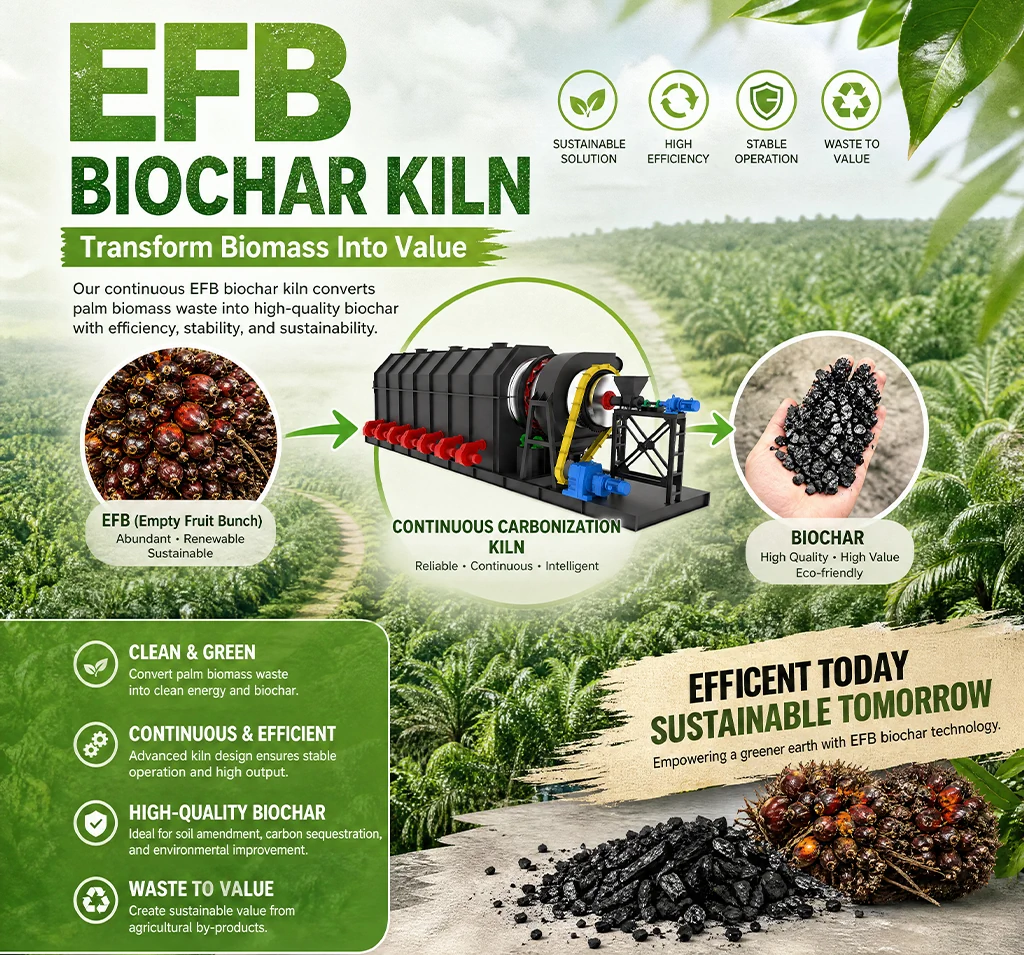
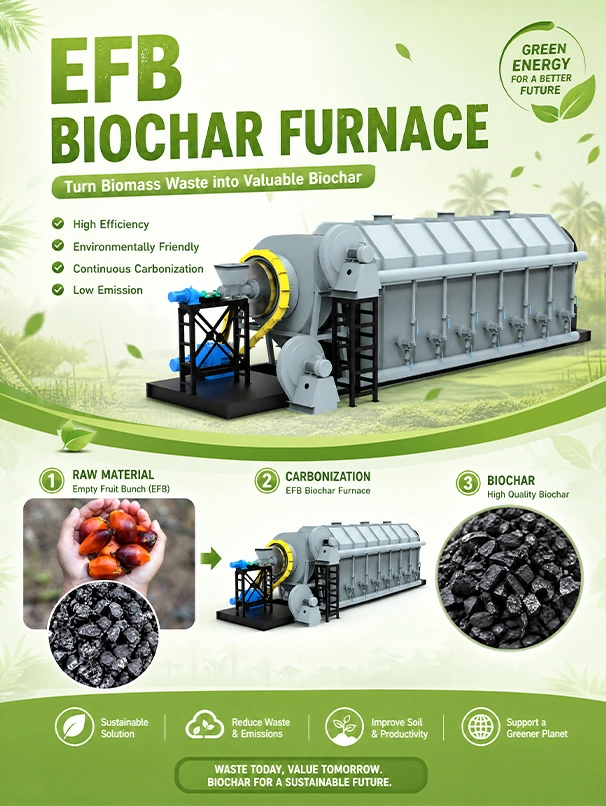
The EFB Biochar Kiln is an advanced thermal conversion system designed to transform empty fruit bunches, also known as EFB, into high-quality biochar. Empty fruit bunches are one of the main by-products of palm oil mills. When they are left untreated, they can create storage, transportation, odor, and disposal problems. With an efficient biochar kiln, palm oil producers can convert this agricultural waste into a valuable carbon-rich product for soil improvement, agricultural production, animal bedding, wastewater treatment, and industrial applications.
Our EFB Biochar Kiln uses controlled pyrolysis technology to process dried and prepared empty fruit bunches in an oxygen-limited environment. During the process, organic materials are thermally decomposed without complete combustion. This produces biochar while also generating combustible gases that can be recycled as a heat source, helping reduce fuel consumption and operating costs.
Designed for palm oil mills, biomass processing companies, agricultural enterprises, fertilizer manufacturers, and environmental projects, the EFB Biochar Kiln provides a practical solution for waste reduction and resource recovery.
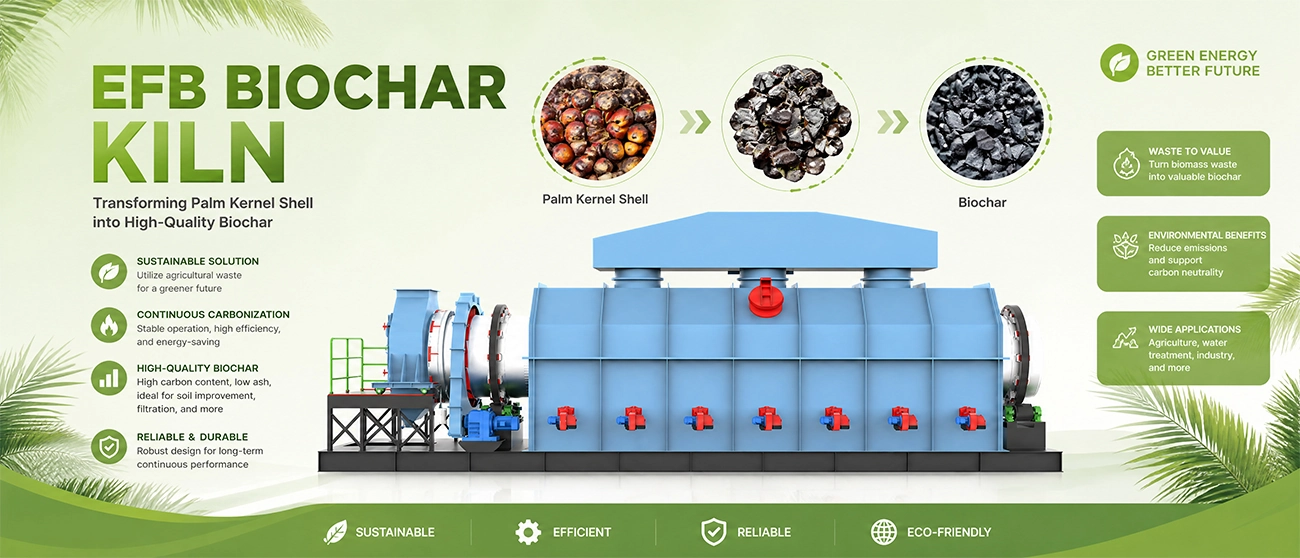
EFB stands for Empty Fruit Bunches. After palm fruits are sterilized and separated in a palm oil mill, the remaining fibrous bunches become EFB waste. A large palm oil processing facility can produce a considerable amount of empty fruit bunches every day.
EFB typically contains:
Because of its high organic content, EFB is a suitable raw material for biomass fuel, compost, pellets, briquettes, activated carbon, and biochar production. However, fresh EFB usually has a high moisture content and a bulky structure. Pre-treatment, including shredding and drying, is often necessary before entering the kiln.
The EFB Biochar Kiln provides a controlled way to convert this low-value waste into a stable carbon material with a wide range of commercial uses.
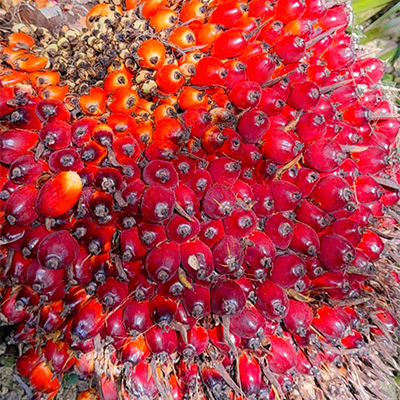
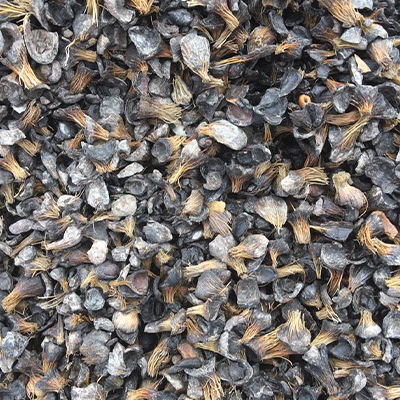
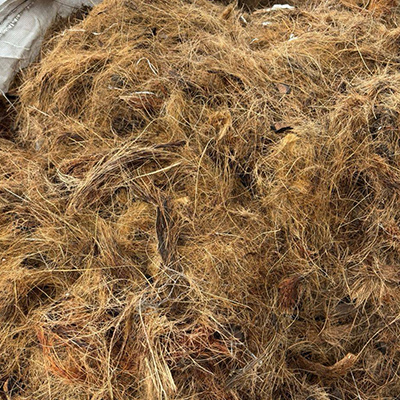
Source: Fibrous fruit bunches remaining after threshing of palm fruit.
Features:
High cellulose, hemicellulose and lignin content (suitable for pyrolysis to produce biochar).
Moisture content is about 50%-65%, and needs to be dried before use.
Yield: About 0.2-0.3 tons of EFB are produced for every ton of palm fruit processed.
Source: The hard shell left after the palm kernel is crushed.
Features:
High carbon content (high calorific value, about 16-19 MJ/kg), suitable for combustion or gasification power generation.
Low ash content, less residue after combustion.
Yield: About 0.05-0.1 tons of PKS are produced per ton of palm fruit.
Source: Residual fiber after oil extraction from palm pulp.
Features:
Oil residue (5%-10%), which can be further extracted or burned for energy.
Can also be used for compost or animal feed (defatting required).
Yield: Each ton of palm fruit produces about 0.12-0.15 tons of PPF.
Prepared EFB is delivered to the feeding system by a conveyor, screw feeder, loader, or other suitable equipment. The feeding system can be adjusted according to the raw material size, moisture level, and required production capacity.
For continuous equipment, the feeder supplies EFB into the pyrolysis chamber at a stable rate. Consistent feeding helps maintain even temperature and improves the quality of the finished biochar.
EFB with excessive moisture requires drying before pyrolysis. The drying section uses hot gas generated by the kiln to reduce moisture content. This improves thermal efficiency and prevents unstable operation.
Lower moisture content can provide several advantages:
A complete production line may include an EFB dryer system depending on the project requirements.
After drying, the EFB enters the pyrolysis chamber. The material is heated in a low-oxygen or oxygen-free environment. Instead of burning completely, the biomass breaks down into solid carbon, combustible gas, and a small amount of liquid or vapor compounds.
The operating temperature is selected according to the desired biochar properties. Lower temperatures may retain more volatile organic compounds and nutrients, while higher temperatures generally produce biochar with higher carbon stability and porosity.
Important operating parameters include:
During pyrolysis, the EFB releases combustible gases. These gases can be collected and burned in the combustion chamber to provide heat for the kiln.
Gas recycling helps:
During start-up, an external fuel source may be required until the system reaches the appropriate operating temperature. After stable operation begins, the generated gas can often support most of the heating demand.
Freshly produced biochar must be cooled before storage or packaging. Hot biochar exposed directly to air may oxidize or ignite. The cooling system reduces the temperature in a controlled environment and protects the quality of the final product.
The cooled biochar can then be discharged into:
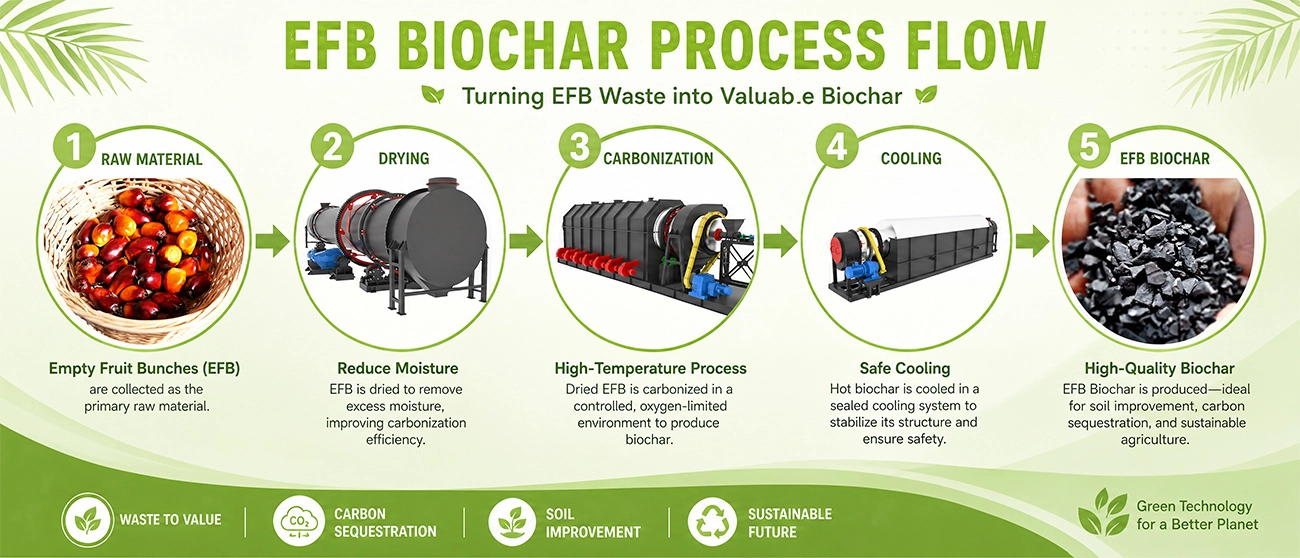
The kiln is designed to provide stable and controllable heating for biomass carbonization. Temperature control can be adjusted to meet different biochar specifications and applications.
Depending on the customer’s requirements, the EFB Biochar Kiln can be configured as a batch-type or continuous-type system.
A batch kiln is suitable for:
A continuous kiln is suitable for:
The kiln recycles combustible pyrolysis gas as a heat source. This reduces dependence on diesel, natural gas, wood, or other external fuels.
Energy performance depends on raw material moisture, kiln design, process temperature, insulation, and operating conditions. Proper drying and feeding control are important for achieving stable energy efficiency.
Different applications require different biochar characteristics. By adjusting operating parameters, the kiln can produce biochar with different levels of:
The final properties should be tested according to the intended application and local regulations.
The system is equipped with combustion and gas treatment components to reduce smoke and unburned gases. Pyrolysis gas can be burned in a dedicated chamber, while dust and exhaust gas may be treated through cyclones, scrubbers, filters, or other environmental protection equipment.
The exact emission control system should be selected according to local environmental standards, plant size, feedstock conditions, and installation location.
The kiln body is manufactured with heat-resistant materials and thermal insulation. The internal structure is designed to withstand continuous high-temperature operation and biomass abrasion.
Key components may include:
An automatic control system can monitor and regulate:
Automation helps reduce manual labor and supports more stable product quality.
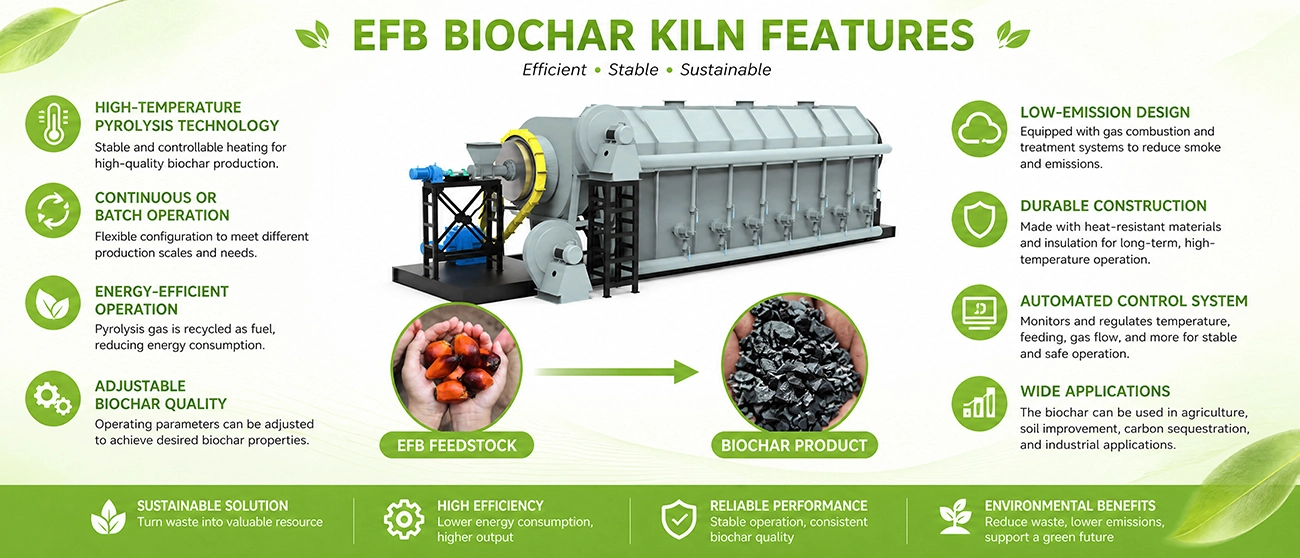
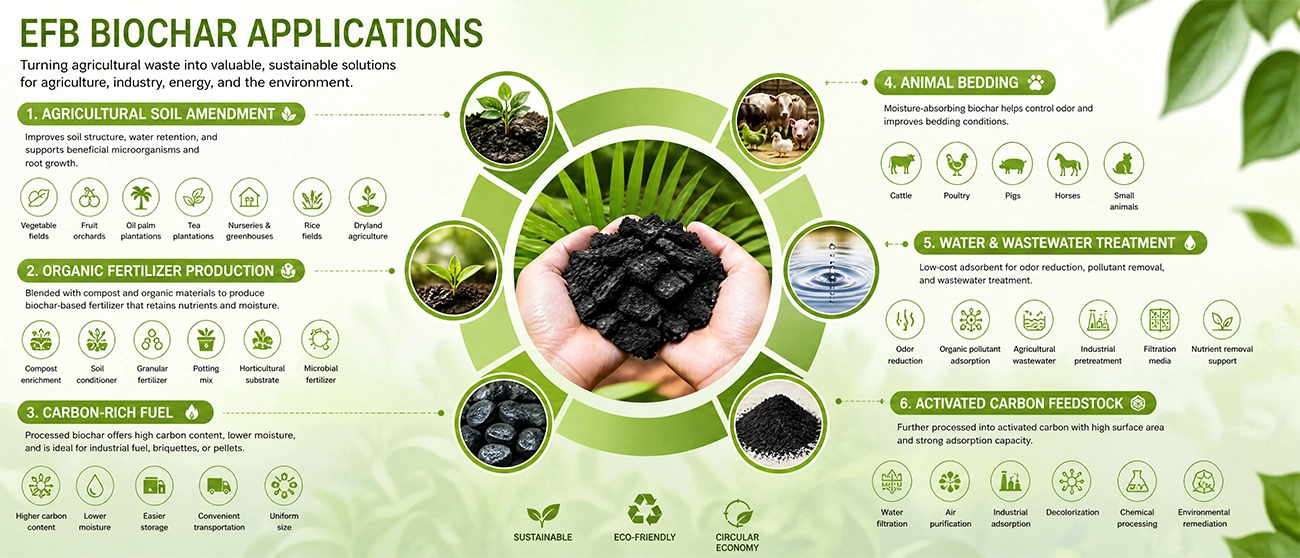
EFB biochar can be used as a soil amendment to improve soil structure and water retention. Its porous structure may help create a better environment for beneficial microorganisms and root growth.
Biochar can be applied to:
Biochar should generally be mixed with compost, fertilizer, manure, or other nutrient sources before agricultural use. Testing is recommended to determine the appropriate application rate for each soil type.
EFB biochar can be blended with compost and organic materials to produce biochar-based fertilizer. Its porous surface can help retain nutrients and moisture.
Manufacturers can use biochar in:
After proper processing, EFB biochar can be used as a solid fuel for selected industrial applications. It can also be further processed into briquettes or pellets.
Biochar fuel offers:
Fuel applications must consider ash content, calorific value, emissions, and local safety requirements.
Some types of clean, properly processed biochar may be used as animal bedding material. Its moisture-absorbing structure can help control odor and improve bedding conditions.
Before use in animal-related applications, the biochar must meet appropriate hygiene, contamination, and safety requirements.
Biochar can be used as a low-cost adsorbent for certain water treatment applications. Its performance depends on surface area, pore structure, ash content, pH, and activation method.
Potential applications include:
For advanced purification, EFB biochar may need additional activation, grinding, washing, or chemical treatment.
EFB biochar can be further processed into activated carbon through physical or chemical activation. Activated carbon generally has a higher surface area and stronger adsorption capacity than ordinary biochar.
This creates opportunities for manufacturers working in:
Environmental remediation
Water filtration
Air purification
Industrial adsorption
Decolorization
Chemical processing
| Model | XY-800 | XY-1000 | XY-1200 | XY-1500 | XY-1800 | XY-2000 |
| Number of cylinder layers | Single | Single | Double | Double | Double | Double |
| Cylinder diameter | 800mm | 1000mm | 1200/700mm | 1500/900mm | 1800/1200mm | 2000/1500mm |
| Capacity | 200-300kg/h | 300-400kg/h | 450-600kg/h | 600-800kg/h | 800-1000kg/h | 1000-1200kg/h |
| Cylinder material | 309S/310S/316L | 309S/310S/316L | 309S/310S/316L | 309S/310S/316L | 309S/310S/316L | 309S/310S/316L |
| Temerature | 500-800ºC | 500-800ºC | 500-800ºC | 500-800ºC | 500-800ºC | 500-800ºC |
| Carbonization time | 20-60min | 20-60min | 20-60min | 20-60min | 20-60min | 20-60min |
| Raw material particle size | ≤4cm | ≤4cm | ≤4cm | ≤4cm | ≤4cm | ≤4cm |
| Heating method | indirect heating | indirect heating | indirect heating | indirect heating | indirect heating | indirect heating |
| Operation mode | continuously working | continuously working | continuously working | continuously working | continuously working | continuously working |
| Control method | PLC control | PLC control | PLC control | PLC control | PLC control | PLC control |
Frequently asked questions
Here are answers to some frequently asked questions about skid-mounted carbonization furnaces. If you have any other questions, please feel free to contact our customer service team directly, and we will be happy to provide you with a detailed explanation.
Both continuous and batch-type systems are available. Continuous kilns are generally suitable for larger, stable production, while batch systems are useful for flexible or smaller-scale projects.
Yes. Pyrolysis gas can be collected and burned as a heat source after start-up. This helps reduce external fuel consumption.
The output depends on moisture content, ash content, pyrolysis temperature, residence time, and feedstock characteristics. A detailed estimate should be based on the customer’s actual EFB data.
The kiln is designed to reduce uncontrolled burning and improve biomass utilization. Combustible gas recycling and exhaust treatment can help control emissions. The final system should comply with local environmental regulations.
To prepare a suitable proposal, provide the EFB availability, moisture content, expected capacity, target biochar application, operating hours, available site area, electricity conditions, and required automation level.