 Henan Xuye Machinery Equipment Co., Ltd.
SEARCH WHAT YOU WANT
Search allProductNews
SEARCH
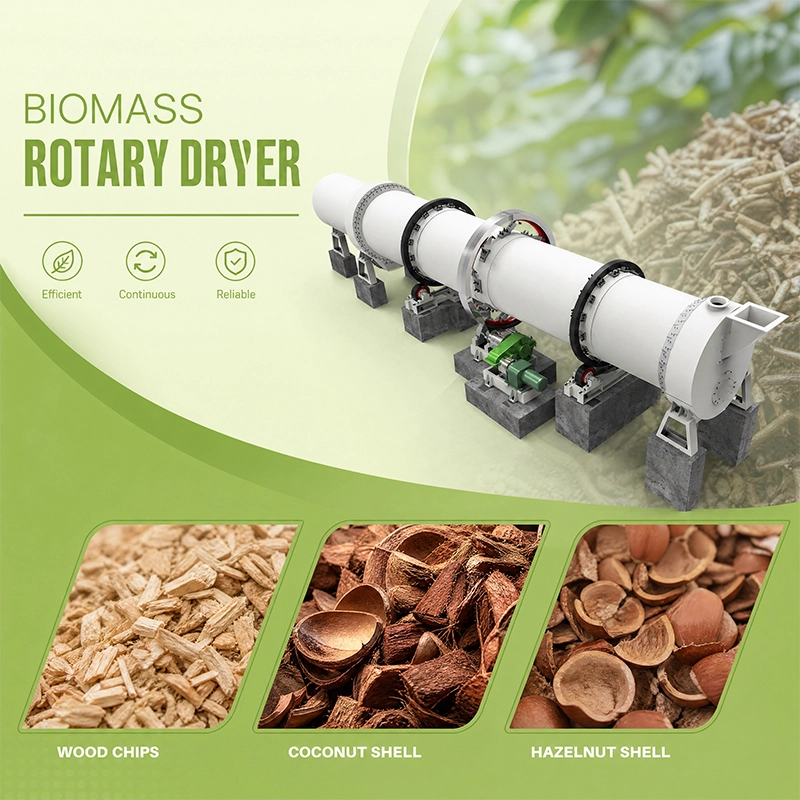
The Biomass Rotary Drum Dryer is a heavy-duty, continuous drying system engineered to reduce the moisture content of raw biomass materials — wood chips, sawdust, bark, straw, bagasse, rice husk, and similar agricultural and forestry residues — to the target moisture level required for pellet production, briquetting, combustion fuel, or downstream biomass processing. As a core piece of equipment in biomass energy and wood-processing supply chains, the rotary drum dryer is built to handle the high volumes, variable moisture content, and physically demanding material characteristics typical of raw biomass feedstock, delivering consistent, uniform drying performance around the clock.
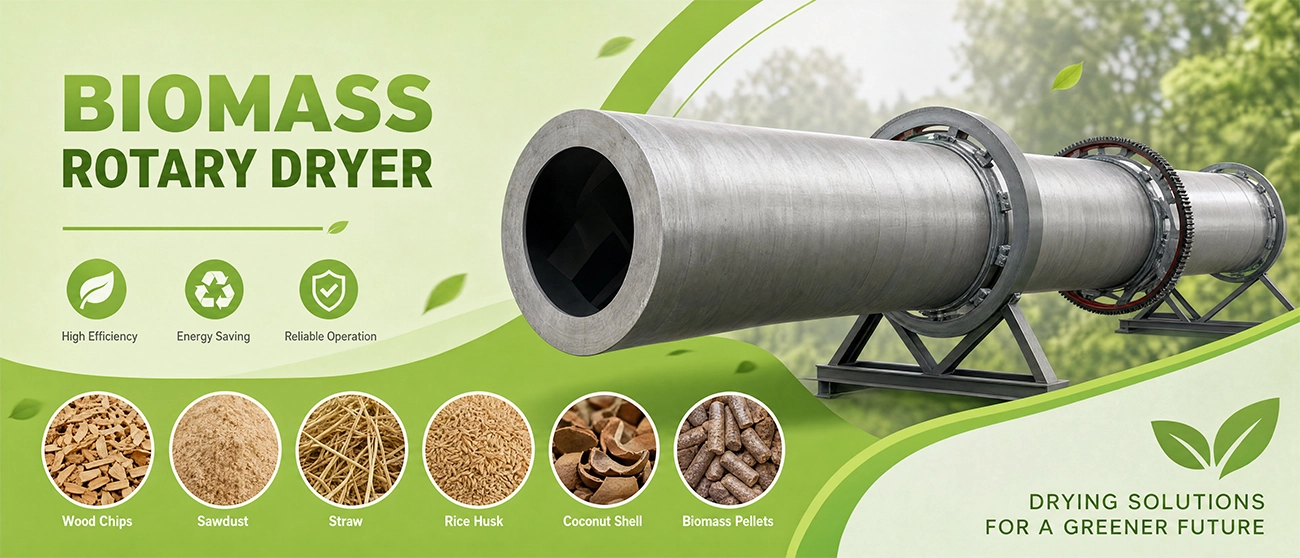
Raw biomass feedstock — freshly harvested wood chips, mill residue sawdust, agricultural crop residues, and similar materials — typically arrives with moisture content ranging from 30% to 60% or higher, depending on the source material, season, and storage conditions. This moisture level is far too high for most downstream biomass applications:
A properly sized and configured biomass rotary drum dryer addresses all of these challenges by reducing feedstock moisture to the target specification in a continuous, high-throughput process, positioning the dried material for reliable downstream processing and improved fuel value.
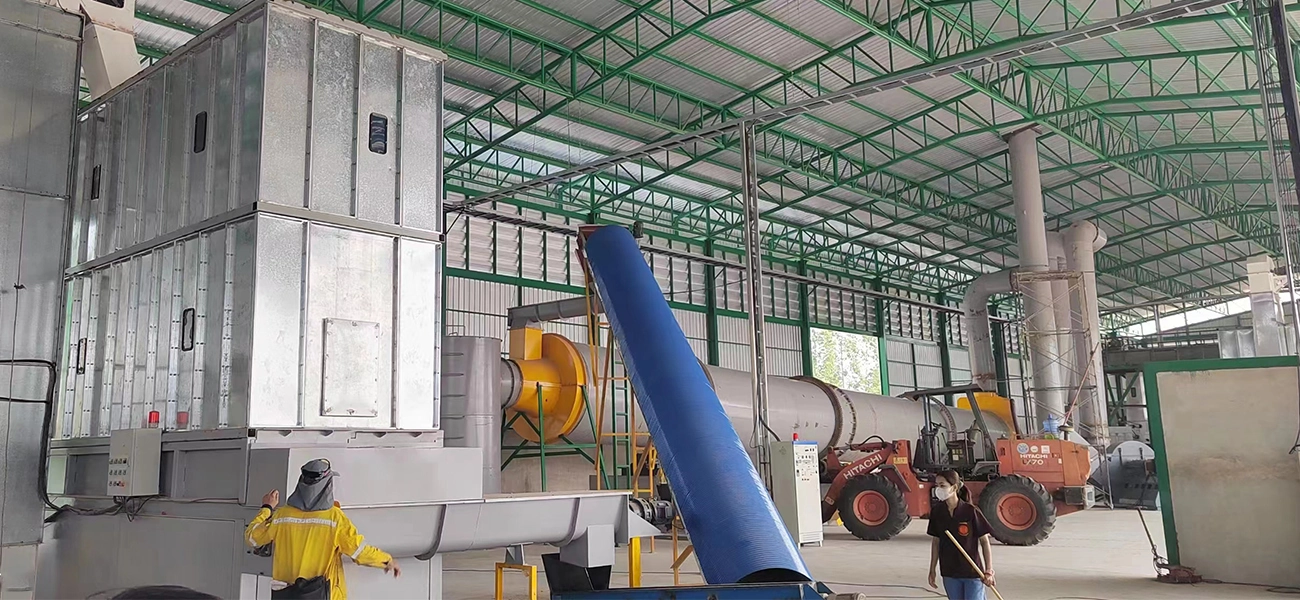
A biomass rotary drum dryer consists of a large-diameter, slightly inclined rotating cylindrical drum fitted with internal lifting flights. Wet biomass material is continuously fed into the drum at the elevated inlet end, where it is exposed to a stream of hot drying gas — generated by a dedicated heat source — as it travels the length of the drum toward the discharge end.
1. Material Feed — Wet biomass, typically pre-sized by chipping, shredding, or hammer milling to a relatively uniform particle size, is fed into the drum’s inlet housing via a screw conveyor, belt conveyor, or similar metering feed system that ensures a steady, controlled material feed rate.
2. Tumbling and Lifting Action — As the drum rotates continuously (typically at a relatively slow rotational speed engineered for the specific material and drum size), the internal lifting flights repeatedly lift the biomass material and let it cascade, or shower, down through the passing hot air/gas stream. This continuous tumbling action exposes fresh material surfaces to the drying medium, dramatically increasing the effective heat and mass transfer surface area compared to static drying methods.
3. Heat and Moisture Transfer — The hot drying gas — which may be direct combustion gas from a biomass, coal, natural gas, or other fuel-fired furnace, or in some designs, indirect heated air — evaporates surface and internal moisture from the tumbling material as it passes through the drum. Airflow configuration can be co-current (hot air and material flow in the same direction, generally preferred for reducing fire risk with combustible biomass materials since the hottest air meets the wettest, coolest material) or counter-current (opposing flow direction, used in certain designs where more aggressive final moisture reduction is required).
4. Discharge — Dried material exits the drum at the lower discharge end, assisted by the drum’s slight incline and continuous rotation, and is conveyed to downstream processing — such as a pellet mill, briquetting press, storage silo, or combustion boiler feed system — while exhaust gas, now carrying evaporated moisture and entrained fine particulate, passes through cyclone separators and/or bag filter dust collection equipment before release to atmosphere.
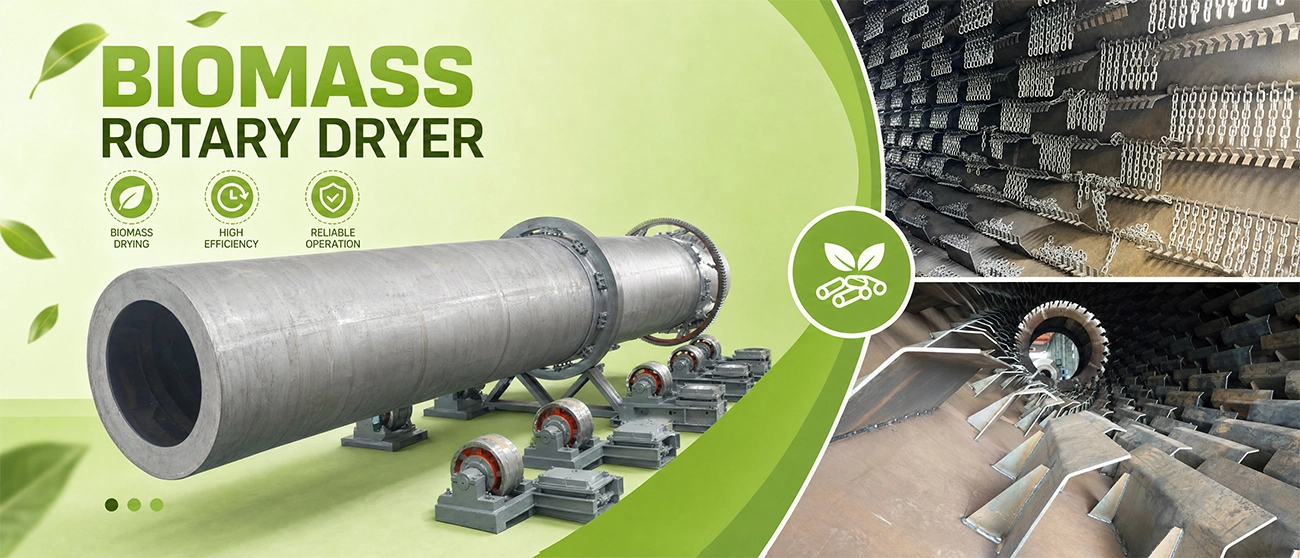
The rotating drum shell is fabricated from heavy-gauge carbon steel plate, rolled and welded to precise cylindrical tolerances and reinforced as needed to withstand the combined mechanical loading of the material bed, internal flighting, and continuous rotational operation over the equipment’s long service life. Wear-resistant lining options are available for the inlet zone and other high-abrasion areas where coarse or abrasive biomass material contacts the drum surface most aggressively.
Internal flight geometry, spacing, and configuration are engineered specifically around the physical characteristics of the biomass material being processed — particle size, shape, bulk density, and moisture content all influence optimal flight design. Properly designed flighting maximizes the showering and tumbling action that drives efficient drying while minimizing material buildup, flight blinding, or uneven bed distribution across the drum’s cross-section.
The loaded drum rests on precision-machined riding rings supported by roller assemblies positioned along the drum’s length, distributing the substantial rotating weight evenly across the support structure while enabling smooth, low-friction rotation. Proper riding ring and roller alignment is critical to long-term mechanical reliability and minimizing uneven wear, particularly given the significant loaded weight of large-diameter biomass dryers processing high material volumes.
The drum is rotated via a girth gear and pinion arrangement or friction drive configuration, sized to the torque requirements of the specific drum diameter, length, and loaded material weight. Variable-speed drive control allows operators to adjust rotational speed to fine-tune material residence time in response to changing feedstock moisture content or particle characteristics — an important operational flexibility given the natural variability of raw biomass feedstock from batch to batch or season to season.
Sealed inlet and discharge housings minimize both false air infiltration (which reduces drying efficiency and destabilizes the process air balance) and dust or material escape at these transition points between the rotating drum and stationary equipment.
Given the combustible nature of dried biomass material and biomass dust, safety systems are a critical design consideration for biomass rotary dryers, particularly at higher operating temperatures. Available safety features include spark detection and suppression systems at key points in the process airflow, temperature monitoring with automatic shutdown interlocks, explosion venting on ductwork and dust collection equipment, and emergency material discharge or dump gate systems designed to rapidly clear the drum in the event of an overheat or fire condition. Facility-specific fire and explosion protection design should be developed in accordance with applicable local fire codes and industry safety standards (such as NFPA guidance for biomass and dust handling systems, where applicable to your jurisdiction).
Standard instrumentation includes inlet and outlet temperature monitoring, drum rotational speed control, and material feed rate monitoring, with control system design ready for integration into facility-level PLC and automation systems supporting centralized process monitoring, data logging, and automated safety interlocks.
Wood pellet manufacturing is one of the largest application areas for biomass rotary drum dryers, where raw sawdust, wood shavings, and wood chip feedstock must be dried to the tight moisture specification required for consistent pellet binding and mill performance. Both single-pass and triple-pass configurations are widely used across this industry depending on facility scale and feedstock characteristics.
Sawmills and wood products manufacturing facilities use rotary drum dryers to process bark, sawdust, and other mill residue byproducts into dried material suitable for sale as fuel, further processing into pellets or briquettes, or use as a biomass boiler fuel source within the same facility — turning a waste stream into a value-added product.
Straw, bagasse (sugarcane residue), rice husk, corn stover, and similar agricultural residues are increasingly processed through rotary drum drying as part of biomass energy and biofuel production supply chains, supporting renewable energy initiatives that convert agricultural byproducts into usable fuel or feedstock material.
Biomass-fired power plants and combined heat and power (CHP) facilities use rotary drum dryers to condition fuel feedstock moisture content ahead of combustion, improving boiler efficiency and combustion stability compared to burning high-moisture, as-received biomass material directly.
Similar to pellet production, briquetting processes require biomass feedstock dried to a controlled moisture range to achieve proper compaction and briquette durability, making rotary drum drying a standard upstream processing step in briquette manufacturing facilities.
Bark and wood residue processed for landscaping mulch and similar horticultural products are sometimes dried using rotary drum equipment to achieve target moisture and handling characteristics for packaging and distribution.
| Model | Cylinder diameter(mm) | Cylinder length(mm) | Cylinder volume(m3) | Cylinder rotary speed (r/min) | Power(kW) | Weight(t) |
| 0.6×5.8 | 600 | 5800 | 1.7 | 1-8 | 3 | 2.9 |
| 0.8×8 | 800 | 8000 | 4 | 1-8 | 4 | 3.5 |
| 1×10 | 1000 | 10000 | 7.9 | 1-8 | 5.5 | 6.8 |
| 1.2×5.8 | 1200 | 5800 | 6.8 | 1-6 | 5.5 | 6.7 |
| 1.2×8 | 1200 | 8000 | 9 | 1-6 | 5.5 | 8.5 |
| 1.2×10 | 1200 | 10000 | 11 | 1-6 | 7.5 | 10.7 |
| 1.2×11.8 | 1200 | 11800 | 13 | 1-6 | 7.5 | 12.3 |
| 1.5×8 | 1500 | 8000 | 14 | 1-5 | 11 | 14.8 |
| 1.5×10 | 1500 | 10000 | 17.7 | 1-5 | 11 | 16 |
| 1.5×11.8 | 1500 | 11800 | 21 | 1-5 | 15 | 17.5 |
| 1.5×15 | 1500 | 15000 | 26.5 | 1-5 | 15 | 19.2 |
| 1.8×10 | 1800 | 10000 | 25.5 | 1-5 | 15 | 18.1 |
| 1.8×11.8 | 1800 | 11800 | 30 | 1-5 | 18.5 | 20.7 |
| 1.8×15 | 1800 | 15000 | 38 | 1-5 | 18.5 | 26.3 |
| 1.8×18 | 1800 | 18000 | 45.8 | 1-5 | 22 | 31.2 |
| 2×11.8 | 2000 | 11800 | 37 | 1-4 | 18.5 | 28.2 |
| 2×15 | 2000 | 15000 | 47 | 1-4 | 22 | 33.2 |
| 2×18 | 2000 | 18000 | 56.5 | 1-4 | 22 | 39.7 |
| 2×20 | 2000 | 20000 | 62.8 | 1-4 | 22 | 44.9 |
| 2.2×11.8 | 2200 | 11800 | 44.8 | 1-4 | 22 | 30.5 |
| 2.2×15 | 2200 | 15000 | 53 | 1-4 | 30 | 36.2 |
| 2.2×18 | 2200 | 18000 | 68 | 1-4 | 30 | 43.3 |
| 2.2×20 | 2200 | 20000 | 76 | 1-4 | 30 | 48.8 |
| 2.4×15 | 2400 | 15000 | 68 | 1-4 | 30 | 43.7 |
| 2.4×18 | 2400 | 18000 | 81 | 1-4 | 37 | 53 |
| 2.4×20 | 2400 | 20000 | 91 | 1-4 | 37 | 60.5 |
| 2.4×23.6 | 2400 | 23600 | 109 | 1-4 | 45 | 69.8 |
| 2.8×18 | 2800 | 18000 | 111 | 1-3 | 45 | 62 |
| 2.8×20 | 2800 | 20000 | 123 | 1-3 | 55 | 65 |
| 2.8×23.6 | 2800 | 23600 | 148 | 1-3 | 55 | 70 |
| 2.8×28 | 2800 | 28000 | 172 | 1-3 | 75 | 75 |
| 3×20 | 3000 | 20000 | 14 | 1-3 | 55 | 75 |
| 3×23.6 | 3000 | 23600 | 170 | 1-3 | 75 | 85 |
| 3×28 | 3000 | 28000 | 198 | 1-3 | 90 | 91 |
| 3.2×23.6 | 3200 | 23600 | 193 | 1-3 | 90 | 112 |
| 3.2×32 | 3200 | 32000 | 257 | 1-3 | 110 | 129 |
| 3.6×36 | 3600 | 36000 | 366 | 1-3 | 132 | 164 |
| 3.8×36 | 3800 | 36000 | 408 | 1-3 | 160 | 187 |
| 4×36 | 4000 | 36000 | 452 | 1-3 | 160 | 195 |
Frequently asked questions
Here are answers to some frequently asked questions about skid-mounted carbonization furnaces. If you have any other questions, please feel free to contact our customer service team directly, and we will be happy to provide you with a detailed explanation.
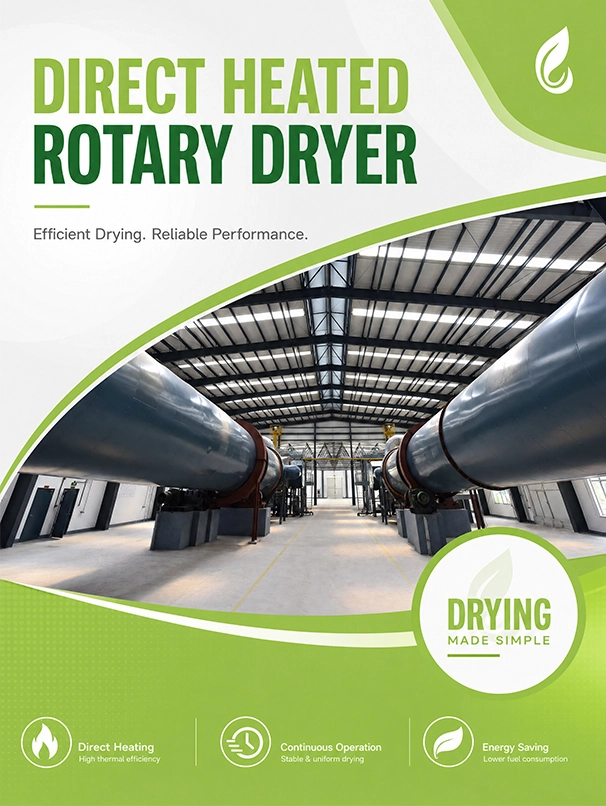
A direct heated rotary dryer brings the material into direct contact with hot combustion gases to dry it. An indirect heated rotary dryer, by contrast, uses a heating medium that does not contact the material directly; heat transfers through the drum shell wall via conduction. Direct dryers are more efficient and economical for most bulk solids applications.
Direct heated rotary dryers can process a wide range of materials including minerals (limestone, quartz sand, iron ore), aggregates (slag, coal, clay), agricultural products (fertilizers, animal feed), chemicals, and biomass. They are suitable for materials that are not sensitive to direct contact with hot combustion gases.
Thermal efficiency can reach 80% to 90% with proper design and operation. The efficiency depends on the temperature differential between inlet and exhaust gases, flight design, and the relationship between drum speed and material residence time.
Flights are essential for maximizing heat transfer. They pick up the material from the bottom of the drum, carry it up the side, and shower it through the hot gas stream. This cascading action creates maximum surface area contact between the material and the drying gases.
Proper sizing requires consideration of the material type, initial and final moisture content, required throughput, and heat source availability. Laboratory testing of the specific material is recommended for accurate sizing. Manufacturers can provide customized designs based on your specific requirements.