 Henan Xuye Machinery Equipment Co., Ltd.
SEARCH WHAT YOU WANT
Search allProductNews
SEARCH
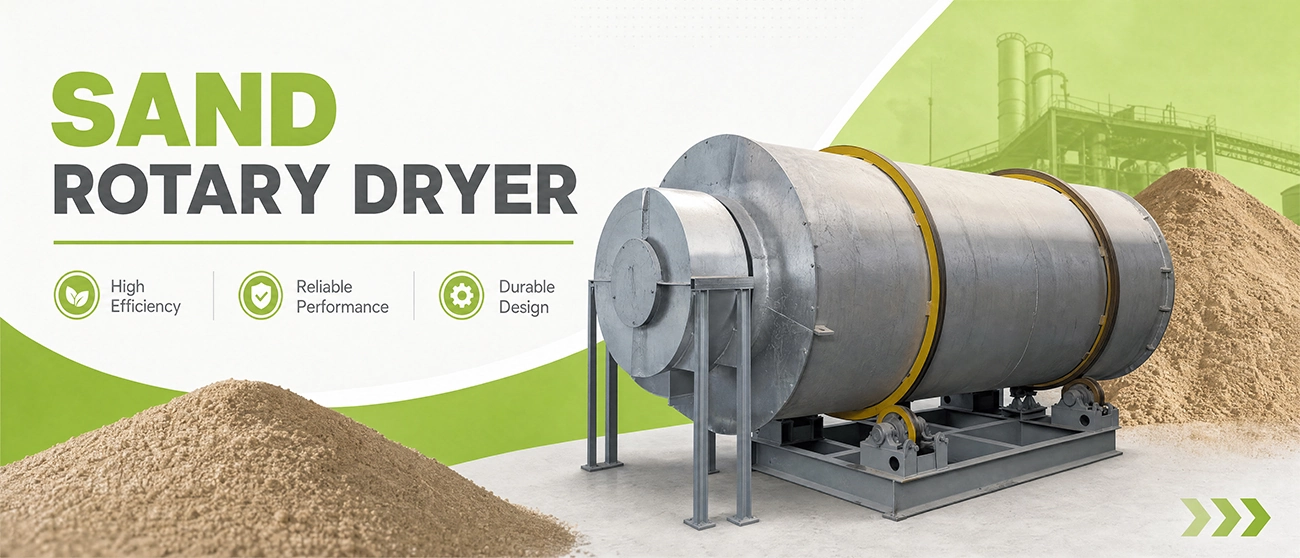
A Sand Rotary Dryer is an industrial drying machine designed to continuously remove moisture from sand and other granular mineral materials. It is widely used in construction materials, foundries, glass manufacturing, mining, cement plants, aggregate processing, and mineral processing industries.
The rotary dryer uses a rotating cylindrical drum to continuously lift, scatter, and tumble wet sand while hot air passes through the material. This creates intensive contact between the hot gas and wet particles, allowing moisture to evaporate efficiently.
Compared with simple stationary drying equipment, a rotary sand dryer offers continuous operation, large processing capacity, stable drying performance, and flexible fuel options. Depending on the application, the system can be equipped with a gas burner, biomass furnace, coal-fired hot air furnace, or other suitable heat source.
For sand with high initial moisture content, the drying system can be designed with suitable feeding, heating, dust collection, and material conveying equipment to create a complete sand drying line.
Sand can contain a considerable amount of surface moisture after washing, mining, dredging, or screening. Excess moisture can affect transportation, screening, mixing, storage, and downstream processing.
A sand rotary dryer provides a practical solution for continuous industrial-scale drying.
Rotary dryers can handle large quantities of sand continuously. The drum diameter, drum length, lifting flights, air volume, and heat source can be designed according to the required capacity.
This makes the equipment suitable for both small and large-scale industrial applications.
Unlike batch drying equipment, a rotary dryer can continuously feed wet sand and continuously discharge dried material.
This is particularly useful for production lines that operate for long periods and require stable material flow.
The internal lifting flights repeatedly lift and distribute the sand inside the drum.
As the sand falls through the hot gas stream, a large contact area is created between the material and drying air. This improves heat and mass transfer and helps accelerate moisture evaporation.
The final moisture content can be controlled by adjusting operating parameters such as:
The actual operating conditions should be determined according to the characteristics of the sand and the required final moisture.
A sand drying system can be configured with different heat sources depending on local fuel availability and operating costs.
Possible heat sources include:
Other suitable thermal energy sources
Natural gas
LPG
Diesel
Biomass
Coal
Hot air from an existing industrial process
The working principle of a sand rotary dryer is based on the transfer of heat from a hot gas stream to wet material.
Wet sand is transported into the dryer through a conveyor, screw feeder, bucket elevator, or other suitable feeding equipment.
A controlled feeding system helps maintain stable material flow and consistent drying performance.
A heating system generates the required hot air.
Depending on the customer’s fuel and site conditions, the system may use a gas burner, biomass furnace, coal-fired furnace, or another suitable heat source.
Inside the rotating drum, specially designed lifting flights lift the sand as the drum rotates.
When the material reaches a certain height, it falls downward through the hot air.
This repeated lifting and falling action increases the contact area between the sand and hot air.
Heat is transferred from the hot gas to the wet sand.
The water contained on the surface of the particles evaporates and is carried away by the exhaust gas.
As the sand moves through the drum, its moisture content gradually decreases.
After sufficient residence time inside the drum, the dried sand moves toward the discharge end.
The dried product can then be transported to storage, screening, packaging, or another processing stage.
Exhaust gas from the dryer may contain fine sand particles and dust.
A dust collection system such as a cyclone separator, bag filter, or other suitable equipment can be installed to reduce dust emissions and recover fine material.
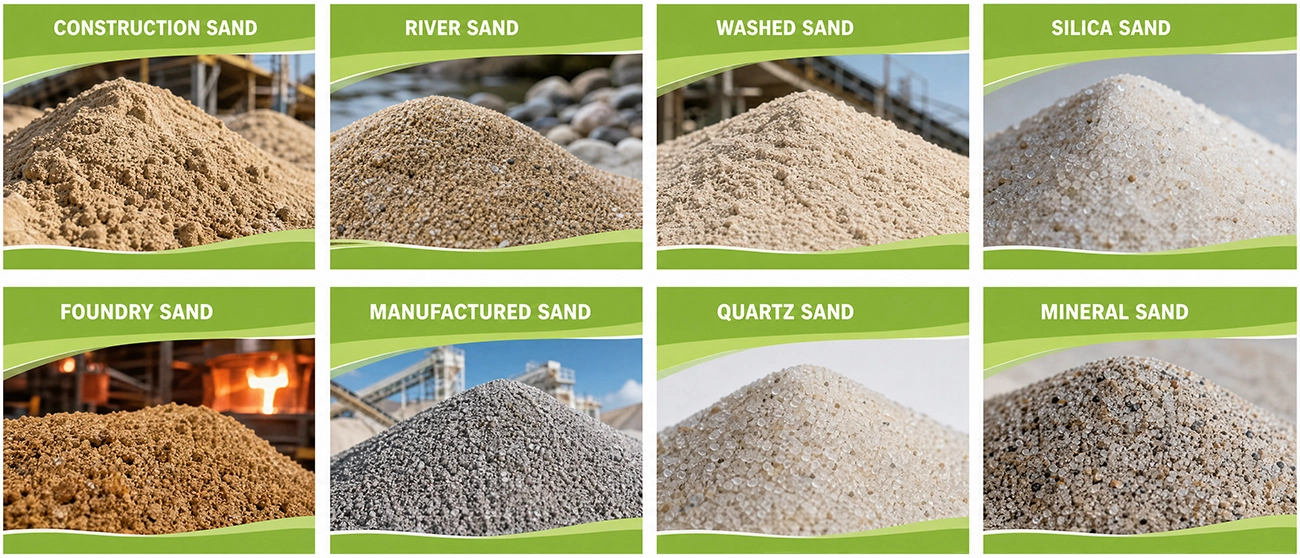
The sand rotary dryer can be used for many types of sand and mineral materials.
Construction sand may contain significant surface moisture after washing or outdoor storage.
Drying the sand before mixing, screening, packaging, or further processing can improve production stability.
River sand often contains moisture after extraction and washing. A rotary dryer can continuously reduce the moisture content before the sand enters subsequent processing equipment.
Washed sand is commonly processed with water, resulting in high surface moisture. A sand dryer can be installed after washing and dewatering equipment to reduce the remaining moisture.
Silica sand used in glass, foundry, ceramics, filtration, and other industrial applications may require controlled drying before further processing.
The dryer can be designed according to the particle size and temperature requirements of the silica sand.
Drying foundry sand can help maintain consistent material conditions before molding, mixing, recycling, or other foundry processes.
Temperature and residence time should be carefully controlled when processing specialized foundry materials.
Manufactured sand produced by crushing and screening stone may require drying before storage or downstream processing, particularly when it has been washed.
Quartz sand can be dried using rotary drying technology when the material and process conditions are compatible with the required drying temperature.
Various granular mineral materials can also be processed using rotary dryers, provided their particle characteristics and thermal properties are suitable for rotary drying.
| Model | Cylinder data | Capacity(t/h) | Cylinder rotary speed(r/min) | Power(kW) | ||||
| Outer cylinder diameter(m) | Outer cylinder length(m) | Cylinder volume(m3) | River sand | Fly ash | Slag | |||
| S6203 | 1.6 | 1.8 | 3.6 | 2-3 | 1-2 | 1-2 | 3-10 | 4 |
| S6205 | 2 | 2 | 6.28 | 4-5 | 2-3 | 3-4 | 3-10 | 5.5 |
| S6210 | 2.2 | 2.5 | 9.5 | 8-10 | 4-5 | 6-8 | 3-10 | 7.5 |
| S6215 | 2.5 | 2.8 | 13.7 | 12-15 | 7-8 | 10-12 | 3-10 | 11 |
| 2×4 | 2 | 4 | 12.56 | 8-12 | 4-6 | 8-10 | 3-10 | 3×2 |
| 2×5 | 2 | 5 | 15.7 | 12-15 | 6-7 | 10-13 | 3-10 | 4×2 |
| 2×6 | 2 | 6 | 18.84 | 20-25 | 10-17 | 20-27 | 3-10 | 7.5×2 |
| 2.2×4.5 | 2.2 | 4.5 | 17.09 | 14-18 | 7-9 | 12-15 | 3-10 | 5.5×2 |
| 2.5×6 | 2.5 | 6.5 | 31.89 | 23-28 | 10-13 | 20-22 | 3-10 | 5.5×4 |
| 2.7×7 | 2.7 | 7 | 40.5 | 30-35 | 20-25 | 27-45 | 3-10 | 7.5×4 |
| 2.8×6 | 2.8 | 6 | 36.9 | 30-35 | 15-18 | 25-30 | 3-10 | 5.5×4 |
| 3×6 | 3 | 6 | 42.39 | 35-40 | 18-20 | 32-35 | 3-10 | 7.5×4 |
| 3×7 | 3 | 7 | 49.46 | 40-45 | 20-25 | 35-40 | 3-10 | 7.5×4 |
| 3.2×7 | 3.2 | 7 | 56.26 | 45-50 | 25-30 | 40-45 | 3-10 | 11×4 |
| 3.2×8 | 3.2 | 8 | 64.3 | 50-55 | 30-35 | 45-50 | 3-10 | 11×4 |
| 3.6×8 | 3.6 | 8 | 81.38 | 60-70 | 35-40 | 60-65 | 3-10 | 15×4 |
| 3.8×9 | 3.8 | 9 | 102 | 70-80 | 40-45 | 70-75 | 3-10 | 15×4 |
| 4×10 | 4 | 10 | 125.6 | 90-100 | 45-50 | 80-90 | 3-10 | 18.5×4 |
| 4.2×8.5 | 4.2 | 8.5 | 117.7 | 80-100 | 45-60 | 80-90 | 3-10 | 18.5×4 |