 Henan Xuye Machinery Equipment Co., Ltd.
SEARCH WHAT YOU WANT
Search allProductNews
SEARCH
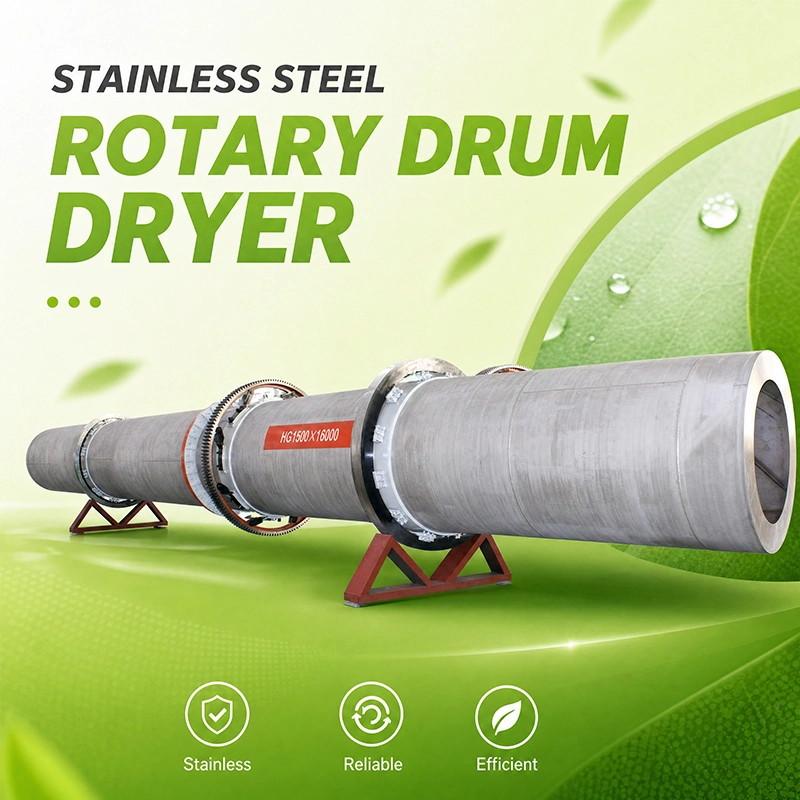
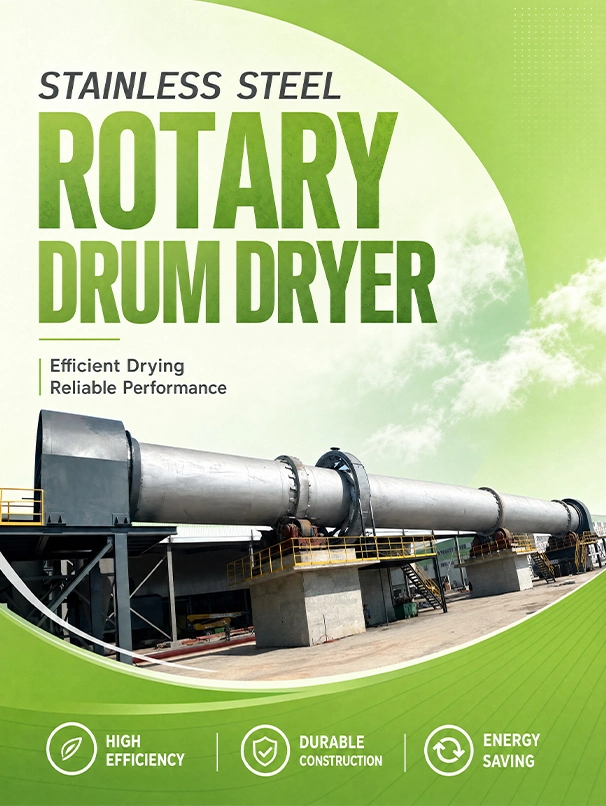
The Stainless Steel Rotary Dryer is a continuous, high-capacity drying system engineered for industries where corrosion resistance, hygienic construction, and product purity are non-negotiable. Built entirely in 304 or 316L stainless steel — from the rotating drum shell to the internal lifting flights, seals, and product-contact surfaces — this equipment is designed to dry powders, granules, crystals, and fibrous materials reliably around the clock, without the surface degradation, flaking, or contamination risk associated with carbon steel or coated equipment.
Whether you’re drying food ingredients, pharmaceutical intermediates, fine chemicals, fertilizers, or specialty minerals, a stainless steel rotary dryer delivers the combination of thermal drying performance and material integrity that stricter industries increasingly require. Unlike batch dryers or smaller-scale drying equipment, the rotary dryer format is purpose-built for continuous, high-throughput operation, making it the standard choice for production lines that cannot afford downtime for cleaning-related equipment failure, corrosion-driven maintenance, or inconsistent drying results.
Carbon steel rotary dryers depend on a protective coating, paint system, or refractory lining to resist corrosion from moisture, acidic vapors, or chemically reactive dust generated during the drying process. Over time, these protective layers wear, chip, or crack — especially at high-friction points like the internal lifting flights, drum seams, and discharge chute — exposing the underlying carbon steel to corrosion. Once corrosion begins, it typically accelerates, leading to pitting, material loss, and eventually costly unplanned repairs or premature equipment replacement.
Stainless steel eliminates this failure mode at the source. Because corrosion resistance is a property of the alloy itself rather than an applied coating, a stainless steel rotary dryer maintains consistent corrosion protection across its entire service life, including in high-wear zones like the internal flighting where coatings typically fail first. This is particularly critical for materials that are acidic, alkaline, hygroscopic, or otherwise chemically aggressive — as well as for any process involving regular wet cleaning or wash-down, where humidity and standing moisture would quickly attack unprotected carbon steel.
Food safety and pharmaceutical manufacturing standards increasingly demand equipment that can be thoroughly cleaned and visually inspected between production runs, with minimal risk of harboring bacteria, mold, or cross-contaminating residues. Stainless steel’s smooth, non-porous surface is inherently easier to clean and sanitize than painted or coated carbon steel, and its resistance to pitting and surface degradation means the surface stays smooth and cleanable over years of operation rather than developing the microscopic surface roughness that corroded or worn coatings eventually exhibit.
Sanitary design details — including continuous, ground-smooth welds at the drum seams, minimized internal ledges or dead zones where material could accumulate, and accessible inspection points at the feed and discharge ends — are standard features of our stainless steel rotary dryer construction, supporting compliance with food-grade and pharmaceutical cleanliness expectations.
For high-value or sensitive products, the drying equipment itself can become a source of quality defects if it degrades over time. Rust particles, flaking coating material, or corrosion byproducts can contaminate the dried product, causing discoloration, off-specification purity results, or outright batch rejection. Because stainless steel does not rust, flake, or leach material into the product stream, it protects both the visual quality and chemical purity of your finished dried product — an especially important consideration for food ingredients, pharmaceutical actives, and specialty chemicals where even trace contamination can be costly.
While the initial material cost of stainless steel construction is higher than carbon steel, this upfront investment is frequently offset — and often exceeded — by the elimination of recurring costs associated with carbon steel degradation: periodic recoating or relining, unplanned downtime for corrosion-related repairs, batch losses from contamination events, and premature full equipment replacement. For facilities running continuous, high-volume production, or processing corrosive or hygiene-sensitive materials, stainless steel construction is frequently the lower total-cost-of-ownership choice over the equipment’s full operating life, even though the sticker price is higher on day one.
Stainless steel rotary dryers are engineered specifically for sustained, round-the-clock industrial production — not intermittent or small-batch drying. The rotating drum design, combined with a continuous material feed and discharge, allows the dryer to process a steady stream of wet material and deliver consistent moisture reduction hour after hour, shift after shift, without the cycle-time penalties inherent to batch drying equipment.
At its core, a rotary dryer is a slightly inclined, slowly rotating cylindrical drum equipped with internal lifting flights arranged along its interior wall. The drying process unfolds in a continuous, four-stage flow:
1. Material Feed — Wet material enters the drum at the elevated feed end, typically through a sealed inlet housing designed to minimize air infiltration and prevent material spillage at the point of entry.
2. Tumbling and Showering — As the drum rotates, the internal lifting flights repeatedly lift the material and let it cascade, or “shower,” down through the drum’s cross-section. This tumbling action continuously exposes fresh material surfaces to the surrounding air stream, dramatically increasing the effective contact area between the wet material and the hot drying air compared to static or lightly agitated drying methods.
3. Hot Air Contact and Moisture Evaporation — A stream of hot air, generated by a dedicated heat source, flows through the drum as the material showers through it. Depending on the process design, this airflow can move in the same direction as the material flow (co-current configuration, generally preferred for heat-sensitive materials since the hottest air contacts the wettest material, allowing rapid initial evaporative cooling) or in the opposite direction (counter-current configuration, often preferred when a lower final moisture content or more thorough drying is required, since the driest material meets the hottest air just before discharge). The combination of tumbling agitation and hot air contact drives moisture evaporation efficiently and uniformly as material travels the length of the drum.
4. Discharge and Air Handling — By the time material reaches the lower, discharge end of the drum — assisted by the drum’s slight incline and rotational movement — it has reached the target final moisture content and exits through a sealed discharge housing into downstream handling equipment (conveyors, coolers, or packaging systems, depending on the production line). Simultaneously, the exhaust air stream, now carrying the evaporated moisture along with fine particulate carried up from the tumbling material, is drawn through ductwork to a dust collection system — typically a cyclone separator and/or bag filter — which recovers fine product particles and ensures the exhaust air meets emission requirements before release.
The drum’s rotational speed, angle of inclination, internal flight design, and air flow rate are all engineering variables that determine the material’s residence time inside the dryer and, ultimately, the final moisture content and drying uniformity achieved. Because these variables interact closely with the specific physical and thermal characteristics of each material, rotary dryer systems are typically engineered and tuned around the specific product being processed rather than sold as one-size-fits-all equipment.
The rotating drum shell is fabricated from 304 or 316L stainless steel plate, rolled and welded to precise cylindrical tolerances to ensure smooth, stable rotation. 304 stainless steel provides strong general-purpose corrosion resistance suitable for a wide range of standard drying applications, while 316L — which contains molybdenum for enhanced resistance to chlorides and more aggressive chemical environments — is recommended for materials with higher salinity, acidity, or specific chemical corrosivity. Material grade selection should be based on the specific chemistry of the material being dried, and our engineering team can advise on the appropriate choice for your process.
The internal lifting flights are the heart of the drying process, and their design is customized to the flow characteristics of each material. Sticky, cohesive materials, free-flowing granules, and fine powders each require different flight geometry, spacing, and configuration to achieve optimal tumbling and showering behavior without material buildup, flight blinding, or uneven drying. Flight design is one of the most important — and most frequently underestimated — engineering variables in rotary dryer performance, and is a key reason why proper equipment sizing should be based on real material testing or detailed material data rather than generic assumptions.
The feed inlet and discharge outlet are engineered with sanitary sealing systems designed to minimize both air infiltration (which reduces drying efficiency and can destabilize the internal air balance) and material leakage or dust escape at these transition points, where the rotating drum meets stationary housing components. These seals are also designed for straightforward inspection and maintenance access, supporting routine hygiene verification in food and pharmaceutical applications.
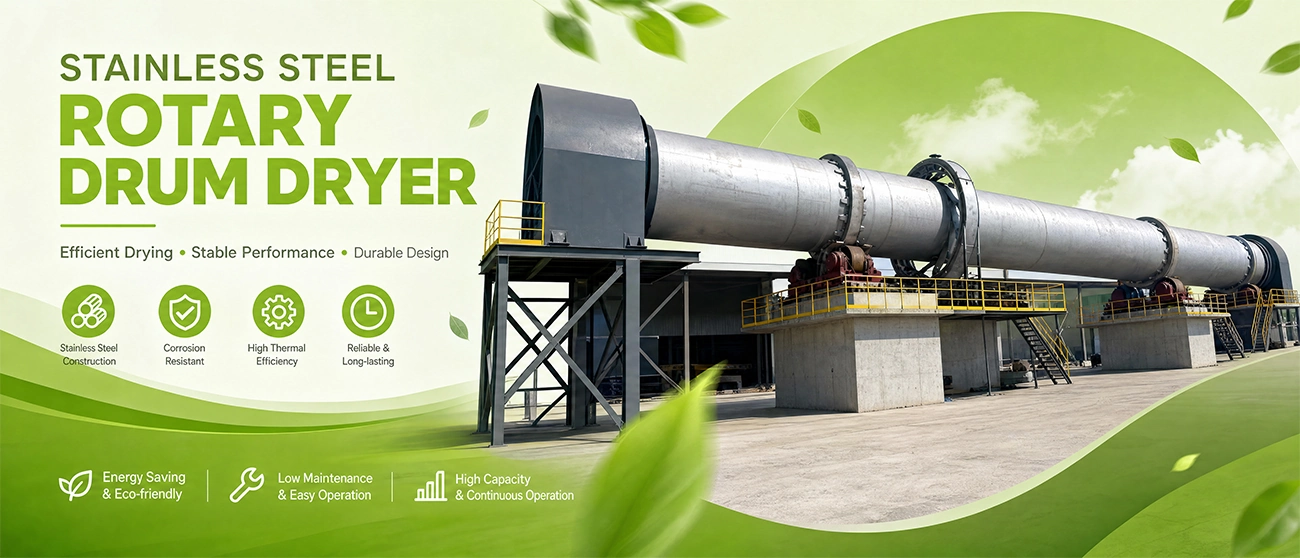
The drum rests on precision-machined riding rings supported by roller assemblies positioned along the drum’s length, allowing smooth, low-friction rotation while distributing the drum’s substantial loaded weight evenly across the support structure. Proper riding ring and roller alignment is essential to long-term mechanical reliability, minimizing uneven wear and vibration that could otherwise shorten equipment service life or affect drying consistency.
The drum is rotated via a girth gear and pinion arrangement, or alternatively a friction drive configuration depending on unit size and required torque characteristics. A variable-speed drive is available and commonly specified, allowing operators to adjust drum rotational speed to fine-tune material residence time and drying performance across different materials, moisture conditions, or seasonal production changes without requiring mechanical modification.
An insulated outer jacket is available for the drum shell, reducing external heat loss during operation, improving overall thermal efficiency and energy cost per unit of product dried, and reducing external surface temperature for improved personnel safety around the operating equipment.
Standard instrumentation includes temperature monitoring at the drum’s inlet and outlet, allowing operators to track drying performance and detect process deviations in real time. The control system is designed for integration with facility-level PLC and automation systems, supporting centralized process monitoring, data logging, and remote operational oversight as part of a broader production line control strategy.
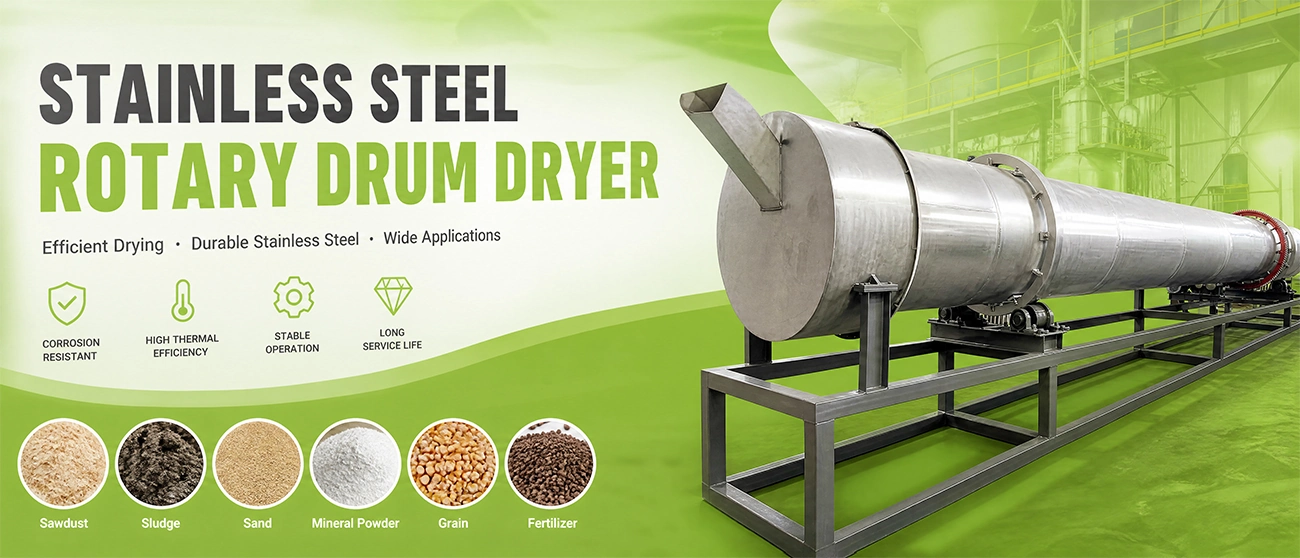
Stainless steel rotary dryers are widely used throughout food processing operations for drying food ingredients, powdered products, granulated food materials, and food-grade minerals. Sanitary construction, smooth cleanable surfaces, and freedom from rust or coating contamination risk make stainless steel the standard material choice wherever food safety compliance and product purity are production requirements.
Pharmaceutical intermediates, active pharmaceutical ingredients, and excipients require drying equipment that supports strict cleanliness protocols and minimizes cross-contamination risk between production batches. Stainless steel’s cleanability, corrosion resistance, and compatibility with validated cleaning procedures make it the appropriate material choice for pharmaceutical-grade rotary drying applications.
Specialty chemicals, fine chemical powders, and crystalline chemical products often present corrosive or chemically reactive properties that would rapidly degrade carbon steel equipment. Stainless steel rotary dryers provide the material compatibility needed to process these products reliably over extended operating campaigns without the progressive equipment degradation carbon steel would experience in the same service.
Granulated fertilizers and agricultural chemical products frequently involve corrosive or hygroscopic material properties that benefit from stainless steel’s corrosion resistance, extending equipment service life in an application where carbon steel dryers commonly experience accelerated wear.
Specialty minerals, pigments, and other industrial materials where product appearance, purity, and consistency directly affect end-use value are commonly processed using stainless steel rotary dryers, protecting both the material’s physical characteristics and the equipment’s long-term reliability.
| Model | Cylinder diameter(mm) | Cylinder length(mm) | Cylinder volume(m3) | Cylinder rotary speed (r/min) | Power(kW) | Weight(t) |
| 0.6×5.8 | 600 | 5800 | 1.7 | 1-8 | 3 | 2.9 |
| 0.8×8 | 800 | 8000 | 4 | 1-8 | 4 | 3.5 |
| 1×10 | 1000 | 10000 | 7.9 | 1-8 | 5.5 | 6.8 |
| 1.2×5.8 | 1200 | 5800 | 6.8 | 1-6 | 5.5 | 6.7 |
| 1.2×8 | 1200 | 8000 | 9 | 1-6 | 5.5 | 8.5 |
| 1.2×10 | 1200 | 10000 | 11 | 1-6 | 7.5 | 10.7 |
| 1.2×11.8 | 1200 | 11800 | 13 | 1-6 | 7.5 | 12.3 |
| 1.5×8 | 1500 | 8000 | 14 | 1-5 | 11 | 14.8 |
| 1.5×10 | 1500 | 10000 | 17.7 | 1-5 | 11 | 16 |
| 1.5×11.8 | 1500 | 11800 | 21 | 1-5 | 15 | 17.5 |
| 1.5×15 | 1500 | 15000 | 26.5 | 1-5 | 15 | 19.2 |
| 1.8×10 | 1800 | 10000 | 25.5 | 1-5 | 15 | 18.1 |
| 1.8×11.8 | 1800 | 11800 | 30 | 1-5 | 18.5 | 20.7 |
| 1.8×15 | 1800 | 15000 | 38 | 1-5 | 18.5 | 26.3 |
| 1.8×18 | 1800 | 18000 | 45.8 | 1-5 | 22 | 31.2 |
| 2×11.8 | 2000 | 11800 | 37 | 1-4 | 18.5 | 28.2 |
| 2×15 | 2000 | 15000 | 47 | 1-4 | 22 | 33.2 |
| 2×18 | 2000 | 18000 | 56.5 | 1-4 | 22 | 39.7 |
| 2×20 | 2000 | 20000 | 62.8 | 1-4 | 22 | 44.9 |
| 2.2×11.8 | 2200 | 11800 | 44.8 | 1-4 | 22 | 30.5 |
| 2.2×15 | 2200 | 15000 | 53 | 1-4 | 30 | 36.2 |
| 2.2×18 | 2200 | 18000 | 68 | 1-4 | 30 | 43.3 |
| 2.2×20 | 2200 | 20000 | 76 | 1-4 | 30 | 48.8 |
| 2.4×15 | 2400 | 15000 | 68 | 1-4 | 30 | 43.7 |
| 2.4×18 | 2400 | 18000 | 81 | 1-4 | 37 | 53 |
| 2.4×20 | 2400 | 20000 | 91 | 1-4 | 37 | 60.5 |
| 2.4×23.6 | 2400 | 23600 | 109 | 1-4 | 45 | 69.8 |
| 2.8×18 | 2800 | 18000 | 111 | 1-3 | 45 | 62 |
| 2.8×20 | 2800 | 20000 | 123 | 1-3 | 55 | 65 |
| 2.8×23.6 | 2800 | 23600 | 148 | 1-3 | 55 | 70 |
| 2.8×28 | 2800 | 28000 | 172 | 1-3 | 75 | 75 |
| 3×20 | 3000 | 20000 | 14 | 1-3 | 55 | 75 |
| 3×23.6 | 3000 | 23600 | 170 | 1-3 | 75 | 85 |
| 3×28 | 3000 | 28000 | 198 | 1-3 | 90 | 91 |
| 3.2×23.6 | 3200 | 23600 | 193 | 1-3 | 90 | 112 |
| 3.2×32 | 3200 | 32000 | 257 | 1-3 | 110 | 129 |
| 3.6×36 | 3600 | 36000 | 366 | 1-3 | 132 | 164 |
| 3.8×36 | 3800 | 36000 | 408 | 1-3 | 160 | 187 |
| 4×36 | 4000 | 36000 | 452 | 1-3 | 160 | 195 |
Frequently asked questions
Here are answers to some frequently asked questions about skid-mounted carbonization furnaces. If you have any other questions, please feel free to contact our customer service team directly, and we will be happy to provide you with a detailed explanation.
It can be used for drying chemical materials, minerals, powders, granules, sludge, food-related materials, pharmaceutical raw materials, and other industrial products, depending on the dryer design.
Stainless steel provides excellent corrosion resistance, high mechanical strength, easy cleaning, and good durability. It is particularly suitable for corrosive, wet, or demanding industrial applications.
Yes. Stainless steel dryers can be designed for corrosive materials. For highly corrosive chemicals, 316 stainless steel or other corrosion-resistant materials may be recommended.
Yes. A stainless steel dryer can be equipped with electric heating systems. Other heating options may include natural gas, biomass, steam, thermal oil, or other heat sources depending on the application.
The operating temperature depends on the material, dryer structure, stainless steel grade, and drying process. The required inlet and outlet temperatures should be determined according to the characteristics of the material.