 Henan Xuye Machinery Equipment Co., Ltd.
SEARCH WHAT YOU WANT
Search allProductNews
SEARCH
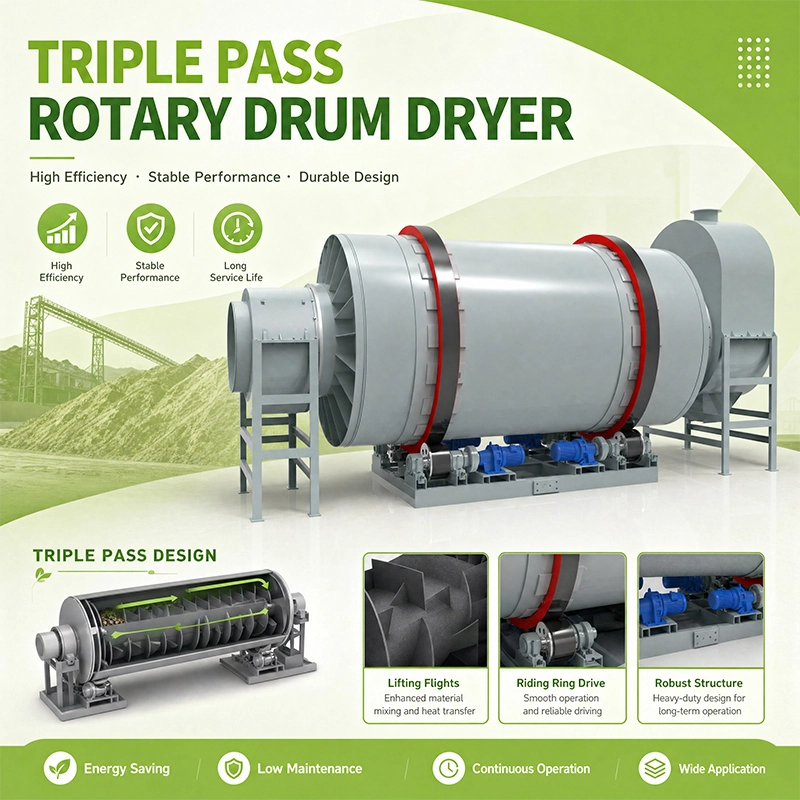
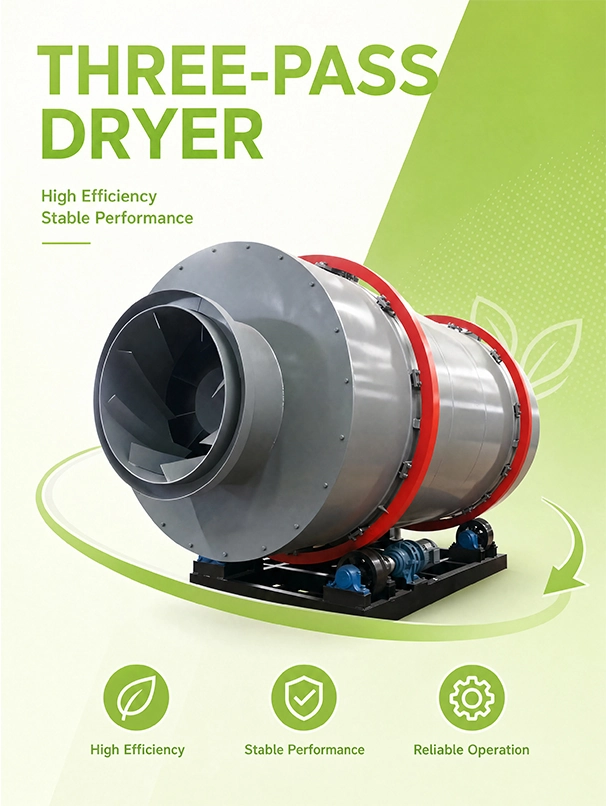
The Triple Pass Rotary Dryer is an industrial drying machine designed for continuous drying of bulk materials with high moisture content. With a multi-pass drum structure, the dryer allows hot gas and wet materials to exchange heat efficiently through multiple drying stages, making it suitable for large-scale material processing.
Our triple pass rotary dryers are mainly used for drying gypsum, sand, mineral powder, coal slime, fly ash, and other similar bulk materials. The equipment is widely used in mining, mineral processing, building materials, coal processing, chemical industries, and environmental applications.
Compared with conventional single-cylinder rotary dryers, the triple pass rotary dryer provides a more compact drying system, improved heat transfer, and efficient utilization of hot gas. It can be customized according to material characteristics, initial moisture content, final moisture requirements, processing capacity, and available heat source.
If you are looking for a reliable triple pass rotary dryer for gypsum, sand, mineral powder, coal slime or fly ash, our equipment can be designed according to your specific production requirements.
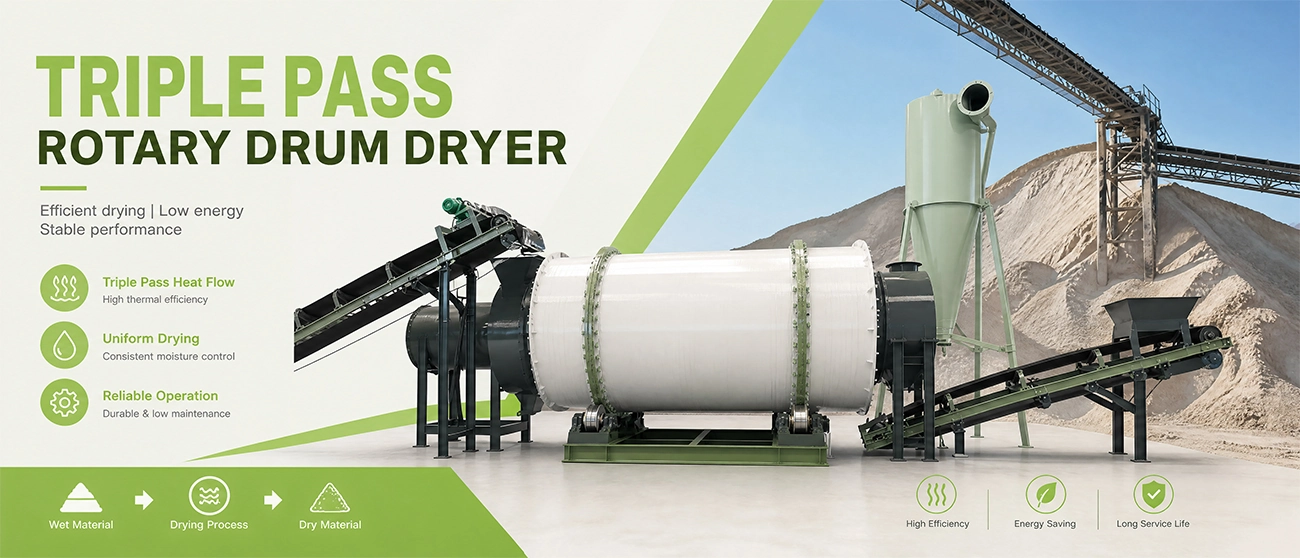
Our triple pass rotary dryers are primarily designed for inorganic bulk materials and industrial residues. The main applications include gypsum, sand, mineral powders, coal slime, and fly ash.
Gypsum is one of the common materials processed by rotary drying equipment. Natural gypsum, desulfurization gypsum, phosphogypsum, and other gypsum-containing materials may contain considerable amounts of moisture after mining, washing, separation, or processing.
A triple pass rotary dryer can continuously remove excess moisture from gypsum before further processing.
Typical applications include:
The drying temperature and residence time can be adjusted according to the specific gypsum characteristics and final moisture requirement.
Sand drying is another major application of triple pass rotary dryers.
Wet sand may be difficult to screen, transport, mix, or process efficiently. Drying reduces moisture and improves the flowability and handling characteristics of the material.
The dryer can be used for:
Dry sand is widely used in construction materials, mortar production, concrete-related applications, glass manufacturing, foundries, and other industrial processes.
Mineral powders often require moisture reduction before grinding, classification, mixing, storage, or subsequent processing.
The triple pass rotary dryer can be used for different types of mineral powders, including:
Because mineral powders can have different particle sizes, bulk densities, and moisture contents, the dryer can be configured according to the specific material.
Coal slime is a fine-grained coal processing by-product with relatively high moisture content. Its high moisture can significantly affect transportation, combustion efficiency, storage, and further utilization.
A triple pass rotary dryer can continuously reduce the moisture content of coal slime and improve its suitability for subsequent utilization.
Typical applications include:
The drying system can be designed with suitable dust collection and gas-handling equipment to meet the requirements of coal processing operations.
Fly ash generated by coal-fired power plants can contain moisture after collection, transportation, storage, or processing. Drying can improve its handling and suitability for subsequent utilization.
A rotary dryer can be used to reduce fly ash moisture before:
Because fly ash is a fine powder, proper control of airflow, dust collection, feeding, and discharge is important for stable operation.
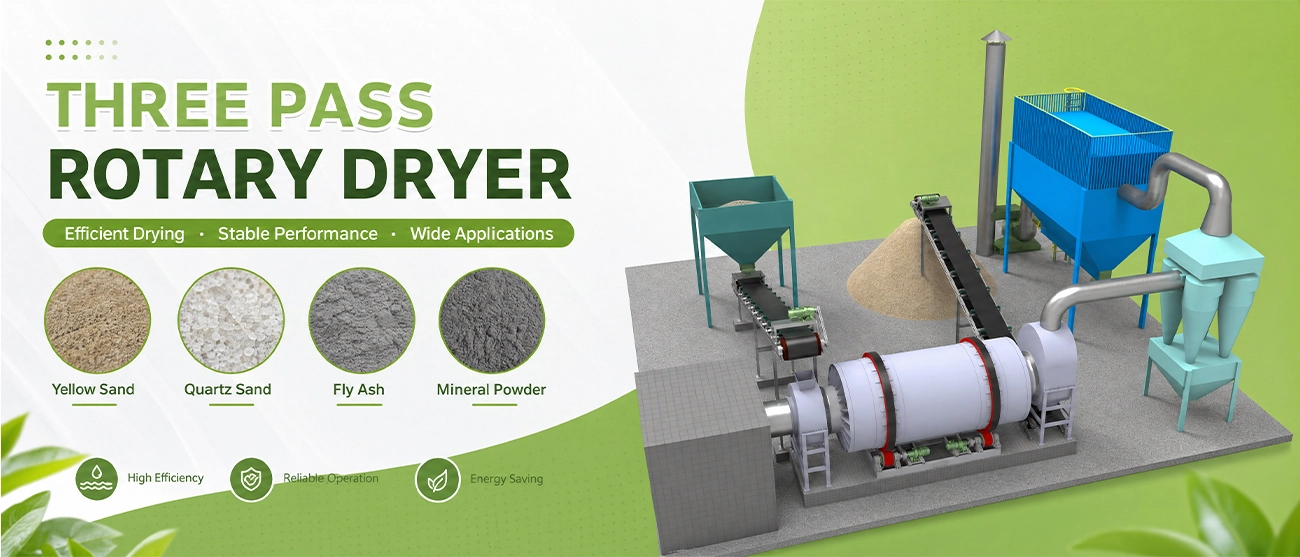
The working principle of a triple pass rotary dryer is based on continuous contact between wet material and heated gas.
Wet material is introduced into the dryer through the feeding system. As the drum rotates, internal lifting flights continuously lift and scatter the material. The material falls through the hot gas stream, creating a large contact area between the particles and the drying medium.
The material passes through multiple drying sections. During this process, heat is transferred from the hot gas to the wet material, causing moisture to evaporate.
The dried material is then discharged from the outlet and transported to the next processing stage.
A typical drying system includes:
The exact configuration depends on the material, capacity, moisture content, fuel type, and required final moisture.
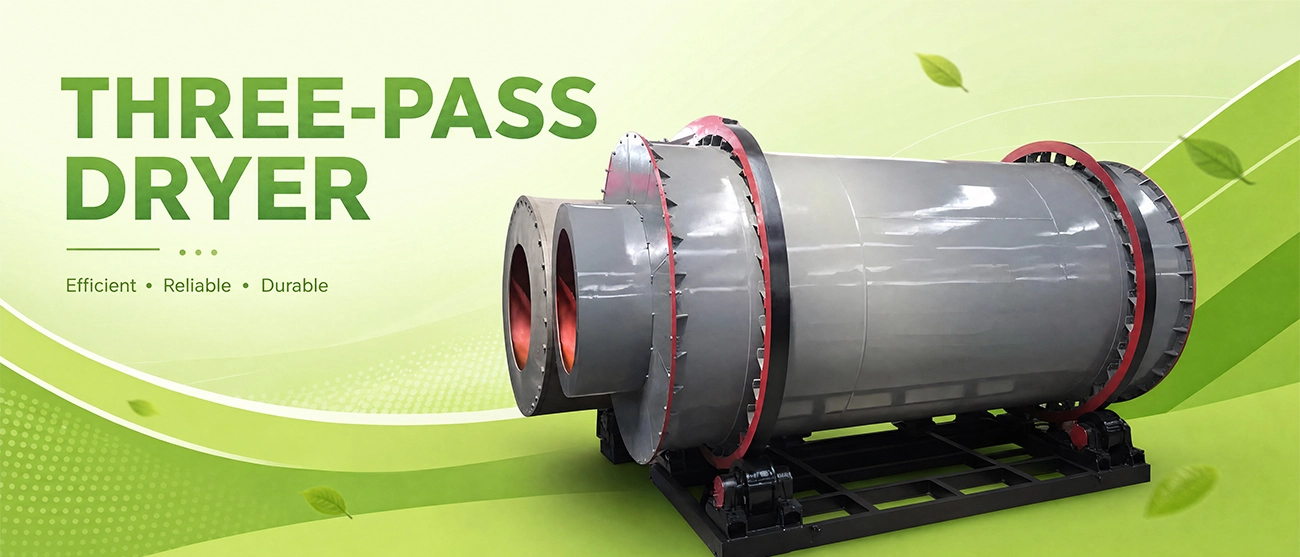
The structure of the dryer is designed to increase drying efficiency while maintaining continuous material movement.
The multi-pass drum is the main component of the dryer. It provides multiple material and gas flow paths, allowing the drying process to take place through several stages.
Lifting flights are installed inside the drum. They lift and distribute wet materials as the drum rotates.
Proper flight design is important because different materials require different lifting and cascading characteristics.
The feeding system continuously introduces wet material into the dryer.
For materials such as gypsum, sand, mineral powder, coal slime, and fly ash, the feeding equipment can be selected according to particle size, moisture content, bulk density, and feeding capacity.
After drying, the material is discharged continuously through the outlet and transferred to storage or the next processing step.
The drying process requires a suitable heat source to produce hot gas. Depending on the application, the heat source may be configured according to the customer’s fuel availability and production requirements.
Drying fine materials such as mineral powder, coal slime, and fly ash can generate dust. A suitable dust collection system is therefore an important part of the complete drying line.
Cyclones, bag filters, or other dust control equipment can be selected according to the material and emission requirements.e.
The multi-pass structure promotes effective contact between the hot gas and wet material. This allows heat to be transferred efficiently during the drying process.
The multi-pass configuration can provide a relatively compact drying system while maintaining sufficient drying capacity.
This can help reduce installation space compared with some conventional long single-pass rotary dryers.
The triple pass rotary dryer is designed for continuous industrial production. Wet material can be continuously fed into the machine while dried material is continuously discharged.
This makes it suitable for large-scale production lines.
The drying system can be designed according to the initial and final moisture content of the material.
This is particularly important for gypsum, sand, coal slime, and other materials whose moisture content can vary significantly.
The dryer can handle many types of granular and powdered industrial materials.
Its main applications include:
Gypsum + Sand + Mineral Powder + Coal Slime + Fly Ash
It can also be adapted for other similar materials after evaluating their physical and drying characteristics.
Important operating parameters such as hot gas temperature, material residence time, feed rate, airflow, and drum rotation can be adjusted according to production requirements.
The rotary drying process combines material movement and drying in one continuous system, reducing the need for multiple separate drying stages.
The dryer can be integrated with crushing, screening, grinding, conveying, dust collection, storage, and other equipment to create a complete material processing system.
| Model | Cylinder data | Capacity(t/h) | Cylinder rotary speed(r/min) | Power(kW) | ||||
| Outer cylinder diameter(m) | Outer cylinder length(m) | Cylinder volume(m3) | River sand | Fly ash | Slag | |||
| S6203 | 1.6 | 1.8 | 3.6 | 2-3 | 1-2 | 1-2 | 3-10 | 4 |
| S6205 | 2 | 2 | 6.28 | 4-5 | 2-3 | 3-4 | 3-10 | 5.5 |
| S6210 | 2.2 | 2.5 | 9.5 | 8-10 | 4-5 | 6-8 | 3-10 | 7.5 |
| S6215 | 2.5 | 2.8 | 13.7 | 12-15 | 7-8 | 10-12 | 3-10 | 11 |
| 2×4 | 2 | 4 | 12.56 | 8-12 | 4-6 | 8-10 | 3-10 | 3×2 |
| 2×5 | 2 | 5 | 15.7 | 12-15 | 6-7 | 10-13 | 3-10 | 4×2 |
| 2×6 | 2 | 6 | 18.84 | 20-25 | 10-17 | 20-27 | 3-10 | 7.5×2 |
| 2.2×4.5 | 2.2 | 4.5 | 17.09 | 14-18 | 7-9 | 12-15 | 3-10 | 5.5×2 |
| 2.5×6 | 2.5 | 6.5 | 31.89 | 23-28 | 10-13 | 20-22 | 3-10 | 5.5×4 |
| 2.7×7 | 2.7 | 7 | 40.5 | 30-35 | 20-25 | 27-45 | 3-10 | 7.5×4 |
| 2.8×6 | 2.8 | 6 | 36.9 | 30-35 | 15-18 | 25-30 | 3-10 | 5.5×4 |
| 3×6 | 3 | 6 | 42.39 | 35-40 | 18-20 | 32-35 | 3-10 | 7.5×4 |
| 3×7 | 3 | 7 | 49.46 | 40-45 | 20-25 | 35-40 | 3-10 | 7.5×4 |
| 3.2×7 | 3.2 | 7 | 56.26 | 45-50 | 25-30 | 40-45 | 3-10 | 11×4 |
| 3.2×8 | 3.2 | 8 | 64.3 | 50-55 | 30-35 | 45-50 | 3-10 | 11×4 |
| 3.6×8 | 3.6 | 8 | 81.38 | 60-70 | 35-40 | 60-65 | 3-10 | 15×4 |
| 3.8×9 | 3.8 | 9 | 102 | 70-80 | 40-45 | 70-75 | 3-10 | 15×4 |
| 4×10 | 4 | 10 | 125.6 | 90-100 | 45-50 | 80-90 | 3-10 | 18.5×4 |
| 4.2×8.5 | 4.2 | 8.5 | 117.7 | 80-100 | 45-60 | 80-90 | 3-10 | 18.5×4 |
Frequently asked questions
Here are answers to some frequently asked questions about skid-mounted carbonization furnaces. If you have any other questions, please feel free to contact our customer service team directly, and we will be happy to provide you with a detailed explanation.
A three-drum dryer, also called a triple-pass rotary dryer or three-cylinder dryer, is a drying machine consisting of three concentric cylinders (inner, middle, and outer) nested together. Materials are fed into the innermost drum and progressively move through the middle and outer drums, undergoing heat exchange with hot air flow.
Compared to single-drum dryers, three-drum dryers offer significantly higher thermal efficiency (can reach up to 80%), reduce power consumption by up to 60%, save about 50% of floor space, and reduce the machine length by about one-third.
Three-drum dryers are widely used for drying granular materials with high moisture content, including quartz sand, river sand, slag, fly ash, sawdust, coal, dry mortar, lees, and various chemical and building materials.
A single-pass dryer has one long drum where material travels through once. A triple-pass dryer has three nested drums of different diameters. Material passes through the inner, middle, and outer drums sequentially, providing longer residence time and better heat exchange within a much shorter overall length.
Key factors include: the type and moisture content of the material to be dried, the required capacity per hour, the available heat source (coal, oil, gas, etc.), energy efficiency requirements, and available floor space.