 Henan Xuye Machinery Equipment Co., Ltd.
SEARCH WHAT YOU WANT
Search allProductNews
SEARCH
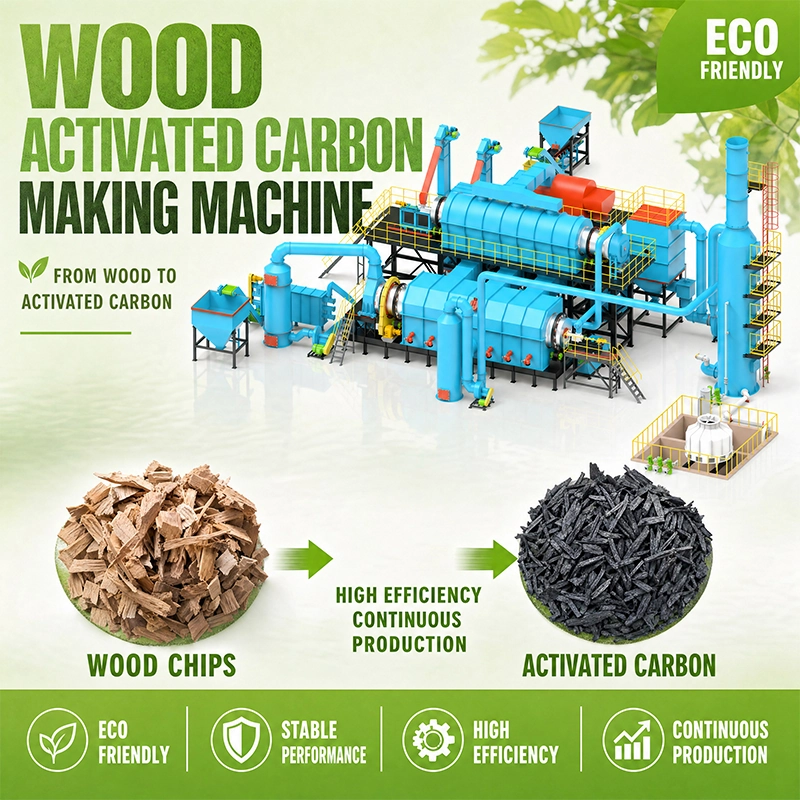
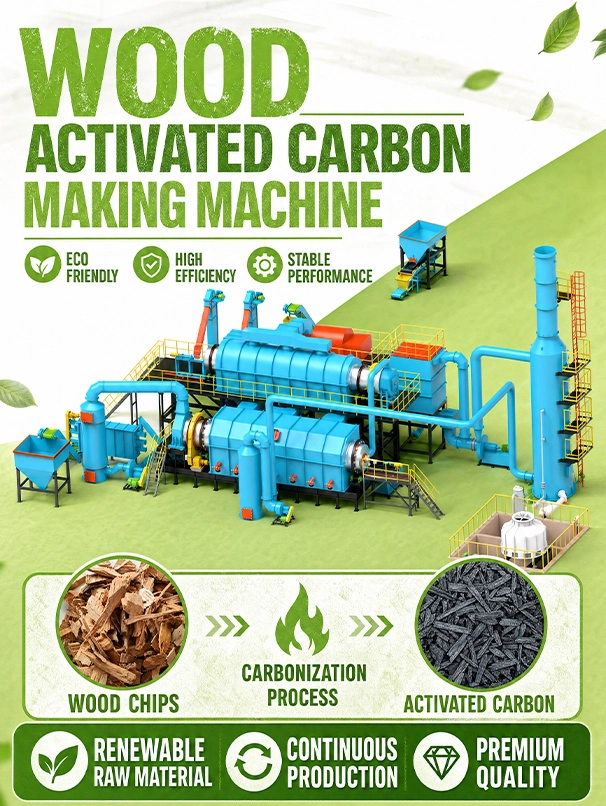
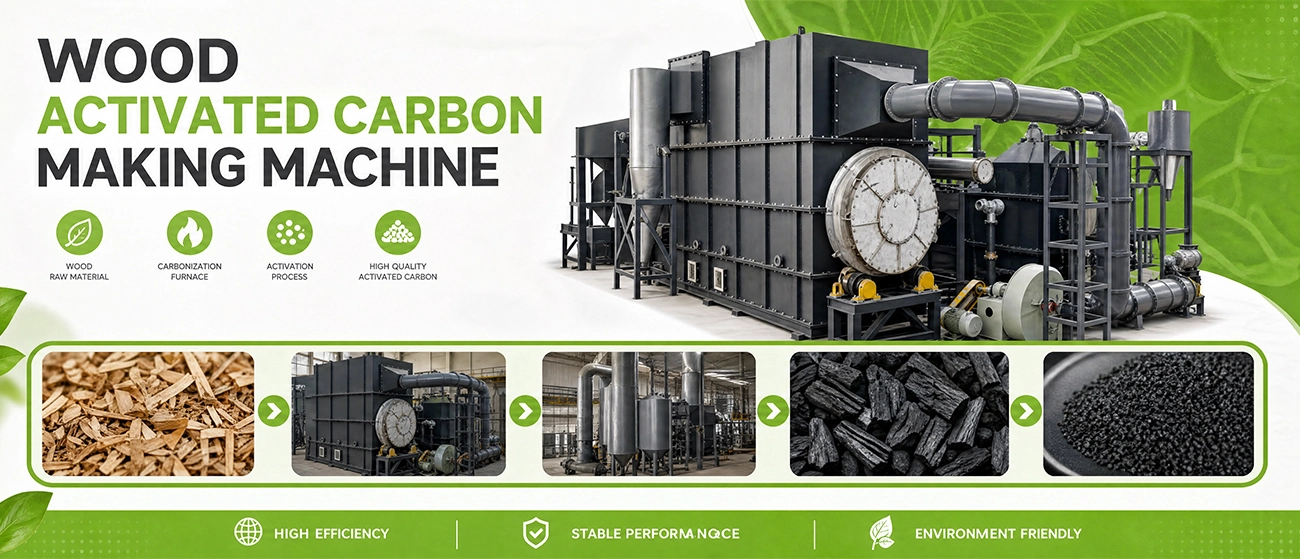
Wood activated carbon making machine is a complete production system designed to convert wood materials such as hardwood, wood chips, sawdust, and forestry waste into high-performance activated carbon. With advanced carbonization and activation technology, this machine can produce activated carbon with high adsorption capacity, developed pore structure, and excellent chemical stability.
Wood-based activated carbon is widely used in water purification, air treatment, solvent recovery, food processing, chemical industries, pharmaceuticals, and industrial gas purification. Due to the renewable characteristics of wood resources, wood activated carbon production has become an important solution for sustainable biomass utilization.
Henan XUYE provides complete wood activated carbon production lines including raw material crushing equipment, drying systems, carbonization furnaces, activation kilns, cooling systems, grinding machines, screening machines, and packaging systems. Our equipment can be customized according to different raw materials, production capacities, and application requirements.
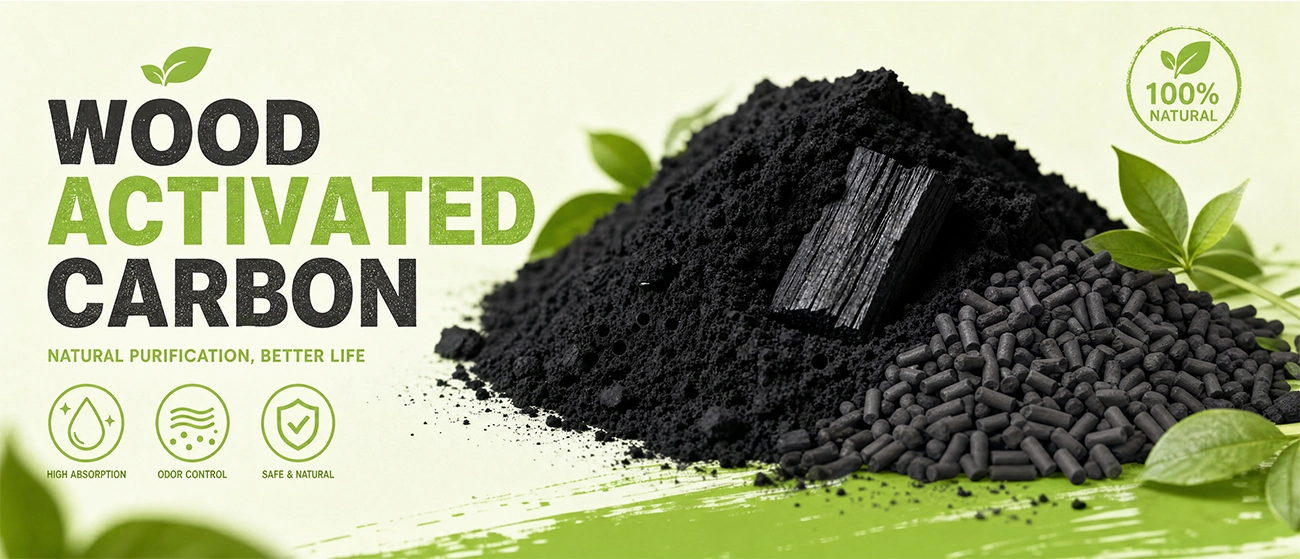
Wood activated carbon is a porous carbon material produced from wood biomass through carbonization and activation processes. During production, wood materials are first converted into charcoal through high-temperature carbonization. The charcoal is then activated under controlled conditions to create millions of microscopic pores inside the carbon structure.
These pores provide activated carbon with a large specific surface area, allowing it to adsorb impurities, organic compounds, odors, gases, and pollutants.
Compared with other types of activated carbon, wood activated carbon usually has:
Wood activated carbon is especially suitable for liquid phase adsorption applications because of its well-developed mesopores.
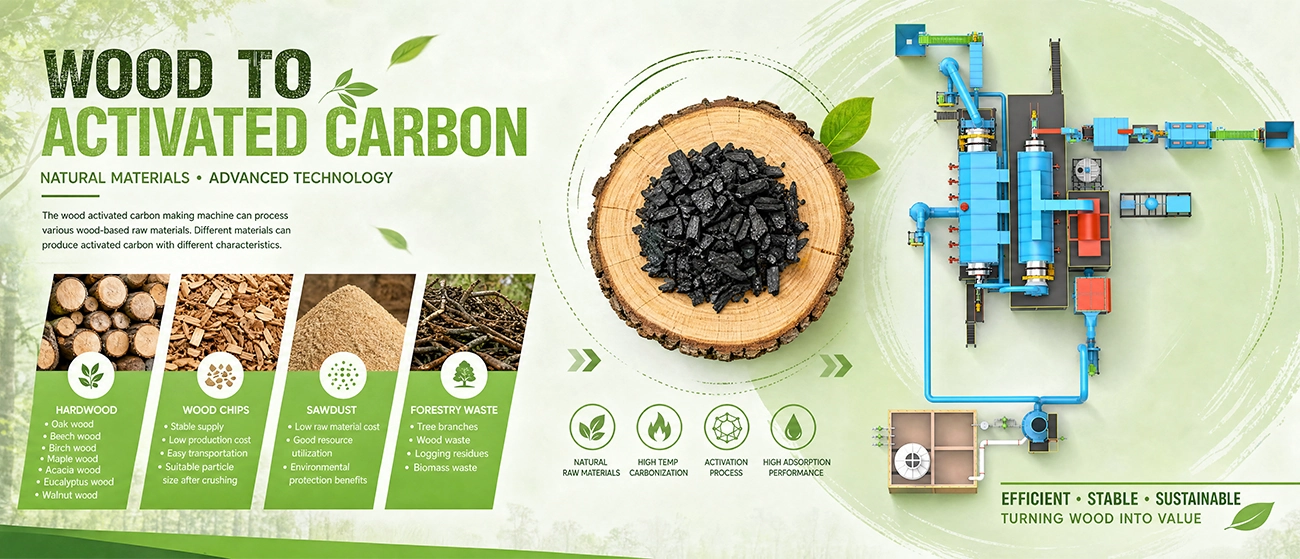
The wood activated carbon making machine can process various wood-based raw materials. Different materials can produce activated carbon with different characteristics.
Hardwood is one of the most popular raw materials for producing premium activated carbon.
Common hardwood materials include:
Hardwood usually contains high fixed carbon content and produces activated carbon with good mechanical strength and adsorption performance.
Wood chips are widely available from sawmills and forestry industries.
Advantages of using wood chips:
Wood chip activated carbon is commonly used for:
Sawdust is a common waste material from furniture factories and wood processing plants.
The advantages include:
With proper drying and carbonization technology, sawdust can be converted into high-quality powdered activated carbon.
Wood activated carbon production can also utilize forestry residues:
Using forestry waste helps reduce waste disposal problems and improves biomass resource utilization.
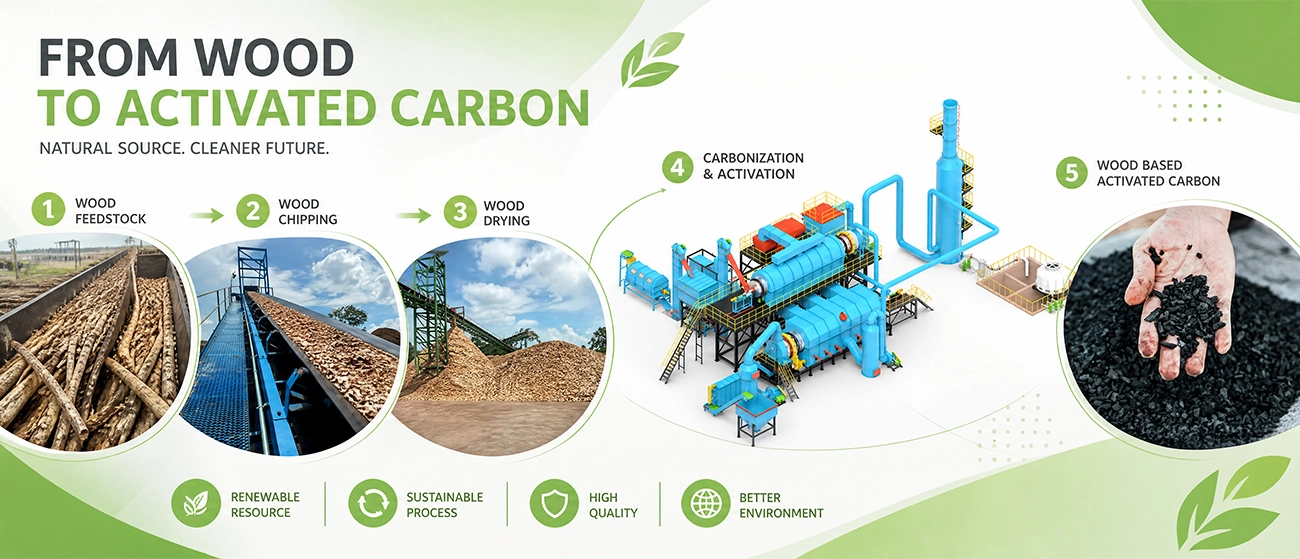
The production of wood activated carbon mainly includes four important stages:
The first step is preparing suitable wood materials.
Large wood blocks or branches are processed by:
The purpose is to reduce the material size and improve heat transfer efficiency during carbonization.
The processed material is usually controlled at a suitable particle size according to the production process.
Wood materials usually contain moisture. Excessive moisture can affect carbonization efficiency and increase energy consumption.
A rotary dryer is commonly used to reduce moisture content.
The drying process provides:
The drying temperature and residence time can be adjusted according to different wood materials.
Carbonization is a key step in wood activated carbon production.
During carbonization, wood materials are heated in an oxygen-free or low-oxygen environment. Volatile components are removed, leaving carbon-rich charcoal.
Main reactions include:
A continuous carbonization furnace or rotary carbonization kiln is usually selected for industrial production.
Advantages of continuous carbonization:
Activation is the most important stage for improving adsorption performance.
The carbonized material is heated at high temperature with activation agents such as:
During activation, gases react with carbon atoms and create internal pores.
The activation process increases:
Industrial activation temperatures are usually around 800–1000°C depending on the raw material and product requirements.
The machine can process various renewable wood resources, helping customers reduce raw material costs.
Suitable materials include:
The advanced activation process creates:
The production line can recycle combustible gases generated during carbonization.
This reduces:
Modern control systems improve:
The operator can monitor:
through the control system.
XUYE provides customized activated carbon production solutions based on:
From small-scale plants to industrial production lines, different configurations can be provided.
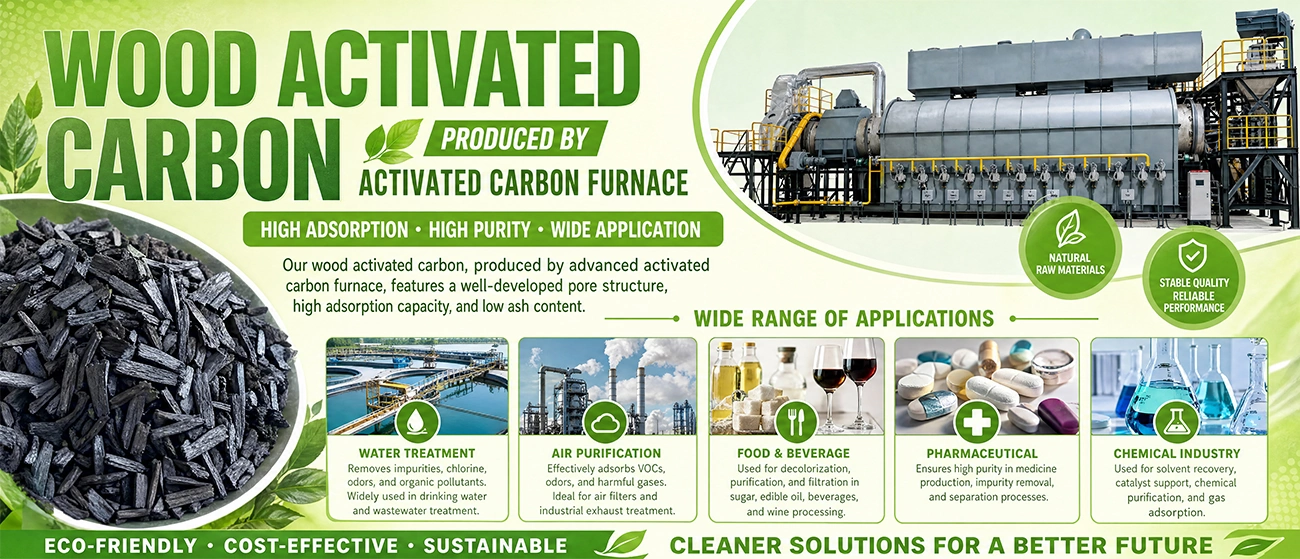
Wood activated carbon produced by the wood activated carbon making machine has excellent adsorption performance and is widely used in many industries. Due to its developed pore structure and high adsorption capacity, wood-based activated carbon has become an important filtration and purification material worldwide.
Water purification is one of the largest application fields of wood activated carbon.
It can remove:
Wood activated carbon is widely used in:
The large mesopore structure of wood activated carbon makes it highly effective for removing large organic molecules.
Wood activated carbon has excellent gas adsorption performance.
It can be used for:
Applications include:
Activated carbon produced from wood materials is especially suitable for removing volatile organic compounds (VOCs).
High-quality wood activated carbon is commonly used in food processing.
Applications include:
The low ash content and excellent adsorption ability make wood activated carbon suitable for applications requiring high purity.
Wood activated carbon is used in pharmaceutical production because of its chemical stability and purification ability.
Applications include:
Special activated carbon grades can be produced according to pharmaceutical requirements.
In chemical production, activated carbon is used for:
Wood activated carbon can help improve production efficiency and reduce waste discharge.
| Capacity | 5-8t/d | 8-10t/d | 10-12t/d | 12-15t/d | 15-20t/d |
| Dryer model | HG-800 | HG-1000 | HG-1200 | HG-1500 | HG-1800 |
| Dryer power | 3kw | 4kw | 7.5kw | 15kw | 22kw |
| continuous carbonization furnace model | TH-1500 | TH-1500 | TH-1800 | TH-2000 | TH-2000 |
| Carbonization temperature | 600-850℃ | ||||
| Fixed carbon content after carbonization | 70-80% | ||||
| Carbonization furnace drum material | 309S/310S | 309S/310S | 309S/310S | 309S/310S | 309S/310S |
| Activation furnace model | HN-5 | HN-8 | HN-10 | HN-12 | HN-15 |
| Activation furnace power | 15kw | 22kw | 30kw | 37kw | 37kw |
| Activation furnace chamber material | QQ345+nano thermal insulation board+refractory | ||||
| Activation temperature | 850-950℃ | ||||
| Activator | Water vapor or Phosphoric acid (customized according to customer requirements, equipment design will be updated) | ||||
| Activation time | 1-2h | ||||
| Cooling machine model | GTL-1004 | GTL-1204 | GTL-1206 | GTL-1504 | GTL-1506 |
| Temperature after cooling | ≤40℃ | ||||
| Activated carbon crusher model | SGP-400 | SGP-400 | SGP-600 | SGP-800 | SGP-800 |
| Activated carbon finished product size | 4-60mesh | ||||
| Activated carbon iodine value | 800-1300mg/g | ||||
| Activated carbon specific surface area | 800-1500m²/g | ||||
| Activated carbon strength | ≥95 | ||||
| CTC | ≥60% | ||||
| Filling density | 0.45-0.55g/cm3 | ||||
| Activated carbon ash | ≤3% | ||||
Frequently asked questions
Here are answers to some frequently asked questions about skid-mounted carbonization furnaces. If you have any other questions, please feel free to contact our customer service team directly, and we will be happy to provide you with a detailed explanation.
The production capacity depends on:
Raw material type
Moisture content
Equipment configuration
Carbonization and activation conditions
XUYE can design production lines from small-scale plants to large industrial activated carbon factories.
Typical capacities range from several hundred kilograms per day to dozens of tons per day.
Wood activated carbon and coconut shell activated carbon have different pore structures.
Wood activated carbon generally has:
More developed mesopores
Faster adsorption speed
Better performance for liquid purification
Coconut shell activated carbon usually has:
More micropores
Higher hardness
Better performance for gas adsorption and gold recovery
The suitable type depends on the final application.
The production temperature depends on the process stage.
Typical temperatures include:
Carbonization:
400–700℃
Activation:
800–1000℃
The exact temperature is adjusted according to:
Product application
Raw material properties
Required iodine value
Yes.
By adding different crushing and screening equipment, the production line can produce:
Particle size can be customized according to customer requirements.
Yes.
XUYE provides:
For overseas customers, online technical support and engineer service can be arranged.