SEARCH WHAT YOU WANT

Skid-Mounted Continuous Carbonization Furnace

Looking for a compact, modular, and easy-to-install carbonization solution for biomass processing?Our skid-mounted continuous carbonization furnace is designed for customers who need stable continuous operation, reduced installation time, flexible plant layout, and reliable carbonization quality. Compared with traditional on-site assembled systems, a skid-mounted continuous carbonization furnace offers a more integrated structure, faster project deployment, easier transportation, and better consistency across different installation sites.

This modular continuous carbonization system is suitable for sawdust, rice husk, wood shavings, bamboo waste, coconut shell, palm shell, fruit shells, and other biomass residues. It supports continuous feeding, controlled pyrolysis, gas recycling, automatic temperature management, and continuous discharging, making it a strong choice for industrial biochar production, biomass charcoal processing, waste-to-value projects, and carbon material preparation.

Whether you are building a new carbonization plant, expanding an existing biomass charcoal line, or looking for a container-friendly modular carbonization solution for export, our skid-mounted continuous carbonization furnace can be customized to match your raw material, capacity target, local energy conditions, and environmental requirements.

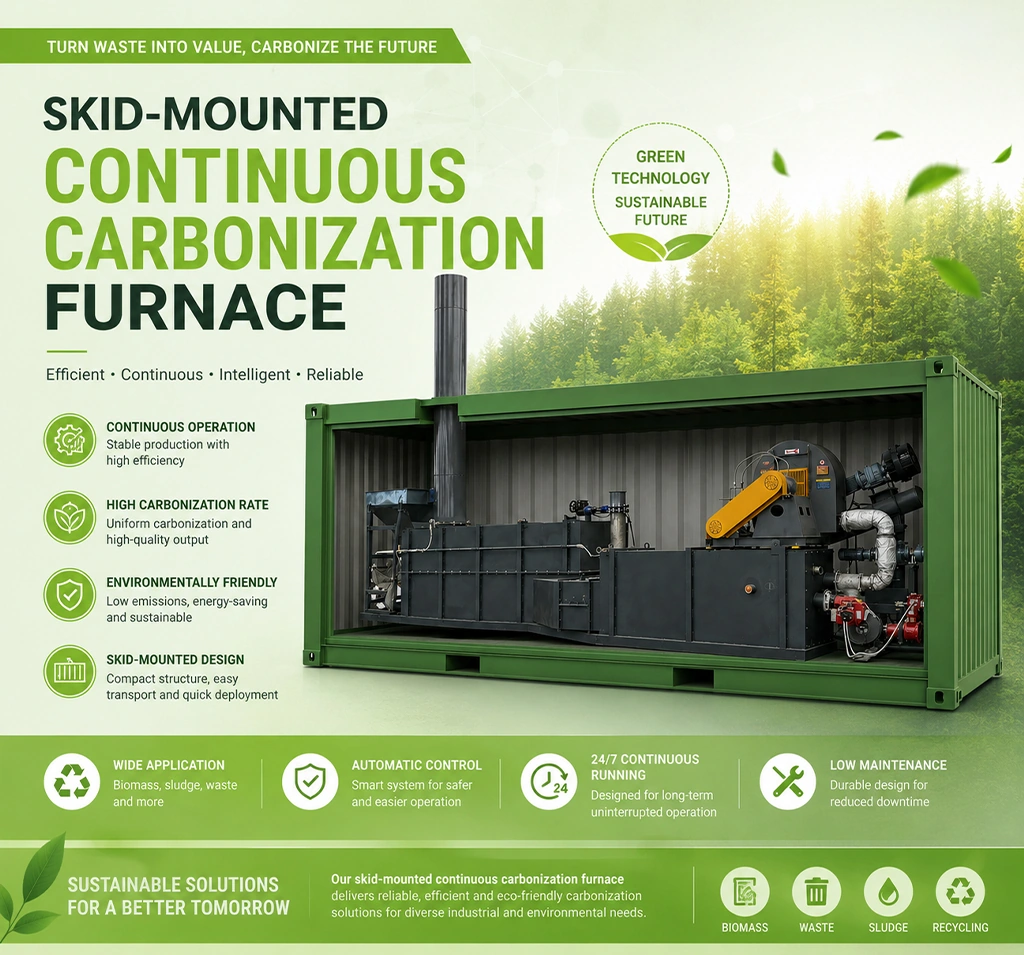
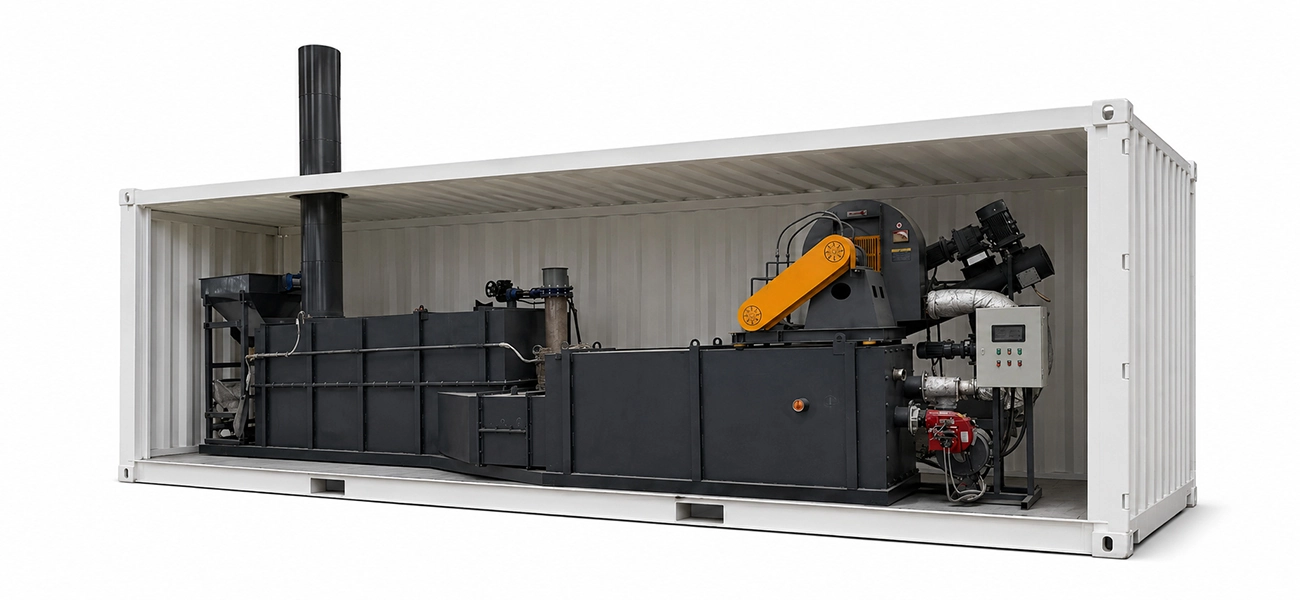
Industrial continuous carbonization furnace integrated into a skid-mounted structure for efficient operation

What Is Skid-Mounted Continuous Carbonization Furnace ?

The Skid-Mounted Continuous Carbonization Furnace is an advanced biomass carbonization system designed for efficient and continuous production of charcoal and biochar. The entire equipment is integrated into a compact skid-mounted structure, making transportation, installation, and operation more convenient for industrial users. It is widely used for processing biomass materials such as wood chips, sawdust, coconut shells, rice husks, bamboo, palm shells, and agricultural waste.

The furnace adopts a continuous feeding and discharging design, allowing stable 24-hour operation with high production efficiency. During the carbonization process, combustible gases, tar, and smoke generated under high temperature are collected and recycled into the external combustion chamber as heating fuel, significantly reducing fuel consumption and improving thermal efficiency. The advanced gas purification and cooling system helps ensure cleaner emissions and stable product quality.

Compared with traditional carbonization equipment, the skid-mounted continuous carbonization furnace offers faster installation, lower labor costs, energy-saving performance, and easier maintenance. Its optimized anti-blocking structure effectively prevents tar blockage problems and supports long-term continuous operation. The final charcoal or biochar products feature high carbon content, uniform quality, and wide applications in fuel, agriculture, metallurgy, and environmental protection industries.
Skid-Mounted Continuous Carbonization Furnace Working Process

The Skid-Mounted Continuous Carbonization Furnace works through a continuous high-temperature pyrolysis process that converts biomass materials into charcoal or biochar in an oxygen-limited environment. Raw materials such as wood chips, sawdust, rice husks, coconut shells, bamboo, or agricultural waste are first fed into the furnace through an automatic feeding system.

Inside the carbonization chamber, the materials are gradually heated by indirect or external heating. As the temperature rises, moisture is removed first, followed by the decomposition of volatile components in the biomass. During this pyrolysis process, combustible gases, smoke, and tar are generated. These by-products are collected through a gas recovery system and transported to the external combustion chamber, where they are burned again as a secondary heat source for the furnace. This recycling design greatly reduces fuel consumption and improves thermal efficiency.

The furnace operates continuously, allowing raw materials to enter from one side while finished charcoal or biochar is discharged from the other side without interrupting production. A cooling system then lowers the temperature of the final product before packaging or storage, preventing spontaneous combustion.

The skid-mounted integrated structure combines the carbonization system, combustion chamber, cooling system, and control system into one compact unit, making installation, transportation, and operation more convenient. The optimized internal design also helps prevent tar blockage problems and supports stable long-term continuous operation.

Key Advantages of a Skid-Mounted Continuous Carbonization Furnace

1. Modular Design for Faster Installation

One of the biggest benefits of a skid-mounted continuous carbonization furnace is modularity. Since major process units are pre-installed and aligned before shipment, site assembly workload is reduced. This can shorten project timelines, lower labor requirements, and decrease installation complexity, especially for overseas projects or remote industrial sites.

2. Continuous Operation for Higher Throughput

Unlike batch carbonization furnaces that require repeated loading, heating, unloading, and restart cycles, a continuous carbonization furnace runs in a stable production rhythm. Continuous feeding and discharge improve effective operating time and help maximize daily output. For medium and large-scale biomass charcoal production, this is a major operational advantage.

3. Better Process Stability

Stable process conditions are essential for carbonization quality. A skid-mounted continuous carbonization furnace supports controlled residence time, stable temperature zones, and smoother material movement. This helps improve product consistency in terms of carbonization degree, fixed carbon level, and downstream process suitability.

4. Reduced Site Construction Risk

For many buyers, project delays happen not because the main equipment is unavailable, but because site assembly, piping, wiring, and structural coordination become more complicated than expected. A skid-mounted carbonization system minimizes these risks by moving more of the integration work into the factory. This is particularly valuable for first-time project owners or customers managing cross-border installations.

5. Easier Layout Planning

The skid-mounted concept helps simplify plant layout. With clearer module boundaries, buyers can more easily plan raw material flow, service space, electrical routing, maintenance access, and future expansion. For plants with limited land or existing workshop constraints, this can be an important advantage.

6. Energy-Saving Potential

Many skid-mounted continuous carbonization furnace systems include combustible gas recovery and reuse. By using pyrolysis gas as a supplementary heating source, the system can reduce dependence on diesel, gas, or other purchased fuel. Over long operating periods, this can improve cost efficiency significantly.

7. Export-Friendly Engineering

For international buyers, skid-mounted systems are often easier to ship, install, and commission than fully field-assembled structures. The modular design also helps standardize repeated delivery for distributors, EPC partners, and multi-site investors.

Skid-Mounted Continuous Carbonization Furnace Suitable Raw Materials

Our skid-mounted continuous carbonization furnace can be customized for a wide range of biomass and organic feedstocks. The exact process route depends on particle size, moisture content, bulk density, ash level, and target end use.

Sawdust and Wood Shavings

Sawdust is one of the most common materials for continuous carbonization. It flows well after proper drying and is suitable for stable continuous feeding. A skid-mounted sawdust carbonization furnace is often used in biomass charcoal and biochar production projects.

Rice Husk

Rice husk is abundant and widely available in many agricultural regions. Because it is lightweight and dusty, handling design is important. A properly engineered rice husk carbonization machine can improve feeding stability, reduce leakage risk, and support cleaner plant operation.

Coconut Shell and Palm Shell

Coconut shell and palm shell are widely used for higher-value charcoal and activated carbon precursor production. These materials may require specific residence time and thermal profile adjustments for the best carbonization results.

Bamboo Waste

Bamboo chips, bamboo powder, and bamboo processing residues can also be carbonized continuously. A modular continuous carbonization system can be configured to address the bridging and flow characteristics of bamboo-based feedstock.

Fruit Shells and Agricultural Residues

Peanut shell, walnut shell, apricot shell, straw residues, and similar biomass materials may also be suitable, provided the raw material characteristics are evaluated in advance. For mixed biomass streams, we recommend sharing sample data during the RFQ stage.

Application Areas

Biochar Production

Biochar is used in soil improvement, environmental remediation, carbon sequestration agriculture, and specialty applications. A skid-mounted continuous carbonization furnace can provide stable and scalable front-end carbonization for biochar projects.

Biomass Charcoal Manufacturing

For charcoal powder, briquette feedstock, and industrial carbon material production, continuous carbonization offers better consistency than small batch methods. This helps create a stronger base for downstream shaping and packaging.

Activated Carbon Precursor Preparation

Coconut shell char, fruit shell char, and other premium carbonized materials are often used as precursors for activated carbon. A continuous carbonization furnace can improve raw material consistency before activation.

Biomass Waste Recycling

Woodworking plants, rice mills, bamboo processors, and agricultural processing companies can use a modular carbonization furnace to convert low-value residues into marketable carbon products or useful thermal resources.

Industrial Waste-to-Value Projects

Some organic industrial residues may be suitable for carbonization-based reduction and resource recovery. These projects usually require stronger environmental and safety engineering support, which is why system-level customization is important.

Skid-Mounted Continuous Carbonization Furnace Video

Industrial Skid-Mounted Carbonization Furnace

Skid-Mounted Continuous Carbonization Furnace Technical Parameters

ModelXY0.9- 8mXY1.1-8mXY1.1-10mXY1.3-10m
Cylinder Wall Thickness12 mm12 mm12 mm12 mm
Cylinder Material310S Stainless Steel310S Stainless Steel310S Stainless Steel310S Stainless Steel
Carbonization Time20–40 min20–40 min20–40 min20–40 min
Carbonization Temperature700–900°C700–900°C700–900°C700–900°C
Combustible Gas Temperature400–550°C400–550°C400–550°C400–550°C
Riding Ring MaterialForged No.35 SteelForged No.35 SteelForged No.35 SteelForged No.35 Steel
Support Roller MaterialHeat-treated No.45 SteelHeat-treated No.45 SteelHeat-treated No.45 SteelHeat-treated No.45 Steel
Sprocket MaterialQuenched No.45 SteelQuenched No.45 SteelQuenched No.45 SteelQuenched No.45 Steel
Reducer TypeHelical Gear Hard Tooth Surface ReducerHelical Gear Hard Tooth Surface ReducerHelical Gear Hard Tooth Surface ReducerHelical Gear Hard Tooth Surface Reducer
Motor Power4 kW (Variable Frequency)5.5 kW (Variable Frequency)5.5 kW (Variable Frequency)7.5 kW (Variable Frequency)
Feed Inlet SealGraphite Packing SealGraphite Packing SealGraphite Packing SealGraphite Packing Seal
Discharge Hood SealTriple-layer Flexible SealTriple-layer Flexible SealTriple-layer Flexible SealTriple-layer Flexible Seal
Discharge Hood Insulation10 cm Ceramic Fiber Blanket + 0.5 cm Fiber Castable Lining10 cm Ceramic Fiber Blanket + 0.5 cm Fiber Castable Lining10 cm Ceramic Fiber Blanket + 0.5 cm Fiber Castable Lining10 cm Ceramic Fiber Blanket + 0.5 cm Fiber Castable Lining

FAQ

Frequently asked questions

Here are answers to some frequently asked questions about skid-mounted carbonization furnaces. If you have any other questions, please feel free to contact our customer service team directly, and we will be happy to provide you with a detailed explanation.

What is the difference between a skid-mounted continuous carbonization furnace and a standard continuous carbonization furnace?

A skid-mounted continuous carbonization furnace uses a modular pre-integrated structure built on skids, which makes transportation and installation easier. A standard continuous carbonization furnace may require more field assembly and site integration work.。

What raw materials can this machine process?

Typical materials include sawdust, wood shavings, rice husk, bamboo waste, coconut shell, palm shell, fruit shells, and similar biomass residues. Final suitability depends on size, moisture, and target product requirements.

Is drying required before carbonization?

If the raw material moisture content is too high, drying is usually recommended. Lower and more stable inlet moisture improves thermal efficiency and product consistency.

Can the system recycle pyrolysis gas?

Yes. Our skid-mounted continuous carbonization furnace configurations support combustible gas recovery and reuse, which can reduce external fuel demand.

Can the machine be customized?

Yes. Capacity, heating source, automation level, environmental treatment modules, electrical standard, and layout can all be customized according to project requirements.