 Henan Xuye Machinery Equipment Co., Ltd.

SEARCH WHAT YOU WANT
Search allProductNews
SEARCH
I. Current Status of Powdered Activated Carbon Applications In recent years, with the rapid development of industries such as water treatment, food decolorization, chemicals, new materials, and new energy, the demand for activated carbon has continued to grow. Among them, powdered activated carbon is widely used in industrial fields due to its large specific surface area, fast adsorption rate, and flexible application. After powdered activated carbon becomes saturated, it needs to be regenerated online or replaced with new activated carbon. Currently, the technology and equipment for online regeneration coupled with activated carbon adsorption are relatively few, resulting in a large amount of waste powdered activated carbon. Currently, the main methods for treating waste powdered activated carbon include incineration, landfill, and recycling. Landfill not only occupies valuable land resources but also poses a significant environmental pollution risk. Incineration, although it can recover some heat, damages the pore structure of activated carbon, making resource recycling impossible. In contrast, recycling can restore the adsorption performance of waste activated carbon and allow for reuse, which is a key way to achieve green, low-carbon, and circular economy. In terms of technology, commonly used regeneration methods at home and abroad include thermal regeneration, chemical regeneration, biological regeneration, and emerging methods such as microwave regeneration and ultrasonic regeneration. Among these, thermal regeneration is the most widely used regeneration technology in industry due to its strong adaptability and high processing efficiency.

II. Major Problems in Powdered Activated Carbon Regeneration While thermal regeneration technology is mature and widely used in centralized regeneration enterprises and industrial enterprises for granular activated carbon, powdered activated carbon regeneration still faces numerous industrialization bottlenecks, resulting in insufficient centralized regeneration capacity and a large amount of powdered activated carbon not being recycled for high-value utilization.

III. Technical and economic limitations of powdered carbon granulation regeneration Currently, domestic hazardous waste enterprises adopt a technical route of granulating powdered carbon before thermal regeneration to simplify equipment and operation and reduce treatment difficulty. While this approach solves the problem of powdered carbon transportation and collection to some extent, it has significant drawbacks: a substantial decrease in product quality and value; the addition of binders and mechanical extrusion during granulation compresses or even blocks the original microporous structure of activated carbon. While the regenerated product retains some adsorption capacity, it cannot restore the high specific surface area and rapid adsorption kinetics of the original powdered carbon. It can only be used as a low-grade product in applications with less stringent requirements, severely impacting the efficient utilization of resources and economic value. Mechanical damage to pore structure: The mechanical damage to activated carbon caused by the granulation process is irreversible. High-pressure molding leads to the formation of dense contact interfaces between powdered carbon particles, significantly reducing the proportion of mesopores and micropores. This structural change is fundamentally different from the regeneration of undisturbed activated carbon. Original regeneration primarily addresses the issue of adsorbates occupying pore channels, while granulation regeneration alters the essential characteristics of activated carbon at the structural level. Fundamental differences in process: Original powdered carbon regeneration is a performance restoration process based on maintaining the original particle morphology and pore structure; granulation regeneration, on the other hand, first changes the morphology and then regenerates, essentially performing secondary processing on the material. This difference results in significant differences in the regeneration mechanism, optimal process parameters, and final product performance of the two processes. Granulation regeneration struggles to achieve the product quality level of undisturbed regeneration. Furthermore, charcoal powder has a wide range of sources and types, involving multiple fields such as municipal water supply, industrial wastewater treatment, food processing, pharmaceuticals, dyes and chemicals, and metallurgy. The charcoal powder generated by different industries varies significantly in terms of pollutant types, adsorbate content, moisture content, ash content, and physicochemical properties, resulting in complex and variable properties. This diversity places extremely high demands on the material universality and technical reliability of the regeneration process, and also poses a severe challenge to the operational flexibility of the regeneration equipment (such as temperature adaptability, atmosphere control capability, and material handling capacity). If the regeneration process and equipment lack sufficient adaptability and controllability, it will be difficult to ensure both regeneration effectiveness and operational stability and economy. Therefore, in the process of charcoal powder regeneration technology innovation, it is essential to strengthen process optimization design and system integration to ensure the reliability and sustainability of industrial applications.
IV. Xuye Machinery has developed a charcoal powder thermal regeneration technology, dividing the charcoal powder regeneration process into three independent but continuous stages: drying, pyrolysis, and activation. Through segmented temperature control, atmosphere regulation, and heat recycling, high-quality virgin charcoal powder regeneration and economical and reliable equipment operation are achieved. Drying Section Control: For powdered activated carbon with high moisture content, low-temperature flue gas and indirect heating are used for drying under inert gas protection, optimizing the drying load and volatile organic compound (VOC) control of the drying section equipment. The drying heat source utilizes the waste heat from the activated carbon activation section, which is introduced into the drying section after cascade utilization, achieving internal heat circulation in the core activation and regeneration system. Pyrolysis Section Control: The dried activated carbon enters the pyrolysis section, where adsorbed organic matter and some impurities undergo thermal decomposition and volatilization at 400–600℃ in an oxygen-free atmosphere. The pyrolysis waste gas is then recycled back to the pyrolysis process after high-temperature dust removal, secondary combustion (1100℃), and waste heat recovery in a waste heat boiler. Activation Section Control: At approximately 900℃, steam generated by the waste heat boiler is used as an activator to activate and restore the microporous structure of the activated carbon. The activation temperature and time are dynamically adjusted according to the target iodine value of the regenerated carbon. The activation waste gas is returned to the pyrolysis and drying sections, achieving cascade energy utilization in the activation and regeneration process.
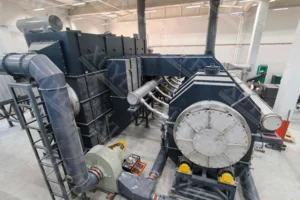
Customized activated carbon kiln specifications according to customer needs, providing full technical solutions from laboratory-level small equipment to large production lines, supporting PLC automation control.
View details
Customized activated carbon kiln specifications according to customer needs, providing full technical solutions from laboratory-level small equipment to large production lines, supporting PLC automation control.
View details
Phosphoric acid activation is a key technology for preparing highly porous activated carbon. This article explains in detail its production steps, phosphoric acid recovery methods and industry application cases.
View details
Specialized in the production of activated carbon kilns for water treatment, air purification, gold extraction and other fields.
View details
Understand the chemical activated carbon production line equipment and professional production technology to help improve the adsorption performance of activated carbon.
View details
Customized activated carbon kiln specifications according to customer needs, providing full technical solutions from laboratory-level small equipment to large production lines, supporting PLC automation control.
View details