 Henan Xuye Machinery Equipment Co., Ltd.
SEARCH WHAT YOU WANT
Search allProductNews
SEARCH
For anyone entering the biomass carbonization business, one of the first — and most important — decisions is choosing the right furnace. Two terms come up constantly in this space: activated carbon furnace and charcoal furnace. They sound similar, they both involve heating carbon-based materials, and they are often confused for one another. But they are not interchangeable, and choosing the wrong one can mean investing in equipment that doesn’t match your target market at all.
This article walks through what each furnace actually does, how their processes differ, and how to decide which one is right for your production goals.

Before comparing the machines, it helps to compare the products.
That single distinction — fuel vs. filtration material — is the root of every technical and structural difference between the two furnaces. Once you understand that, the rest of the comparison makes a lot more sense.
A charcoal furnace carbonizes raw biomass — wood, bamboo, coconut shell, rice husk, or other agricultural residues — through pyrolysis. The material is heated in a low-oxygen chamber, which drives off moisture and volatile gases and leaves behind a carbon-rich solid: charcoal.
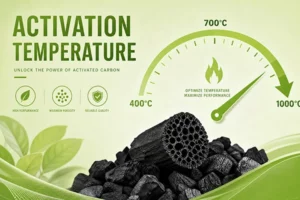
This is a single-pass process. Once the raw material has fully carbonized, the job of the charcoal furnace is essentially done. Typical carbonization temperatures range from about 400°C to 700°C — hot enough to break down the biomass structure but well below what’s needed for true activation.
Charcoal furnaces are commonly used to supply:
Because the process is relatively straightforward, charcoal furnaces tend to be simpler to install, operate, and maintain than activated carbon furnaces.
An activated carbon furnace takes the carbonization process further. After the raw material is carbonized (either in the same system or as a separate prior step), it goes through activation — a high-temperature treatment that opens up a dense internal network of micropores throughout the carbon structure.
There are two main ways this activation happens:
The result is activated carbon: a material with an enormous internal surface area — often 500 to 1,500+ square meters per gram — that makes it extremely effective at trapping gases, odors, chemicals, and impurities. This extra activation stage is what separates an activated carbon furnace from a standard charcoal furnace, and it’s also what makes the equipment more complex to build and operate.nse for your operation depends on your target production scale, available plant footprint, and how much independent control you need over carbonization versus activation process parameters.
| Aspect | Charcoal Furnace | Activated Carbon Furnace |
|---|---|---|
| Process | Single-stage carbonization | Carbonization + activation |
| Typical Temperature | 400°C – 700°C | 800°C – 1000°C (activation stage) |
| Additional Equipment | Minimal (basic gas treatment) | Steam generator, advanced controls, enhanced gas treatment |
| Output Material | Charcoal (fuel-grade) | Activated carbon (adsorption-grade) |
| Surface Area of Product | Low | Very high (500–1500+ m²/g) |
| Investment Level | Lower | Higher |
| Operating Complexity | Moderate | High |
The higher activation temperature required by an activated carbon furnace isn’t just a number on a spec sheet — it has real engineering consequences. Materials used in the furnace lining and structure need to withstand sustained heat well above what a charcoal furnace ever reaches, insulation needs to be more effective, and temperature control needs to be far more precise to produce activated carbon with consistent pore structure.
On top of that, steam-activation systems need a dedicated steam supply, which usually means adding a boiler or steam generator to the production line. Gas treatment systems also need to handle a different mix of byproduct gases compared to standard carbonization. All of this adds cost and complexity — which is why an activated carbon furnace is a bigger investment, both financially and operationally, than a charcoal furnace.
Charcoal (from a charcoal furnace) mainly goes toward:
Activated carbon (from an activated carbon furnace) is used across a much wider range of industrial and environmental applications:
This difference in end use is also a difference in market value. Charcoal is priced as a fuel commodity. Activated carbon is priced as a specialty industrial material — often several times higher per ton than charcoal, reflecting the added processing and the value of its adsorption properties.eable.
Some manufacturers build integrated systems that carbonize and activate material in one continuous line — raw biomass goes in one end, and activated carbon comes out the other, with the carbonization and activation stages happening back-to-back. This reduces material handling and can be more efficient for operations focused entirely on activated carbon production.
Other businesses run this as two separate steps: a charcoal furnace produces raw charcoal first, which is either sold directly as fuel or fed into a separate activated carbon furnace later for activation. This two-stage setup gives more flexibility — you can decide, batch by batch, whether to sell charcoal as-is or process it further into higher-value activated carbon depending on market prices and demand.
Which setup makes sense depends on your capital budget, your target product mix, and how confident you are in steady demand for activated carbon specifically.
This difference in end use is also a difference in market value. Charcoal is priced as a fuel commodity. Activated carbon is priced as a specialty industrial material — often several times higher per ton than charcoal, reflecting the added processing and the value of its adsorption properties.eable.
A charcoal furnace is likely the better starting point if:
An activated carbon furnace makes more sense if:
It’s also worth noting that many operators don’t choose one path permanently — a common strategy is to start with a charcoal furnace to build cash flow and raw material relationships, then expand into activated carbon production once the business is ready to scale into higher-value markets.
Activated carbon kiln, activated carbon production equipment, carbonization furnace, activation furnace
View details
Customized activated carbon kiln specifications according to customer needs, providing full technical solutions from laboratory-level small equipment to large production lines, supporting PLC automation control.
View details
Phosphoric acid activation is a key technology for preparing highly porous activated carbon. This article explains in detail its production steps, phosphoric acid recovery methods and industry application cases.
View details
Customized activated carbon kiln specifications according to customer needs, providing full technical solutions from laboratory-level small equipment to large production lines, supporting PLC automation control.
View details